

The Trump militarisation of Caribbean has entered a dangerous new phase as Washington sends the USS Gerald Ford to waters near Venezuela, heightening regional anxiety and political uncertainty.
Officials described the deployment as the most significant U.S. naval maneuver in the region in decades, signaling what one defense aide called “a visible posture of deterrence.”
The Pentagon said the mission aimed to combat drug cartel strikes, but many analysts believe it also serves broader political and strategic goals ahead of the American midterm elections.
“The administration is showing muscle,” said retired Admiral Luis Torres. “But when power replaces diplomacy, miscalculation becomes the first casualty of ambition.” His warning echoes across Latin America.
The USS Gerald Ford, America’s most advanced aircraft carrier, carries F-18 fighter jets and advanced surveillance drones. Its arrival underscores the deepening scope of the Trump militarisation of Caribbean strategy.
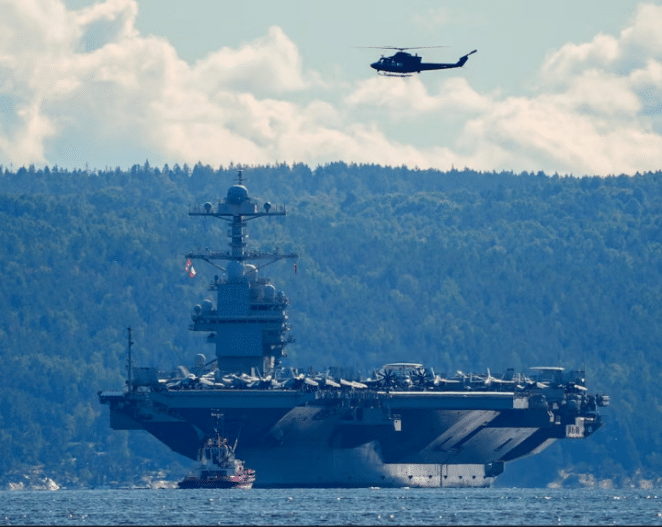
A Pentagon deployment statement claimed the operation “enhances U.S. capacity to disrupt illicit actors threatening national prosperity.” But critics argue it risks destabilizing fragile governments already struggling with economic and humanitarian crises.
From Caracas, President Nicolás Maduro denounced the move as “an act of aggression.” He accused Trump of “fabricating war under the disguise of countering narcotics.” His outrage resonated nationally.
“This is about sovereignty, not drugs,” Maduro said. “They claim to fight criminals, but their ships bring intimidation.” His words encapsulated growing Venezuela tensions over foreign interference.
Since September, the U.S. has targeted suspected smuggling vessels across the Caribbean, destroying multiple boats and claiming links to drug cartel strikes. However, evidence supporting these claims remains largely undisclosed.
President Trump told reporters, “The land will be next.” He added, “We’re going to kill people bringing drugs into our country. They’re going to be dead.”
Human rights groups immediately condemned the remarks. “Such language disregards legal norms,” said José Cordero of Human Rights Watch. “This rhetoric normalizes extrajudicial violence.” The Trump militarisation of Caribbean fuels these concerns.
In Washington, the Pentagon deployment has drawn divided responses. Republican lawmakers praised it as “courageous enforcement,” while Democrats demanded transparency regarding civilian risks and possible violations of international law.
The USS Gerald Ford left the Mediterranean early this month, escorted by two destroyers. Its sophisticated weapons and nuclear propulsion make it a formidable symbol of U.S. global power.
Pentagon spokesperson Sean Parnell said, “Our mission is precision and deterrence.” He claimed the campaign would “defend American lives and the integrity of our hemisphere.” His comments drew mixed reactions.
Analysts suggest the Trump militarisation of Caribbean also targets China and Russia’s expanding influence in Latin America. “It’s about dominance, not just drugs,” said Dr. Marcus Hill of Georgetown University.
The Venezuela tensions have intensified since the deployment. Civil groups report heightened fear among civilians near coastal bases. “We are worried about bombing raids,” said resident Maria Sanchez from Caracas.
Trump’s Defense Secretary, Pete Hegseth, defended the move: “America will no longer tolerate criminal networks that poison our youth.” His statement reinforced the assertive tone of the Trump militarisation of Caribbean.
The CIA reportedly provides intelligence for ongoing operations, including drone surveillance over Venezuelan territory. Trump confirmed he authorized “covert action,” further blurring lines between security missions and political interventions.
“The Caribbean is becoming a testing ground for new military doctrines,” warned Professor Elena Morales from the University of the Andes. “Each Pentagon deployment expands America’s strategic reach.”
Maduro insists Venezuela will not yield. “We will defend our coastlines,” he said, vowing to strengthen alliances with Russia and China, further complicating the Venezuela tensions.
Regional governments remain split. Colombia and the Dominican Republic quietly support the U.S., while Brazil and Mexico condemn “imperialist posturing.” Latin America appears caught between cooperation and confrontation.
Meanwhile, the USS Gerald Ford continues joint exercises with allied forces. Military experts call it a “floating fortress.” Its radar can track targets hundreds of miles inland, amplifying operational capability.
“The message is unmistakable,” said security analyst Dan Wilson. “The Trump militarisation of Caribbean is reshaping hemispheric power dynamics faster than diplomacy can adapt.” His assessment reflects rising regional concern.
Opposition figures in Washington warn of “mission creep.” Senator Tim Kaine urged restraint, asking whether Congress had authorized such extensive overseas actions against alleged drug cartel strikes.
The White House insists legality through executive authority. It cites previous designations of cartels as “foreign terrorist organizations,” granting justification for the continuing Pentagon deployment. Critics remain unconvinced.
Civilian casualties from recent strikes remain disputed. Independent monitors have sought verification, but access to affected areas remains restricted. “We are operating in a fog of secrecy,” said Cordero.
Some Venezuelan opposition members privately welcome the pressure on Maduro. Yet others fear external intervention could worsen suffering. “Our people will pay the price,” warned activist Luisa Ortega.
Economic analysts link rising oil prices and market volatility to Venezuela tensions. Investors fear military conflict may disrupt regional exports and trigger another wave of migration toward Central America.
Trump’s political allies applaud the campaign as evidence of “decisive leadership.” His supporters view the Trump militarisation of Caribbean as restoring “American strength after years of hesitation.”
European allies, however, express unease. France and Spain called for “dialogue and restraint.” The United Nations urged all sides to respect sovereignty and prevent further escalation in the hemisphere.
Ordinary citizens across the Caribbean voice anxiety. “We live between giants,” said fisherman Raul Fernandez in Trinidad. “When warships come, small islands become collateral.” His words capture growing fear.
Analysts predict the Pentagon deployment may extend through the year, overlapping election season. “Symbolism matters more than strategy now,” noted Dr. Hill. “Trump wants optics of power projection.”
Critics say military theatrics divert attention from domestic issues. “This isn’t policy—it’s politics,” said Democratic strategist Olivia Morgan. “Every missile fired abroad echoes at the ballot box.”
For Maduro, the Trump militarisation of Caribbean revives Cold War memories. “They are back to threaten revolution,” he told supporters. His rhetoric aims to consolidate nationalist sentiment amid economic turmoil.
The USS Gerald Ford remains at the heart of operations. Its commanding officer described morale aboard as “unshakable.” Crews prepare for extended patrols, signaling continued American engagement in Caribbean waters.
“The land will tremble before justice,” Trump declared again at a rally. Supporters cheered, but diplomats warned his language risks turning security operations into open-ended conflict.
If escalation continues, analysts fear a domino effect across regional politics. “Power vacuums invite instability,” Morales warned. “Sovereignty debates will define Latin America’s decade ahead.”
For now, the Trump militarisation of Caribbean continues unabated — a fusion of deterrence, politics, and spectacle. Whether it curbs narcotics or ignites chaos remains a question only time will answer.
Across Washington and Caracas alike, the rhetoric grows sharper. Diplomats whisper of back-channel talks, but trust is scarce. The military ships sail on, engines humming, missions expanding daily.
“This could either mark a turning point or a tragedy,” said Admiral Torres. “If dialogue fails, history will remember this as a lesson unlearned.”
Observers believe the Pentagon deployment now represents more than regional control—it embodies Washington’s return to hard power in its backyard, reflecting shifting doctrines of 21st-century American intervention.
Latin American scholars argue that the Venezuela tensions mirror deeper structural failures—economic stagnation, ideological divides, and dependency on superpower politics—all reignited by the Trump militarisation of Caribbean escalation.
Yet amid the turmoil, Caribbean nations plead for neutrality. “We just want peace,” said Jamaican lawmaker Peter Hinds. “The Caribbean shouldn’t become a chessboard for global powers again.”
The USS Gerald Ford sails on under a blazing sun, its flag casting a long shadow over uncertain seas. History watches closely, as diplomacy struggles to stay afloat.


