

Construction crews have officially started work on the Trump White House ballroom, prompting debates over historic preservation and cost, as sections of the East Wing demolition unfold.
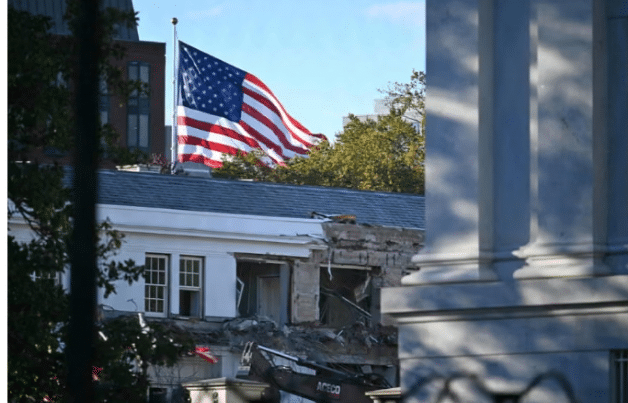
The East Wing demolition began last Monday, with heavy machinery tearing down parts of the historic facade to make way for Trump’s ambitious ballroom project.
President Trump announced the start of his Trump White House ballroom privately funded project on social media, emphasizing that no federal money would be spent on the construction.

The private funding includes contributions from donors and major corporations, reportedly covering the full $250 million cost, according to statements from Trump and his administration.
“This is a historic renovation of the White House,” Trump said, highlighting his goal to build a ballroom capable of hosting large-scale presidential events and public ceremonies.
Photos from the East Wing demolition show scaffolding and machinery actively removing sections of the wing, eliciting reactions ranging from fascination to outright outrage across social media platforms.
Some lawmakers criticized the Trump White House ballroom, arguing that such a lavish presidential project diverts attention from pressing government issues, particularly amid the ongoing government shutdown.
Human rights lawyer Qasim Rashid condemned the $250 million expenditure, stating that wealth and income inequality remain at record highs while taxpayers face stalled services.
Trump defended the historic renovation, noting that the ballroom has been a long-desired addition to the White House and no previous president completed such an ambitious construction.
“The Trump White House ballroom will be beautiful, top of the line, and set a new standard for presidential event spaces nationwide,” he told supporters at a fundraising event.
The private funding campaign reportedly drew donors from major tech companies including Amazon, Apple, Google, Microsoft, Palantir, and Lockheed Martin, highlighting broad corporate interest in the project.
Despite assurances that federal money is not used, the East Wing demolition has drawn criticism from some officials, claiming that structural alterations could affect the historic integrity of the White House.
Democratic congressman Mark Takano proposed legislation limiting construction projects during a government shutdown, arguing that taxpayer protections must be ensured and historic buildings preserved.
Photos reveal significant progress in the East Wing demolition, with some iconic architectural features temporarily removed to accommodate new structural supports for the expansive ballroom.
The Trump White House ballroom is projected to cover 90,000 square feet, seating up to 650 people, with facilities capable of hosting events as large as presidential inaugurations.
“The presidential project is being undertaken efficiently, with a clear timeline and zero cost to the public,” Trump stated, emphasizing private contributions as a model for future renovations.
Architectural experts debate whether the historic renovation respects the original White House design, with some praising modernization and others lamenting disruption to centuries-old heritage.
Construction insiders report that the East Wing demolition involves reinforced steel supports and temporary scaffolding to maintain safety standards during the extensive remodeling work.
Trump highlighted the uniqueness of the Trump White House ballroom, noting that previous presidents never completed a ballroom on this scale or with these design ambitions.

Several civic groups protested outside the White House, arguing that the lavish presidential project contrasts sharply with ongoing social and economic challenges facing average Americans.
The private funding structure has sparked debate over influence and access, with critics suggesting that large corporate donors might receive preferential treatment or symbolic recognition in return.
During a recent dinner for donors, Trump unveiled interior plans for the Trump White House ballroom, including bulletproof glass, modern lighting, and facilities to accommodate 1,000 guests.
The historic renovation aims to balance grandeur with functionality, allowing both ceremonial events and practical government functions without disrupting daily operations in adjacent offices.
“The presidential project is about legacy,” Trump said, insisting that the ballroom will become a centerpiece for future White House events and a national architectural highlight.
Political commentators note that the timing of the East Wing demolition amidst a government shutdown has fueled partisan criticism, raising questions about priorities during fiscal and operational constraints.
Despite the controversy, construction crews continue steady progress on the Trump White House ballroom, with project managers reporting adherence to safety protocols and milestones for completion before 2029.
Some former lawmakers called the demolition an “utter desecration,” warning that the historic renovation risks damaging irreplaceable architectural features, while Trump’s supporters view it as visionary modernization.
Trump emphasized that the Trump White House ballroom will complement the original structure rather than interfere, describing it as “my favorite place,” highlighting both personal pride and political messaging.
Public response remains polarized; social media debates highlight the divide between supporters praising the presidential project and critics condemning the expense amid national economic concerns.
The private funding pledge reinforces Trump’s message that the ballroom is fully donor-supported, though skepticism persists regarding transparency and the influence of large contributions on public policy.
Construction experts observe that the East Wing demolition has been methodical, with careful removal of original materials for potential reuse or preservation, demonstrating attention to historic preservation standards.
As the Trump White House ballroom project progresses, attention will remain on balancing grandeur, historical integrity, and public perception, with completion scheduled before the end of Trump’s second term.
The historic renovation stands as one of the most ambitious White House projects in over a century, reflecting both Trump’s architectural vision and a broader debate over public versus private influence.
Lawmakers, architects, and historians continue to monitor the East Wing demolition, questioning whether the building’s original aesthetic can coexist with the modern design of the expansive ballroom.
Trump’s supporters highlight the presidential project as a legacy-defining initiative, arguing that the Trump White House ballroom will enhance America’s cultural and political symbolism for generations.

The Trump White House ballroom represents a complex intersection of historic renovation, private funding, and public scrutiny, with debates expected to continue until completion in 2029.


