Trump Kennedy Center demolition threat has escalated into a major political and cultural controversy after lawyers for US President Donald Trump warned in a federal court filing that the iconic Washington arts complex could eventually be demolished if extensive repairs are not carried out.
The warning marks the first time the Trump administration has publicly raised demolition as a possible outcome for the John F. Kennedy Center for the Performing Arts, adding a dramatic new dimension to an already bitter legal battle over the president’s efforts to reshape the institution.
Trump Kennedy Center Demolition Threat Emerges in Court
The Trump Kennedy Center demolition threat was contained in a court filing submitted as the administration defended its efforts to alter the appearance and branding of the Kennedy Center.
Trump’s lawyers argued that the building requires a $250 million renovation and warned that failure to undertake the work could leave the complex unsafe and severely deteriorated.
“Without those efforts, the Center will deteriorate further into an unsafe, decrepit structure that will be required to be taken down,” the lawyers stated.
They further suggested that, if demolition eventually became necessary, officials could consider constructing a new facility on the site, including a large outdoor amphitheatre overlooking the Potomac River.
The filing has immediately attracted attention because the Kennedy Center is not simply another public building. Congress established the institution as a living memorial to former President John F. Kennedy, giving the dispute significant political and historical implications.
$250m Renovation Becomes Central Issue
The administration’s position is that the Kennedy Center needs substantial investment to prevent further deterioration.
The proposed renovation is estimated at $250 million and would involve major improvements to the complex.
Trump’s lawyers presented the renovation as the preferred option, while warning that continued deterioration could ultimately make demolition unavoidable.
However, opponents see the warning in the context of Trump’s broader attempt to exert greater control over the institution.
The controversy intensified after Trump’s allies took control of the Kennedy Center’s board and began pursuing changes that have challenged the institution’s traditional identity.
Trump Name Dispute Fuels Kennedy Center Battle
The Trump Kennedy Center demolition threat has emerged alongside a separate legal battle over Trump’s name appearing on the building.
In August, the Kennedy Center board voted 20-3 to change the signage to read “The John F Kennedy Center for the Performing Arts Restored and Renovated by President Donald J Trump.”
The board also approved the name “President Donald J Trump Plaza” for the grounds surrounding the complex.
The administration maintains that the move does not formally rename the Kennedy Center because the institution’s official name remains the John F. Kennedy Center for the Performing Arts.
Trump’s lawyers argued that the additional wording merely recognises the president’s role in restoring and renovating the complex.
That argument has faced strong legal opposition.
A federal judge ruled in May that only Congress has the authority to change the Kennedy Center’s name, noting that Congress established the institution specifically to honour Kennedy.
Judge Christopher Cooper ordered Trump’s name removed from the facade after it was added to the building.
“Congress named the Kennedy Center and only Congress can change it,” the judge said.
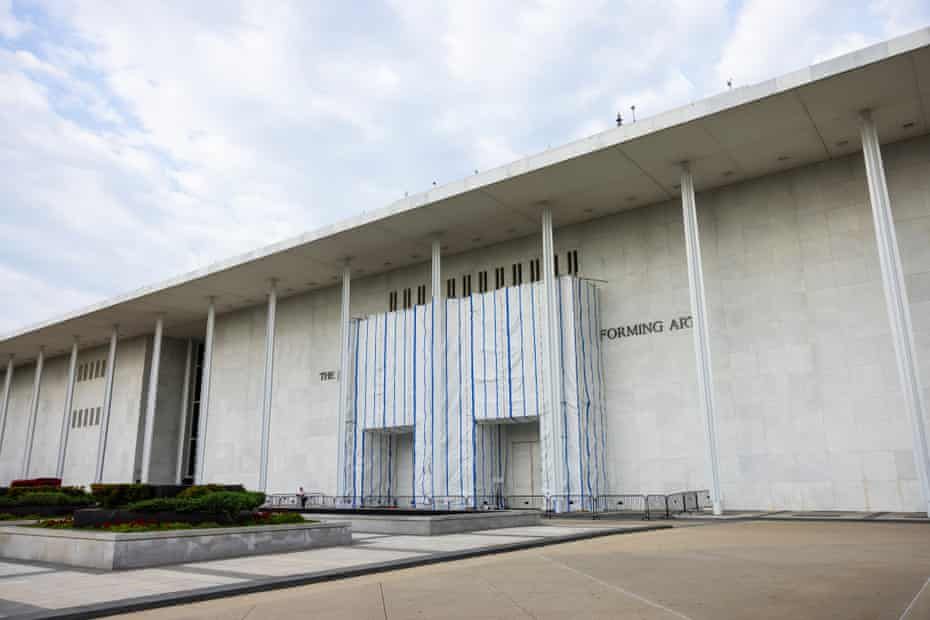
Trump’s name was subsequently removed from the facade, although a large tarpaulin has remained over the affected section.
Federal Court Challenge Continues
The latest court filing was submitted in response to a legal challenge by Democratic congresswoman Joyce Beatty, who sits on the Kennedy Center board because of her congressional position.
Beatty has challenged the administration’s attempt to place Trump’s name on the building.
Her lawyer, Nathaniel Zelinsky, dismissed the administration’s latest argument as legally baseless and suggested that the filing reflected Trump’s personal involvement in the dispute.
A federal court hearing is expected to examine Beatty’s request for an injunction.
The legal battle could determine how much authority Trump’s administration has to change the appearance and identity of a national memorial established by Congress.
Kennedy Center Faces Financial and Artistic Challenges
Beyond the naming dispute, the Kennedy Center has experienced significant changes since Trump took control of its board.
The administration has reduced staffing and pursued changes to the institution’s artistic direction, while critics have accused Trump of attempting to reshape the centre according to his political preferences.
The institution has also faced declining ticket sales.
The Kennedy Center has historically been one of America’s most prominent performing arts venues, hosting major figures from entertainment and culture, including Frank Sinatra, Beyoncé, Robert De Niro and Lin-Manuel Miranda.
Its connection to Kennedy has also made it an important part of Washington’s cultural and political landscape.
For opponents of Trump, any suggestion that the complex could be demolished represents a serious threat to a historic national memorial.
For the administration, however, the renovation debate is being presented as a question of safety, investment and the long-term viability of the facility.
Critics Condemn Demolition Warning
The Kennedy Center demolition controversy has provoked strong reactions from Trump’s political opponents and arts advocates.
Norm Eisen, a former White House ethics official and co-founder of Democracy Defenders Action, accused the administration of threatening to level the Kennedy Center if Trump does not get his way.
Democratic Congressman John Larson also condemned Trump’s actions, arguing that the president should not be placing his name above Kennedy’s on the memorial.
Arts advocacy organisation Hands Off the Arts also criticised the possibility of demolition, describing the Kennedy Center as a national memorial that should be protected.
The controversy has therefore moved beyond a disagreement about construction and renovation.
It now involves fundamental questions about presidential power, congressional authority, historic preservation and the future identity of a landmark created to honour a former American president.
Demolition Is a Warning, Not a Confirmed Plan
Despite the dramatic language surrounding the Trump Kennedy Center demolition threat, the Kennedy Center has not been ordered to be demolished.
The court filing presents demolition as a possible consequence if necessary renovation work is not undertaken and the building deteriorates to the point where it becomes unsafe.
There is also no indication in the material provided that demolition is currently scheduled.
The immediate legal dispute remains focused largely on Trump’s attempt to associate his name with the institution and whether the administration’s actions violate the court’s earlier ruling.
The outcome of those proceedings could have significant consequences for the Kennedy Center and for the balance of power between the White House and Congress over federally established cultural institutions.
Kennedy Center’s Future Hangs in Balance
The Trump Kennedy Center demolition threat has transformed an already contentious naming dispute into a much broader battle over the future of the iconic Washington landmark.
At stake is not only the proposed $250 million renovation but also the question of whether an institution created by Congress as a memorial to John F. Kennedy can be substantially reshaped by a sitting president.
As the court battle continues, the Kennedy Center remains open, but its future direction is increasingly uncertain.
The coming legal proceedings could determine whether Trump’s administration can maintain its proposed changes, whether his name can remain associated with the complex and how the planned renovation will proceed.
For now, demolition remains a warning contained in the administration’s legal argument rather than a confirmed decision to tear down the Kennedy Center.
But the fact that the possibility has now been raised in federal court has dramatically intensified the fight over one of Washington’s most recognisable cultural landmarks.
Read more: Ireport247news
About The Author