

The Trump-Orbán meeting at the White House ended with Hungary receiving a rare one-year exemption from United States sanctions on Russian oil and gas imports.
The decision followed extensive discussions between President Donald Trump and Hungarian Prime Minister Viktor Orbán, highlighting a diplomatic balancing act between Washington’s energy policy and Hungary’s economic survival.
According to a senior White House official, the exemption was granted after Orbán made a compelling case that Hungary’s dependence on Russian oil was essential for national stability.
Trump, emphasizing flexibility in foreign energy relations, stated that “Hungary’s geographical limitations and lack of seaports make alternative supply routes logistically and economically challenging for Budapest.”
The Trump-Orbán meeting underscored a developing friendship between two nationalist leaders united by shared stances on migration, sovereignty, and skepticism toward global liberal institutions.
Trump commended Orbán’s leadership style, describing him as “a strong, independent figure who defends his country’s interests without apology,” during the bilateral talks in Washington.
Orbán, meanwhile, praised Trump for “repairing relations destroyed during the previous Democrat administration,” vowing that Hungary would reciprocate by strengthening defense and energy ties with the United States.
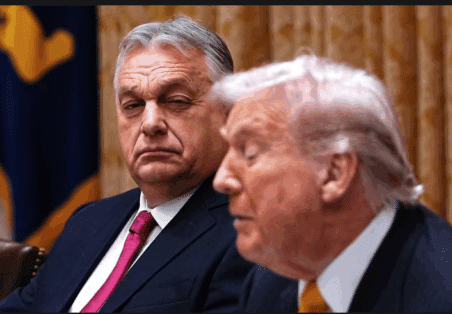
“This is a new chapter of partnership,” Orbán declared, “a golden age for cooperation between Hungary and the United States based on respect and common goals.”
Hungary, heavily reliant on Russian crude via the Druzhba pipeline, argued that immediate compliance with Western energy sanctions could devastate its economy and lead to fuel shortages.
Trump, echoing Orbán’s reasoning, acknowledged the regional complexities. “Hungary has no ports and no sea. Getting oil elsewhere is very difficult. We’re reviewing this carefully,” he said.
The Trump-Orbán meeting was not only about sanctions but also about solidifying conservative alliances across the Atlantic, particularly as both leaders champion nationalist and anti-immigration rhetoric.
Trump, who has intensified restrictions on immigration at home, lauded Hungary’s policies as a model for Europe, urging EU nations to “respect this leader’s approach to borders.”
Orbán responded by describing Hungary as “the last Christian government in Europe,” asserting that liberal Western governments had “abandoned their traditions, values, and cultural roots.”
The Hungarian leader’s remarks resonated with Trump’s base, which views Orbán’s governance as a symbol of resistance against progressive agendas in Western politics.
During the Trump-Orbán meeting, both leaders discussed future collaborations on energy diversification, defense investments, and nuclear technology exchanges valued at approximately $600 million in American contracts.
White House sources confirmed that Hungary pledged to purchase U.S. liquefied natural gas and nuclear fuel to offset criticisms that Budapest was overly reliant on Russian suppliers.
This commitment helped secure Trump’s approval for a one-year sanctions exemption, seen as a strategic compromise balancing diplomacy and national interests.
Orbán assured Trump that Hungary would “stand by America’s broader security goals” while continuing to maintain “essential trade connections that protect Hungarian families and businesses.”
Critics in the European Union, however, warned that the move could embolden other member states to seek similar exemptions, potentially weakening the EU’s collective sanctions framework.
European diplomats expressed frustration, describing the Trump-Orbán meeting outcome as “a geopolitical loophole that risks undermining Western unity against Russian aggression in Ukraine.”
Trump dismissed those concerns, insisting that “the exemption reflects pragmatic leadership, not favoritism,” and reaffirmed his commitment to end the war through negotiation, not escalation.
Orbán has publicly urged Trump to host a trilateral peace summit with Russian President Vladimir Putin, asserting that “dialogue remains the only sustainable path to lasting peace.”
Such proposals have angered European allies who view Orbán’s overtures to Moscow as an attempt to legitimize Russian influence within the European Union.
Nonetheless, the Hungarian leader defended his position, saying, “We are neighbors to the war; we feel its consequences daily. Peace is not politics—it’s survival.”
The Trump-Orbán meeting further amplified debates about transatlantic relations and whether the U.S. should tolerate divergent national policies within allied nations during geopolitical crises.
Analysts say Trump’s leniency toward Hungary reflects his transactional diplomacy—rewarding loyalty and symbolic alignment over rigid adherence to international sanctions policy.
Washington’s foreign policy experts remain divided. Some view Trump’s decision as a bold recognition of Europe’s energy vulnerability, while others fear it could weaken Western credibility.
Energy security experts in Budapest welcomed the decision, noting that Hungary’s energy grid is designed primarily for Russian crude, making rapid transition to alternative suppliers difficult.
“Technically, the pipelines and refineries depend on Russian specifications,” said one analyst. “Without gradual adaptation, sudden changes could trigger widespread shortages and inflation.”
During the Trump-Orbán meeting, Trump reportedly encouraged Orbán to promote greater investment opportunities for U.S. companies in Hungary’s infrastructure and defense sectors.
The leaders agreed to deepen collaboration in nuclear energy technology and logistics networks connecting Central Europe with Western markets.
Orbán described the arrangement as “mutually beneficial,” adding that “Hungary gains energy security, and America strengthens its presence in Central Europe’s strategic economy.”
Their political synergy was evident throughout the summit, which featured informal exchanges and a private lunch hosted by Trump in the White House’s Roosevelt Room.
Observers noted the camaraderie between the two men, both often criticized for their populist methods but celebrated by supporters as defenders of national sovereignty.
Trump’s praise of Orbán’s immigration policies reflected his ongoing campaign message at home—that strong borders and cultural preservation define national greatness.
“Look what’s happened to Europe,” Trump said. “They’ve let migration flood their borders, and now many countries are unrecognizable. Hungary has shown real leadership.”
Orbán echoed this sentiment, condemning EU financial penalties imposed on his government for refusing to comply with migrant quota policies.
“This is the absurd world of modern Europe,” Orbán said. “We protect our borders, and they punish us for defending Christian civilization.”
The Trump-Orbán meeting also carried electoral undertones, as Orbán faces political challenges at home and sees association with Trump as a boost to his domestic standing.
Hungarian political observers suggest that Orbán’s Washington visit was strategically timed to coincide with the beginning of his re-election campaign in 2026.
By showcasing international legitimacy and support from the U.S., Orbán aims to consolidate his nationalist base and marginalize opposition critics portraying him as isolated in Europe.
Trump, in turn, used the meeting to reinforce his image as a dealmaker restoring order to global energy and diplomacy after years of partisan gridlock.
“We’re fixing what was broken,” Trump declared. “America is strong again, our partnerships are growing again, and respect is being restored around the world.”
Orbán applauded the sentiment, replying, “The era of hypocrisy is ending. We now deal with honest leadership that prioritizes its people over empty bureaucratic promises.”
Political analysts described the Trump-Orbán meeting as a “symbolic reunion of conservative governance,” emphasizing national sovereignty, religious identity, and pragmatic trade realism over ideological conformity.
Both leaders framed their cooperation as part of a broader global realignment—one favoring bilateral deals and self-determination over multilateral frameworks dominated by large institutions.
European Commission officials voiced alarm, warning that Hungary’s exemption could set a precedent undermining the EU’s collective energy strategy.
But Budapest dismissed these concerns, arguing that its survival depended on flexibility rather than rigid obedience to “politically motivated energy restrictions.”
Throughout the discussions, Trump maintained that economic realities must guide policy. “We can’t expect nations to destroy themselves for ideology,” he said.
Orbán responded with gratitude, calling Trump “a realist who understands how global politics should serve people, not punish them.”
The Trump-Orbán meeting concluded with an agreement to establish a joint task force exploring avenues for U.S.-Hungarian cooperation in renewable energy and infrastructure modernization.
Officials said both sides also discussed intelligence-sharing initiatives and cybersecurity cooperation as part of a broader strategic dialogue.
Observers viewed these steps as a sign that Hungary intends to balance its Russian energy dependence with a renewed Western partnership under Trump’s administration.
“This is a turning point,” said a Hungarian government spokesman. “We are diversifying responsibly while maintaining sovereignty in decision-making. That’s the Hungarian model.”
In Washington, reactions were mixed. Critics accused Trump of appeasing Moscow by offering loopholes to Russia’s trading partners, undermining efforts to isolate the Kremlin economically.
Supporters countered that the Trump-Orbán meeting displayed pragmatic statesmanship—recognizing that rigid sanctions often hurt allies more than adversaries.
“Real diplomacy requires flexibility,” said one American analyst. “Hungary’s exemption is conditional, not a free pass. It’s about strategic alignment, not weakness.”
As global energy prices fluctuate and the war in Ukraine continues, Trump’s willingness to tailor sanctions policy to individual allies marks a significant shift in U.S. foreign strategy.

For Orbán, the meeting affirmed his relevance on the international stage, proving that Hungary can still secure favorable deals despite EU criticism.
For Trump, it reinforced his narrative of restoring bilateral strength and rejecting what he calls “globalist control over national decision-making.”
Ultimately, the Trump-Orbán meeting highlighted a shared worldview: nations should prioritize domestic interests, uphold cultural identity, and pursue diplomacy rooted in pragmatism over ideology.
Whether this approach will reshape the Western alliance or deepen existing fractures remains uncertain—but both leaders left the summit confident they had strengthened their political brands.


