The Trump Iran military threat escalated sharply on Friday as Iranian military officials warned that any US attack would be met with an immediate and unlimited response, placing American bases across the Gulf region firmly in Tehran’s missile range.
The warning followed Donald Trump’s latest comments signalling readiness for military action while US naval forces continue to build up across the Middle East.
Speaking to Iranian state television, brigadier general Mohammad Akraminia said Iran’s retaliation would be “instant” if Washington miscalculates. He warned that US aircraft carriers operating in the region have “serious vulnerabilities” and that several American bases are well within reach of Iran’s medium-range missiles.
“If such a miscalculation is made by the Americans, it will certainly not unfold the way Trump imagines – carrying out a quick operation and then, two hours later, tweeting that the operation is over,” Akraminia said, according to international news agencies.
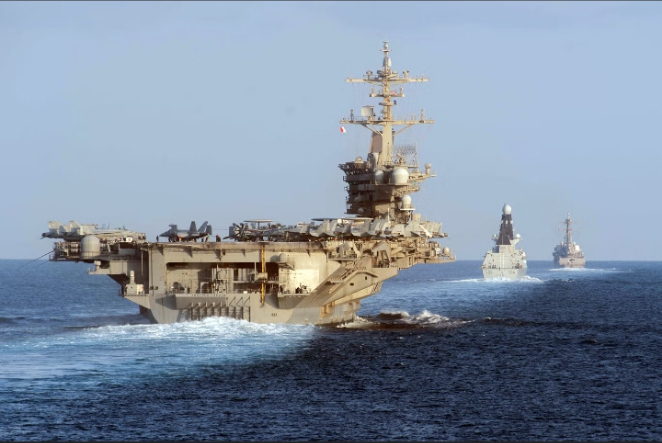
The renewed tension comes amid an expanding US military build-up in the Middle East, with the USS Abraham Lincoln aircraft carrier group and several guided-missile destroyers recently arriving in the region. The deployment follows Trump’s warning that “time is running out” for Iran to agree to a new deal restricting its nuclear programme.
Trump told reporters that he intends to speak with Iran but provided no details on when or how such talks might take place. “We have a lot of very big, very powerful ships sailing to Iran right now, and it would be great if we didn’t have to use them,” the US president said.
Iranian officials, however, have dismissed Washington’s pressure tactics, insisting that Tehran will not be coerced into concessions by threats of force. Military leaders stressed that any US strike would trigger a response that would not be confined to a single target or theatre.
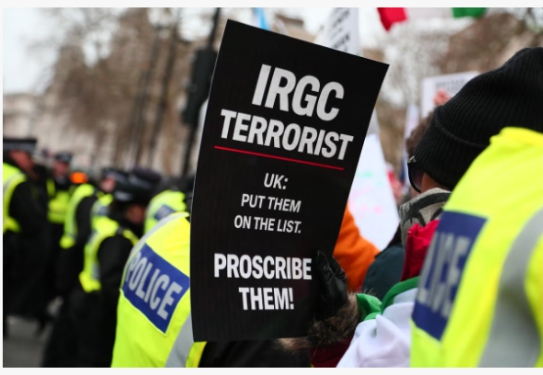
The confrontation has been further complicated by the European Union’s decision to formally designate Iran’s Islamic Revolutionary Guard Corps (IRGC) as a terrorist organisation, a move Tehran condemned as “illegal” and politically motivated.
The EU labels IRGC terrorist organisation decision was adopted during a meeting of EU foreign ministers in Brussels, alongside additional sanctions targeting individuals linked to Iran’s recent crackdown on protests.
Iran’s foreign ministry said branding an official military institution as a terrorist group set a dangerous precedent. In a statement reported by regional media, the ministry said the IRGC “plays a fundamental role in safeguarding national sovereignty, national security and territorial integrity” under Iran’s constitution.
EU foreign policy chief Kaja Kallas defended the move, stating: “If you act as a terrorist, you should also be treated as a terrorist.” She added that the decision would place the IRGC “on the same footing with al-Qaeda, Hamas and Daesh”.
Downing Street welcomed the EU’s decision but declined to confirm whether the UK would follow suit by formally proscribing the IRGC under British law. A spokesperson said the government would continue to keep sanctions policy under review.
As diplomatic pressure mounts, analysts have warned that the risk of miscalculation is growing. Andreas Krieg, associate professor of security studies at King’s College London, told The Independent that Iran would likely seek to avoid an all-out war even if the US launched strikes.
“If the US attacks, Iran’s most likely retaliation is asymmetric and calibrated rather than an immediate all-out exchange,” Krieg said. “It can target US interests and partners through deniable channels, pressure shipping and energy routes, and use cyber operations.”
He added that Tehran would try to avoid drawing Israel into a sustained conflict, which could rapidly widen the war beyond Iran’s control. “The central danger is miscalculation. Coercive signalling can quickly become a war neither side claims to want,” he said.
Regional actors have also begun positioning themselves as potential mediators. Turkish president Recep Tayyip Erdogan told Iran’s president Masoud Pezeshkian that Ankara was prepared to act as a facilitator between Tehran and Washington to ease tensions. Turkey’s presidency said Erdogan had emphasised his readiness to help resolve issues through dialogue and diplomacy.
Meanwhile, reports emerged that a US military destroyer docked at the Israeli port of Eilat as part of what Israeli officials described as pre-planned cooperation between the two allies. The arrival underscored the growing military coordination as tensions with Iran continue to rise.
Within Washington, some former military officials have urged caution. Professor Robert Murrett, a retired US admiral now at Syracuse University, said Iran’s leadership may be “buying time” following recent domestic unrest but warned that the US must clearly define its objectives before any use of force.
“Defining our mission objectives will be key for any use of force against Iran, one which can credibly lead to meeting a strategic end state,” Murrett said. He added that while the movement of US warships is significant, there is already substantial American combat power in the region.
The escalating Trump Iran military threat also follows Trump’s broader foreign policy manoeuvres, including his push for a temporary ceasefire in Ukraine. Critics argue that opening a new front against Iran risks overstretching US influence while destabilising an already volatile region.
World affairs editor Sam Kiley warned that Trump may be backing “the wrong war” by confronting Tehran, arguing that Iran is a far more complex and dangerous adversary than the former president appears to acknowledge. He cautioned that a conflict with Iran could quickly spiral beyond Washington’s control.

For now, Tehran insists it is prepared for any scenario while reiterating that responsibility for escalation would rest squarely with Washington. Iranian military officials have repeatedly stated that Iran threatens US bases not as a provocation but as a deterrent designed to prevent what they describe as reckless American action.
As diplomatic channels remain uncertain and military assets continue to move into place, the standoff highlights the fragile balance between coercive pressure and outright conflict.
Whether the latest Trump Iran nuclear deal warning leads to talks or confrontation may depend on whether both sides can step back from the brink before threats turn into irreversible decisions.
About The Author