Trump Iran war strategy is rapidly becoming one of the most controversial foreign policy shifts of the modern era, as the US president positions American military power off the coast of Iran while dramatically scaling back support for Ukraine in its war against Russia.
The approach, critics warn, risks destabilising two major regions at once — the Middle East and Eastern Europe — while undermining long-standing alliances and reshaping global security balances.
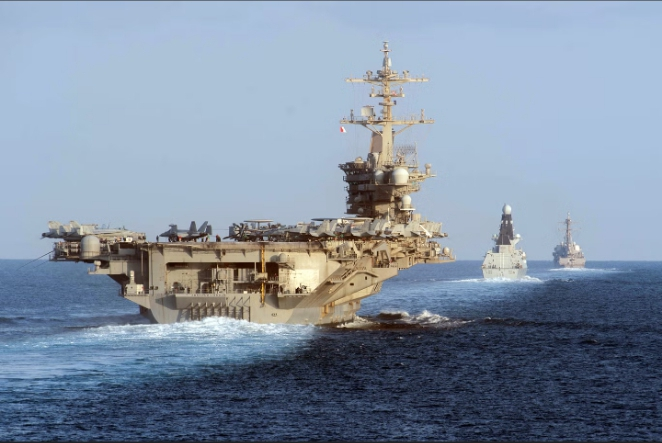
Donald Trump’s latest manoeuvre involves the deployment of what he openly describes as an “Armada” in waters near Iran, led by a Nimitz-class aircraft carrier and supported by a formidable concentration of US naval and air power.
At the same time, American military assistance to Kyiv has been sharply reduced, leaving Ukraine increasingly exposed to Russian air strikes and energy infrastructure attacks during one of the harshest winters in the conflict.
The contradiction at the heart of Trump Iran war strategy lies in the political logic behind it. While the US president has secured a short-term pause in Russian bombardments through negotiations with Moscow, the concessions expected in return place Ukraine in an increasingly vulnerable position.

Western diplomats say Washington has been pushing Kyiv to consider ceding strategic territories, including parts of Donetsk, Zaporizhzhia and Kherson, in exchange for limited ceasefire guarantees.
This has created deep unease across Europe, where officials see the Russia Ukraine conflict as a direct threat to NATO security. Russia’s territorial expansion is widely viewed as a strategic danger to the Baltic states, Poland and the wider European security architecture, making continued support for Ukraine a core pillar of Western defence policy.
By contrast, Iran poses no direct military threat to the United States itself. Yet Trump has shifted his focus toward Tehran, demanding that Iran dismantle its nuclear programme, abandon its missile capabilities and sever support for regional proxy groups such as Hamas and Hezbollah.
The demands are backed not by diplomacy but by overwhelming military pressure, embodied in the deployment of the US military armada off Iran’s coast.
The presence of the aircraft carrier USS Abraham Lincoln and its strike group represents a staggering concentration of firepower. Military analysts describe it as a clear signal of readiness for escalation rather than deterrence.
One senior US officer involved in the deployment was photographed preparing for operations in the Indian Ocean as part of the build-up, reinforcing the seriousness of the posture.
Trump’s rhetoric has abandoned earlier promises to support Iranian protest movements and democratic reform efforts. While he previously encouraged demonstrations against Tehran’s leadership and promised assistance, that narrative has now been replaced by direct military pressure.
Critics argue that any claim of humanitarian intervention has disappeared, leaving only strategic coercion without a credible post-conflict plan.
Historically, the US and its allies have justified interventions in places such as Somalia, the former Yugoslavia and Libya on humanitarian grounds, often under international mandates. But in the case of Iran, analysts say there is no coherent political strategy for what follows regime collapse.
The fear is that dismantling Iran’s state structure would trigger internal fragmentation, civil conflict and the rise of extremist networks across the region.
Security experts warn that Iran’s internal power structures are deeply entrenched, with large segments of the economy controlled by security institutions loyal to the ideological foundations of the Islamic revolution.
These structures have experience in asymmetric warfare, having supported insurgent groups during the Iraq war through sophisticated training and weapons development, including advanced bomb-making techniques.
An attack on Iran, critics argue, would not produce stability but chaos. A regime collapse could unleash forces that the US would be unable to control, potentially triggering regional war, proxy conflicts, mass displacement and global terror reprisals.
Western allies fear that retaliation would not be limited to the Middle East but could extend to European and American targets.
Trump’s strategic focus on Iran also reflects economic and geopolitical motivations.
There is a belief within his political circle that regime change could open Iran’s vast fossil fuel reserves to Western energy companies, mirroring earlier attempts to reshape Venezuela’s political economy.
At the same time, Trump appears to view pressure on Tehran as a way of strengthening Israel’s security position against Iranian-backed regional influence.
However, military analysts stress that Iran lacks the capacity to threaten US territory directly, while Russia’s actions in Europe pose a structural threat to American strategic interests.
US military bases across Europe, NATO commitments, and the stability of Western democracies are all directly affected by Russian expansionism.
The collapse of American Ukraine war support has left Kyiv dangerously exposed. Intelligence sharing continues, but military aid has been reduced to the point where Ukraine’s air defence systems are struggling to protect civilian infrastructure. Large parts of the country face power outages, heating shortages and continued bombardment.
This humanitarian crisis contrasts sharply with the resources being mobilised for potential conflict with Iran. Humanitarian organisations estimate that more than 10 million Ukrainians have been displaced, with nearly six million refugees now living across Europe.
The scale of suffering has transformed Ukraine into one of the largest displacement crises in modern history.
European leaders argue that supporting Ukraine is not only a moral obligation but a strategic investment.
Economic studies suggest that the long-term cost of abandoning Ukraine would far exceed the cost of military support, as instability, refugee flows and expanded Russian influence would impose massive financial and security burdens on Europe and the United States.
At the World Economic Forum in Davos, Finland’s president Alexander Stubb directly challenged the narrative that Ukraine is losing the war, stating:
“There seems to be a narrative that Ukraine is losing this war. I simply don’t buy that. We have enough information and intelligence to back this up as well. But it’s a Russian narrative which has also floated a lot in the US.”
Trump’s former Ukraine envoy, Lt Gen Keith Kellogg, echoed that assessment, warning that Ukraine’s military position could improve significantly if support is restored.
“I understand what’s happening to Kyiv. I understand the temperatures. But I really do believe that if Ukraine gets through this winter, January, February, and you get into March and April, the advantage accrues to Ukraine, not to Russia,” he said.
“[Russia’s] frontline units have been mauled. They’ve lost over 20 general officers.”
These statements directly contradict the logic underpinning Trump Iran war strategy, which assumes Ukraine is a losing cause while Iran represents a decisive opportunity for geopolitical leverage.
Critics argue that the opposite is true: Ukraine represents a viable democratic ally capable of defending itself with Western support, while Iran represents a destabilising conflict with no clear end state.
From a strategic perspective, analysts say that Ukraine offers the US a low-risk intervention model. Military support can be delivered without deploying American troops, while strengthening NATO security and European stability.
Iran, by contrast, represents a high-risk escalation scenario with unpredictable consequences and global security repercussions.
Trump’s political instinct to “back winners” has long shaped his foreign policy approach. European leaders are now attempting to convince him that Ukraine represents a strategic win for America, while an attack on Iran would produce only long-term instability, economic disruption and global insecurity.
Whether that argument succeeds remains uncertain. What is increasingly clear, however, is that Trump Iran war strategy risks creating a lose-lose scenario: destabilisation in the Middle East, weakened alliances in Europe, humanitarian disasters in Ukraine, and the erosion of America’s global credibility as a stabilising power.
There would be no clear victors from a war with Iran. But with renewed US support, Ukraine could still secure its sovereignty, protect its civilian population, and stabilise Europe’s eastern frontier. The choice, analysts warn, is not between two conflicts — but between strategic stability and systemic global risk.