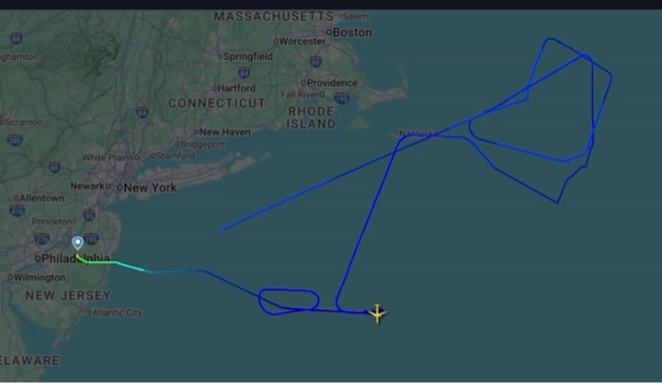
The Trump Greenland Davos crisis intensified on Wednesday after a technical fault forced Air Force One to turn back shortly after departure, delaying Donald Trump’s arrival at the World Economic Forum and amplifying diplomatic unease across Europe.
The White House confirmed that the president’s aircraft returned to Joint Base Andrews due to what officials described as a minor electrical issue detected by the crew during flight.
Although the fault was quickly addressed, the hours-long delay disrupted carefully planned travel arrangements and injected further uncertainty into a trip already overshadowed by controversy.
Trump and his entourage were transferred onto two smaller aircraft, with the president continuing his journey aboard a modified Air Force C-32 typically reserved for domestic routes.
The logistical scramble did little to calm European leaders who are preparing to confront Washington over Trump’s stated ambition to bring Greenland under US control.
Ahead of his departure, Trump had insisted that the United States would be “well represented in Davos — by me,” signalling his intention to dominate proceedings.
The Davos visit comes at a sensitive moment for transatlantic relations, with Denmark, France and Germany leading opposition to any attempt to alter Greenland’s status.
Greenland is a semi-autonomous territory within the Kingdom of Denmark, and its strategic importance has grown amid renewed Arctic competition.
Trump has repeatedly argued that Greenland’s location and resources make it vital to US national security, framing his interest as a strategic necessity.
During a lengthy press conference before boarding Air Force One, the president revealed that he had scheduled multiple meetings focused specifically on Greenland.
When asked how far he was prepared to go to secure control of the territory, Trump offered a stark three-word response: “You’ll find out.”
He has declined to rule out military pressure, a position that has alarmed Nato allies and prompted emergency discussions in European capitals.
The Trump Greenland Davos crisis has already spilled beyond diplomacy, affecting markets and defence planning across the alliance.
France has formally called for a Nato military exercise in Greenland, signalling Europe’s willingness to demonstrate collective resolve.
President Emmanuel Macron has also convened an emergency meeting of European leaders to coordinate a response to Washington’s rhetoric.
Trump, however, has indicated he will not attend the Paris talks, dismissing Macron’s leadership and escalating the personal tone of the dispute.
European officials fear that the Greenland row could weaken unity at a time when cooperation is crucial on Ukraine, trade and climate policy.
According to reports, a proposed $800bn postwar economic support package for Ukraine has been delayed because of disagreements linked to Greenland.
The planned announcement, expected at Davos, was intended to showcase renewed Western solidarity but is now in limbo.
Financial markets have reacted nervously, with the US dollar sliding sharply against the euro and Swiss franc amid geopolitical uncertainty.
Currency traders cited fears that the dispute could trigger retaliatory trade measures or disrupt Nato coordination.
Wall Street stocks and US Treasury bonds also experienced volatility, underlining the global economic impact of diplomatic instability.
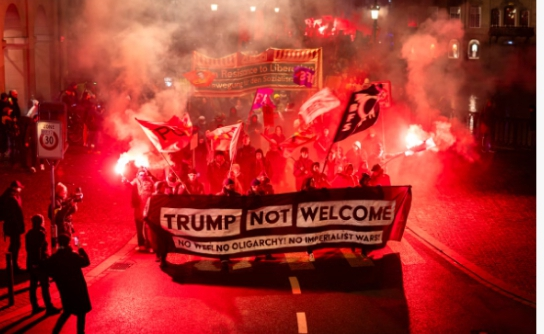
In Switzerland, protests erupted ahead of Trump’s arrival, with demonstrators burning US flags and carrying banners denouncing his Greenland ambitions.
Crowds gathered in Zurich and other cities, chanting slogans that accused the president of bullying European allies.
Swiss authorities have increased security around Davos, anticipating further demonstrations during Trump’s visit.
Despite the unrest, Trump is scheduled to address the World Economic Forum in a high-profile speech on Wednesday afternoon.
Organisers have allocated a prime slot for the address, reflecting both Trump’s influence and the intense interest surrounding his agenda.
It remains unclear whether the flight delay will force changes to his schedule, though aides insist the speech will go ahead as planned.
In Washington, the administration announced plans to withdraw around 200 US personnel from Nato advisory roles.
Officials said the move had been planned for months, but the timing has fuelled speculation that it is linked to Greenland tensions.
European diplomats worry the reduction could be perceived as a signal of disengagement from collective defence.
Trump’s supporters argue that the president is simply pressing allies to take greater responsibility for their own security.
They also contend that Greenland represents a legitimate strategic interest given increasing Russian and Chinese activity in the Arctic.
Critics counter that Trump’s approach risks undermining international law and destabilising long-standing alliances.
Danish leaders have reiterated that Greenland is not for sale and that any change in status must be decided by Greenlanders themselves.
Greenland’s own government has expressed concern that it is being treated as a bargaining chip in great-power politics.
At Davos, business leaders are expected to press Trump on how geopolitical tensions could affect trade, supply chains and investment.
The president has already threatened new tariffs on European goods, adding another layer of friction to the talks.
European Commission officials fear that economic nationalism could derail fragile post-pandemic recovery efforts.
Behind the scenes, US diplomats are working to reassure allies that rhetoric will not translate into unilateral action.
Nevertheless, the Trump Greenland Davos crisis continues to dominate headlines, overshadowing discussions on climate change and global inequality.
Analysts say Trump’s strategy may be designed to project strength to domestic audiences ahead of key political battles at home.
Others warn that miscalculation could provoke a serious rift within Nato at a time of heightened global instability.
As Trump finally makes his way to Switzerland, all eyes are on Davos to see whether confrontation or compromise will prevail.
The coming days are likely to determine whether the Greenland dispute escalates further or is channelled into quieter diplomatic negotiations.
For now, the episode has underscored how quickly technical mishaps, sharp rhetoric and strategic ambition can combine to unsettle global politics.
Whether Davos provides a reset or deepens divisions will shape not only Arctic geopolitics but the future of transatlantic relations.
About The Author