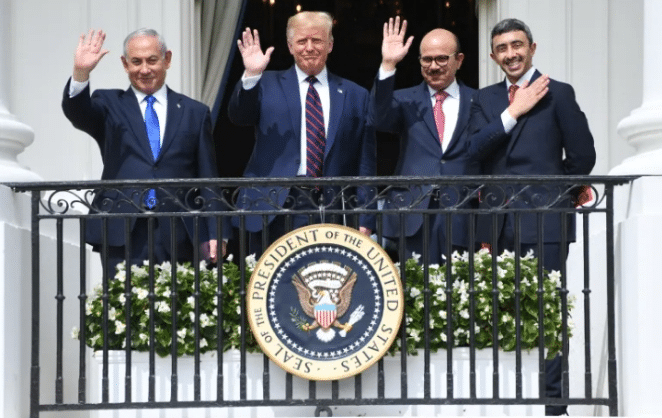
United States President Donald Trump has expressed optimism about an Abraham Accords expansion, signaling hopes that Saudi Arabia and other Arab nations will join the historic diplomatic initiative.
“I hope to see Saudi Arabia go in, and I hope to see others go in. I think when Saudi Arabia goes in, everybody goes in,” Trump said in an interview broadcast Friday.
The Abraham Accords expansion seeks to extend the agreements that normalized relations between Israel and countries including the UAE, Bahrain, Morocco, and Sudan. Trump called the original accords “a miracle” and “amazing.”
Trump emphasized that the pact could help achieve Middle East peace, claiming that wider participation would bolster regional stability after years of conflict. “It’ll help bring long-lasting peace to the Middle East,” he stated.
However, several factors complicate an Abraham Accords expansion, particularly Israel’s two-year military campaign in Gaza and its intensified operations in the West Bank, which have drawn widespread regional criticism.
Israel’s recent strikes have also targeted six other countries, including Qatar, triggering diplomatic tensions and leading to an Arab-Islamic summit in Doha that condemned Israel’s attacks and showed solidarity with affected nations.
The summit, attended by nearly 60 member states of the Arab League and Organisation of Islamic Cooperation, reflected strong opposition to Israel’s actions and created significant obstacles for Saudi Arabia joining accords.
Hezbollah’s Secretary-General Naim Qassem has urged Saudi Arabia to mend ties with Lebanon and build a regional front against Israel, reflecting ongoing pressure on Riyadh regarding the Israel-Gaza conflict and broader Middle East dynamics.
Surveys in Saudi Arabia show resistance to normalization. A recent Washington Institute poll revealed that 81 percent of Saudis view Saudi Arabia joining accords negatively, reflecting public concern over Palestinian rights and regional hostilities.
Similarly, a Foreign Affairs and Arab Barometer poll found declining support in Morocco, where backing for the accords dropped from 31 percent in 2022 to just 13 percent following Israel’s recent Gaza offensive.
Saudi Arabia continues to adhere to the Arab Peace Initiative, emphasizing recognition of Israel only after the establishment of a Palestinian state. This stance complicates prospects for an Abraham Accords expansion in the near term.
Syria’s President Ahmed al-Sharaa also remains cautious, welcoming US diplomatic engagement but rejecting participation in the accords, highlighting regional resistance to normalization amid ongoing conflicts and territorial disputes.
Analysts argue that Trump’s ambitions for an Abraham Accords expansion will require overcoming entrenched opposition, public skepticism, and the fallout from Israel’s aggressive military actions across Gaza and neighboring countries.
Political observers note that while Gulf states like the UAE and Bahrain remain committed to the accords, Saudi Arabia’s strategic calculations are heavily influenced by domestic opinion and regional alliances, especially concerning the Palestinian issue.
Trump’s comments follow a fragile ceasefire between Israel and Hamas, raising questions about whether broader Middle East peace efforts can gain traction while hostilities in Gaza remain unresolved.
“The path to peace is difficult, but broader engagement in the accords could help stabilize the region,” said Dr. Layla Al-Fahad, a Middle East policy analyst, highlighting the potential but fragile opportunities.
Observers stress that any Abraham Accords expansion will require significant diplomatic effort, including addressing public opinion in Saudi Arabia, balancing Israel-Gaza tensions, and coordinating with other Arab states and regional powers.
Trump’s vision underscores a belief that broader participation, especially from Saudi Arabia, could act as a catalyst for wider normalization across the Middle East, yet obstacles remain substantial and complex.
The US president remains optimistic, stating that the accords’ success in previous signatory nations demonstrates potential for expansion despite ongoing regional crises and skepticism from key Arab populations.
Regional analysts caution that Saudi Arabia joining accords hinges on progress in resolving the Palestinian situation and aligning the initiative with broader Arab consensus, rather than unilateral decisions driven by US diplomacy.
Experts highlight the challenge of promoting an Abraham Accords expansion while Israel continues military operations in Gaza, emphasizing that regional stability depends on addressing both humanitarian and political concerns simultaneously.
In recent weeks, the Arab-Islamic summit in Doha was widely cited as a turning point, signaling a united stance by Arab nations against Israel’s escalation, thereby complicating US efforts to encourage Saudi participation.
Trump’s administration has repeatedly framed the original accords as a blueprint for peace, insisting that Middle East peace will require more nations to normalize ties with Israel, including strategically influential countries like Saudi Arabia.
“The accords are a step forward, but it’s only the beginning,” Trump said. “If Saudi Arabia joins, it changes the whole dynamic. Others will follow, and it could be historic.”
Public opinion remains a major hurdle. Polls from across the Arab world indicate that populations remain cautious or hostile toward normalization, fearing that it might undermine Palestinian rights or reward perceived Israeli aggression in Gaza.
Despite this, US officials continue behind-the-scenes diplomacy, seeking to reassure Saudi leaders that an Abraham Accords expansion would strengthen their geopolitical influence while promoting regional security.
Former diplomats warn that Trump’s push could trigger tension with Iran-aligned groups like Hezbollah, whose leaders continue to call for a united Arab front against Israel and emphasize Palestinian solidarity as a condition for peace initiatives.
“The region is highly polarized,” said Dr. Faisal al-Mutairi, a Gulf politics expert. “Expanding the accords is not simply a diplomatic matter. It involves history, religion, domestic politics, and perceptions of justice for Palestinians.”
Trump’s strategy appears to rely on leveraging existing relationships with Gulf allies, showcasing previous successes, and framing Saudi participation as a critical tipping point for Middle East peace across the region.
Observers note that the Israel-Gaza conflict remains the dominant factor influencing public and political attitudes, underscoring that military escalations can rapidly erode diplomatic progress or public support for agreements like the Abraham Accords.
Analysts suggest that a successful Abraham Accords expansion would require parallel humanitarian initiatives in Gaza, confidence-building measures between Israel and its neighbors, and careful messaging to Arab publics wary of normalization.
Trump’s vision envisions Saudi Arabia joining accords as a domino effect, encouraging other Arab and Muslim-majority nations to follow, thereby creating a broader coalition committed to diplomatic engagement rather than prolonged conflict.
Yet, the geopolitical reality is complicated. Iran-aligned actors, domestic opposition within Gulf states, and public perceptions of Israeli military conduct continue to challenge the feasibility of a near-term Abraham Accords expansion.
Experts agree that the US will need to coordinate closely with Arab leaders, reinforce commitments to the Palestinian cause, and demonstrate tangible benefits for all parties to overcome skepticism about Saudi Arabia joining accords.
Trump’s remarks highlight the enduring US commitment to the Abraham Accords framework, even as the Middle East faces persistent crises, suggesting that diplomacy remains a priority alongside military and economic considerations.
“The potential for peace exists, but it will not happen overnight,” Dr. Al-Fahad emphasized. “Saudi Arabia’s decision, regional sentiment, and ongoing conflicts all determine whether an Abraham Accords expansion is achievable.”
In conclusion, Trump’s promotion of an Abraham Accords expansion signals continued US investment in regional diplomacy, but longstanding tensions, public opinion, and the Israel-Gaza conflict will determine whether his vision materializes.
About The Author