
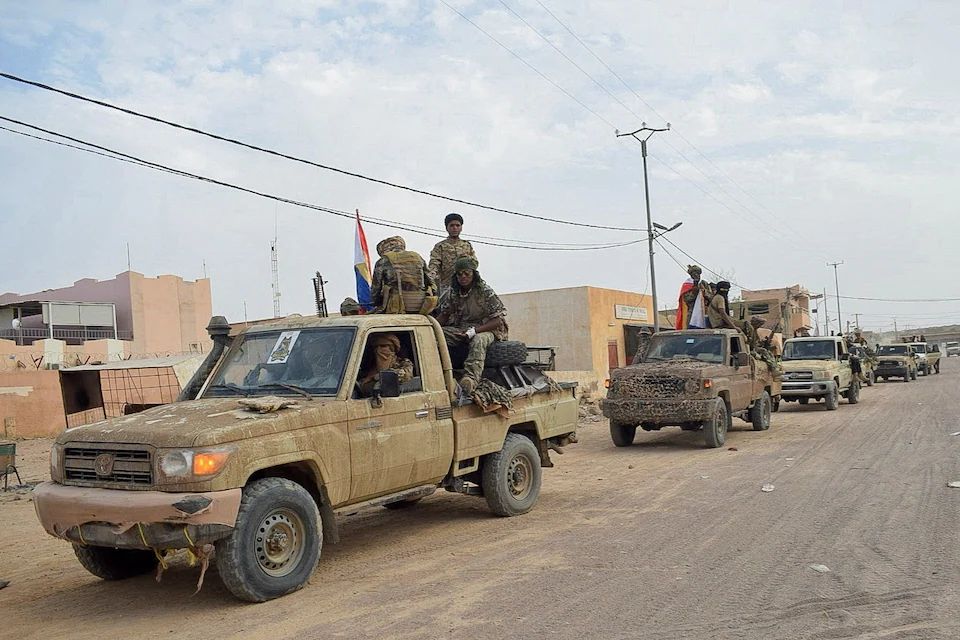
Mali troops return to Kidal after separatists withdraw, marking a symbolic development in the military-led government’s campaign against armed insurgents following airstrikes supported by Russian fighters in the country’s volatile northern region.
Malian troops re-entered the strategic northern town on Tuesday, October 6, 2026, after the Azawad Liberation Front (FLA) announced a controlled withdrawal from the area. The separatist movement said its decision followed military airstrikes targeting its positions.
The development represents a potential morale boost for Mali’s military government, which has struggled to maintain control over parts of the country amid persistent attacks by separatist fighters and jihadist groups linked to al Qaeda.
However, security analysts have cautioned against interpreting the withdrawal as a decisive military victory, noting that territorial control alone may not resolve the deeper security challenges confronting Mali.
The government has said the return of its troops will facilitate the gradual restoration of public administration and essential services in Kidal, a strategically important town that has repeatedly changed hands during the country’s prolonged conflict.

Mali Troops Return to Kidal After Separatist Withdrawal
The Azawad Liberation Front announced on Tuesday that it was conducting a controlled withdrawal from Kidal, six months after capturing the town during coordinated attacks across Mali.
The FLA said the decision followed airstrikes conducted by Malian forces with support from Russian fighters. The operations formed part of a broader military campaign intended to weaken armed groups operating in the northern region.
In a statement explaining its decision, the separatist movement described the withdrawal as a tactical measure rather than an indication that its campaign had ended.
“The FLA specifies that this is a temporary operational measure, also intended to preserve its human and logistical capabilities intact,” the statement said.
The group also insisted that its departure had taken place without a direct confrontation between its fighters and the advancing forces.
“This methodical withdrawal from the area took place without any direct combat having yet pitted its forces against the enemy,” the statement added.
The announcement suggests that the separatists were prioritising the preservation of their personnel and equipment while responding to increased military pressure.
A source close to the FLA leadership told Reuters that aerial operations by Malian and Russian forces had begun three days earlier. The source played down the significance of the withdrawal, describing it as a decision intended to protect lives and military resources.
“For us, war is not a race against the clock,” the source said.
The remarks indicate that the separatist movement does not regard leaving Kidal as the end of its struggle and may seek opportunities to regroup and continue its campaign.
Government Promises Restoration of Public Services
Following the withdrawal announcement, Mali’s government said its troops were reinforcing their presence in Kidal by Tuesday night.
A government statement indicated that the military’s return would create an opportunity to restore civilian administration and basic services in the town.
The authorities said the development would allow for “the gradual return of public administration and basic social services”.
Restoring government institutions in Kidal would represent an important step for Mali’s military leadership, which has faced persistent challenges in extending state authority across remote northern territories.
However, maintaining a military presence may prove easier than establishing lasting stability, particularly if separatist fighters or jihadist groups retain the capacity to launch further attacks.
The situation therefore remains dependent on the government’s ability to secure the town, protect residents and restore essential services while preventing armed groups from regaining control.
Kidal Conflict Deals Fresh Blow to Separatist Forces
Kidal has long occupied a central position in the conflict between Mali’s authorities and Tuareg-led separatist movements seeking greater autonomy or independence for the northern region of Azawad.
The FLA captured the town six months earlier during nationwide attacks in April 2026. Those attacks also killed Mali’s defence minister, delivering a significant blow to the military-led government.
The separatists had joined forces during the offensive with Jama’at Nusrat al-Islam wal-Muslimin, widely known as JNIM, a regional al Qaeda affiliate operating across parts of the Sahel.
Their cooperation created a major security challenge for Mali’s military leaders, who took power through coups in 2020 and 2021 and subsequently pledged to restore national security.
The loss of Kidal in April was particularly damaging because the town had previously been recaptured by Malian forces and Russian fighters in November 2023.
That earlier operation represented one of the most significant territorial gains achieved through the security partnership between Mali’s military government and Russian forces.
The separatists’ subsequent recapture of Kidal demonstrated how fragile those gains remained, despite the government’s continued reliance on foreign military assistance.
Mali Launches Large-Scale Air and Ground Operations
Mali’s military announced on Tuesday that it had launched extensive air and ground operations in the Kidal region as government forces sought to regain the initiative against armed groups.
According to a military statement, the objectives included tracking down and neutralising armed groups, destroying their supply networks and restoring lasting security.
The military also said the operations were intended to restore freedom of movement for people and goods, an important objective in a region where insecurity has disrupted everyday activities.
A security source told Reuters that pro-government fighters, including Russian personnel, had re-entered Kidal on Tuesday afternoon.
The operations followed several weeks of security setbacks in northern and central Mali, increasing pressure on the military leadership to demonstrate that its forces could regain territory and contain insurgent activity.
Nevertheless, the withdrawal of separatist fighters does not necessarily mean that the wider insurgency has been defeated.
Armed groups operating across the Sahel often rely on mobile forces, local networks and supply routes that allow them to retreat from exposed positions and continue operating elsewhere.
Consequently, the government’s ability to hold Kidal and secure surrounding areas will be a critical test of whether the latest operation can deliver more than a temporary change in territorial control.
Russian Fighters Strengthen Mali’s Military Campaign
Russia’s involvement remains a significant element of Mali’s strategy to confront separatist and jihadist groups.
Mali has relied on Russian security assistance for several years, initially through the Wagner mercenary group and subsequently through Africa Corps, a paramilitary organisation comprising many former Wagner fighters.
The partnership has become central to the military government’s efforts to strengthen its forces and regain control over areas affected by persistent insecurity.
Russian fighters also participated in the November 2023 operation that enabled Malian forces to recapture Kidal from insurgents.
However, the town’s loss in April 2026 raised questions about the effectiveness and durability of the government’s security arrangements.
The latest operation provides an opportunity for Africa Corps to demonstrate its continuing relevance to Mali’s military leadership.
Beverly Ochieng, associate director at risk consultancy Control Risks, said a successful recapture could strengthen the government’s position and improve the army’s morale following recent setbacks.
“A successful recapture… affirms the military-led government’s authority and boosts the army’s morale, particularly after several high-profile setbacks both in the north and the central regions in recent weeks,” Ochieng said.
She added that the development could provide an opportunity for Russia’s Africa Corps to reinforce its position as a security partner.
“This is also an opportunity for Africa Corps to reprise its role as the Malian government’s security guarantor after appearing to lose significant ground, including in Kidal, since April.”
Her assessment highlights the political and military importance of the operation for both Mali’s authorities and their Russian partners.
However, the success of the partnership will ultimately depend on whether the forces can sustain their territorial gains and reduce the threat posed by armed groups.
Kidal Recapture Is Symbolic, Not a Decisive Victory
Despite the return of government troops, analysts have warned that control of Kidal should not be mistaken for a decisive victory in Mali’s broader conflict.
Ochieng described the change of control as largely “symbolic” rather than decisive in the government’s campaign against insurgent groups.
The distinction is important because capturing a strategic town does not automatically eliminate armed organisations operating across a wider region.
Separatist movements and jihadist groups may continue to threaten security through attacks, ambushes and operations against military positions, even when they lose control of major settlements.
The FLA’s own statement supports the possibility that its withdrawal is temporary, as the group explicitly described the move as an operational decision designed to preserve its capabilities.
Its leadership’s refusal to portray the departure as a final defeat suggests that the struggle for influence in northern Mali could continue.
The government also faces the challenge of restoring public confidence in areas affected by prolonged conflict and ensuring that residents can access essential services without fear of renewed violence.
Long-Term Security Remains the Main Challenge
For Mali’s military leadership, the return to Kidal offers an opportunity to demonstrate progress after a series of setbacks. Yet the broader security situation remains complicated by the presence of multiple armed groups with different objectives and operational capabilities.
The FLA’s separatist ambitions differ from those of jihadist organisations such as JNIM, even though the groups cooperated during the April attacks.
Addressing these overlapping threats requires more than retaking individual towns. It also involves protecting supply routes, preventing armed groups from regrouping and establishing a durable government presence.
The restoration of public administration and social services could help strengthen state authority, but these measures will require sustained security and resources.
For residents, the most significant measure of success will be whether the latest military operation leads to greater safety, reliable public services and freedom of movement.
Read also: India detains hundreds as Delhi lockdown foils protest against election Chief
The government’s ability to deliver those outcomes will determine whether the return to Kidal becomes a lasting achievement or another temporary shift in control.
For now, Malian troops have regained access to a strategically important northern town, while the separatists insist that their withdrawal does not mark the end of their campaign.
The developments underscore the continuing struggle for territorial control in Mali, where military operations, foreign security assistance and competing armed movements continue to shape the country’s fragile security environment.
About the Author





