Three and a half years into the war against Ukraine, Russia’s funding for Ukraine war is showing cracks, signaling that Moscow may struggle to sustain prolonged military operations. Experts warn that economic resilience is starting to fray under mounting pressure.
Russia experts say the country now relies almost entirely on oil and gas export revenues for its cashflow, leaving it vulnerable to sanctions and geopolitical disruptions that could choke funding for its military.
On October 14, US President Donald Trump predicted that Russia’s economy is “going to collapse,” highlighting growing Western optimism over Moscow’s financial fragility and the potential for negotiating peace.
Kremlin spokesman Dmitry Peskov dismissed the warning the following day, insisting that Russia has a sufficient “margin of safety” to manage ongoing economic and military challenges without threatening the government’s control.
However, Ministry of Finance documents reviewed by Reuters indicate a $51 billion budget deficit in the first eight months of 2025, exceeding the annual target of $47 billion, raising concerns about fiscal sustainability and Russia’s funding for Ukraine war campaign.
Officials are reportedly planning to cut the 2026 defense budget by $11 billion, bringing it down to $154 billion—a seven percent reduction, signaling reduced military spending and tighter fiscal priorities.
Craig Kennedy, a Harvard energy and Russian economics expert, told newsmen that the actual drop in defense funding may reach 15 percent due to reduced bank lending to the defense sector, which has slowed significantly.
“Russia’s funding for Ukraine war in 2025, including state-directed loans to arms manufacturers, is on track to contract by 15 percent this year,” Kennedy said, citing official budget and lending trends that suggest declining military investment.
Even before budget adjustments, Russian advances in Ukraine were slow. Last year, forces captured just 0.69 percent of Ukrainian territory while suffering tens of thousands of casualties, illustrating the heavy human and economic costs of prolonged conflict.
In the first eight months of 2025, Russia seized less than one percent of Ukraine, continuing to pay a heavy human cost while the war’s economic impact intensified, leaving analysts to question the sustainability of Moscow’s strategy.
Russia previously managed to fund its war without major economic contraction, raising taxes, or running high deficits by leveraging oil and gas revenues and directing banks to fund defense, a strategy that insulated the federal budget.
This approach allowed the economy to grow by over four percent in both 2023 and 2024 despite ongoing conflict, a remarkable feat given the scale of international sanctions imposed since the invasion began.
But in 2025, short-term policies designed to maximize war funding are starting to strain Russia’s broader economy, threatening stability outside the defense sector and increasing vulnerability to sanctions.
The government plans to increase VAT from 20 to 22 percent, expanding coverage to generate an additional $14.7 billion in revenue next year, a move signaling economic stress and growing reliance on domestic taxation.
The World Bank predicts that Russia’s economy will grow by just 0.9 percent in 2025 and remain stagnant in subsequent years, reflecting weakening economic resilience and limited fiscal flexibility under ongoing conflict conditions.
“This year, the civilian real economy is flat to down. Only the defense sector remains positive,” Kennedy said, emphasizing the growing divergence between military and civilian finances and highlighting economic strain.
The Center for Macroeconomic Analysis and Short-term Forecasting reported a 5.4 percent contraction across non-defense sectors in the first eight months of the year, confirming stagnation and the rising burden on ordinary Russians.
A primary driver of slowdown is the government diverting bank credit to defense projects, reducing capital availability for commercial and industrial activity in other sectors, which has caused layoffs and industrial strain.
Elvira Nabiullina, Russia’s central banker, warned in June that reserves used to maintain economic growth and fund mega-projects are now “truly depleted,” raising concerns about fiscal sustainability and future emergency spending.
Liquid assets in Russia’s National Welfare Fund have dropped by one-third to $34 billion, with $10 billion allocated to shore up banks, leaving little buffer for crises and exposing Moscow to additional financial risk.
Some banks may face defaults because arms manufacturers, heavily reliant on state-directed debt estimated at $180 billion, could struggle to repay loans, creating systemic risk and potential cascading effects across the economy.
“It’s all toxicity-prone, dark money; nobody knows how much might go bad. That’s 22.7 percent of the entire Russian corporate rouble loan book. It’s a big problem,” Kennedy said, stressing the hidden risks.
Industrial firms are beginning to show stress: Reuters reported on October 9 that several companies had furloughed workers to reduce payroll expenses amid rising financial strain, highlighting the real-world impact of state-directed lending.
Sanctions are compounding these difficulties. Olena Yurchenko, director at the Economic Security Council of Ukraine, said Russia now pays 30 to 50 percent above market rates for sanctioned materials, raising costs and slowing production.
“For military-specific products, the premium sometimes reaches 70 to 80 percent,” Yurchenko said. “This creates a technological gap in Russia’s defense industry that could affect battlefield performance.”
The “death by a thousand cuts” effect is already evident. Delays in weapon production, missile navigation failures, and logistical hurdles are hampering operational capacity and forcing Moscow to adjust tactics under resource constraints.
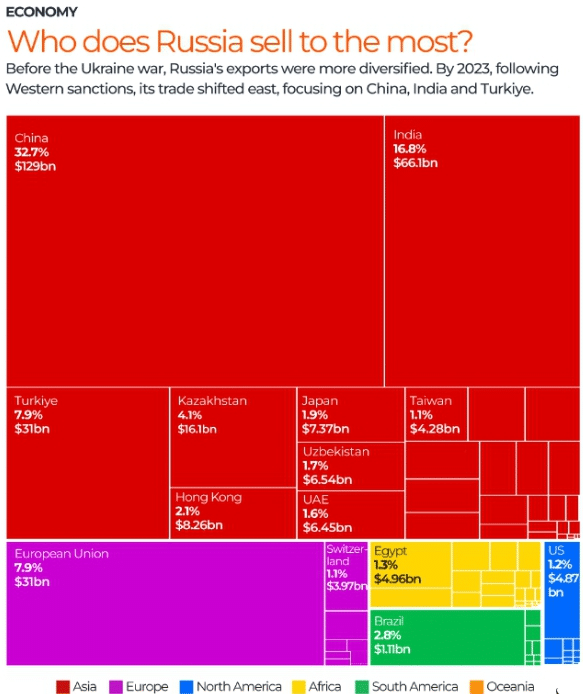
Ukraine’s allies have banned Russian oil imports, cutting $82 billion in annual revenue from the European Union alone. Moscow has partially offset losses through sales to China and India, showing the Kremlin’s continued ability to find alternative markets.
Maximilian Hess, a Foreign Policy Research Institute fellow, said the Russian economy is not yet collapsing due to continued oil revenues, particularly prepayment arrangements with China for discounted crude, which provide temporary cash flow.
The EU, UK, Australia, and Canada have capped prices on Russian oil exports, but Washington has not fully implemented secondary sanctions or price caps, allowing cashflow to persist despite ongoing economic pressure.
Anna Wieslander, director for Northern Europe at the Atlantic Council, criticized the US approach, calling it “soft on Russia” and noting that the Kremlin perceives limited Western pressure, which encourages continued military aggression.
Russia has intensified missile and drone attacks on Ukrainian cities since Trump’s 2024 election, indicating that it continues to leverage military capabilities despite growing economic strain and sanctions-induced inefficiencies.
The EU is considering a 19th sanctions package, targeting refined petroleum products and restricting tanker movements to tighten financial pressure on Moscow, which could significantly reduce Kremlin revenues if fully enforced and potentially hamper Russia’s funding for Ukraine war campaign.
Proposals to use roughly half of nearly $300 billion in seized Russian central bank reserves to fund Ukraine’s defense and reconstruction represent a major political statement against Moscow, signaling Western unity in fiscal pressure.
“Capital needs to shift; no way should that money return to the Russian state,” Wieslander said, stressing the urgency of turning frozen assets into strategic leverage to support Ukraine and weaken Moscow’s war funding.
While Russia has thus far managed to sustain its war economy through oil revenue and state-directed banking, mounting sanctions and domestic economic weaknesses signal potential contraction ahead and reduced capacity for sustained operations.
Analysts warn that without decisive external pressure or internal financial reform, the Kremlin may face mounting challenges in funding military operations, ultimately affecting the trajectory of the Ukraine war and global energy markets.
Experts argue that the coming year could be pivotal, with Russia’s funding for Ukraine war potentially contracting sharply under compounded economic, fiscal, and logistical pressures.
About The Author