Trump derides Newsom UK clean energy deal as the U.S. president publicly attacked California’s governor over an international climate pact, questioning authority, intent, and political symbolism behind the transatlantic move.
President Donald Trump escalated his criticism of California leadership this week, delivering sharp remarks that framed the agreement as reckless and diplomatically misplaced.
Speaking in a brief exchange, Trump derided the governor’s record, arguing that foreign partners should avoid entanglement with policies he described as failed experiments.
At the center of the dispute is California Governor Gavin Newsom, whose administration signed a cooperation pact focused on clean energy development and research exchange.
The memorandum was finalized during meetings in London, underscoring California’s attempt to maintain climate engagement despite federal policy reversals.
Trump’s language was characteristically blunt, using derisive nicknames and warnings that the partnership would bring “nothing but trouble” to overseas allies.
He suggested that California’s internal challenges, including migration and infrastructure delays, should caution external governments against collaboration.
The agreement links California with the United Kingdom on offshore wind, grid modernization, and clean technology financing initiatives.
British Energy Secretary Ed Miliband co-signed the memorandum, pledging technical cooperation and market access discussions.
Supporters say the pact reflects subnational diplomacy filling gaps left by shifting national priorities on climate action.
Trump countered that such arrangements blur constitutional lines, insisting international deals should be reserved for federal authorities alone.
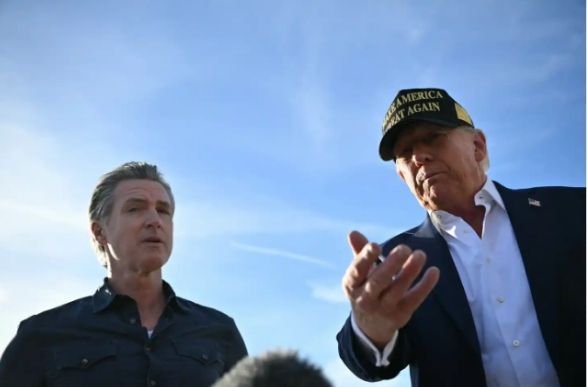
He warned that the venture could “backfire,” predicting limited economic returns and political complications for British stakeholders.
California officials defended the move as lawful, emphasizing memoranda of understanding lack treaty status and carry no binding obligations.
The deal also opens pathways for private-sector participation, including firms like Octopus Energy, which seeks U.S. market expansion.
Backers argue that investment and innovation flows benefit both economies while accelerating emissions reductions targets.
Critics within conservative circles say the symbolism is more political than practical, aimed at elevating Newsom’s national profile.
The governor is widely viewed as a future presidential contender, adding electoral subtext to the international tour.
Trump highlighted California’s stalled high-speed rail project as evidence of mismanagement, asking rhetorically, “How has he done?”
Those remarks resonated with Republican allies who frame state climate ambitions as costly and inefficient.
Yet climate advocates note California’s emissions policies have influenced global standards and technology adoption.
The pact aligns with commitments under the United Nations Framework Convention on Climate Change, which the federal government recently exited again.
State officials stress continuity, arguing long-term climate goals require stability beyond electoral cycles.
Analysts say the dispute reflects broader tensions between federal retrenchment and state-led climate diplomacy.
British officials have largely avoided responding to the personal barbs, focusing instead on technical collaboration details.
Energy researchers see offshore wind cooperation as particularly valuable given California’s vast coastline potential.
The memorandum also encourages joint research between universities, strengthening innovation pipelines across the Atlantic.
Trump’s critique included claims that residents are “leaving” California, citing cost-of-living pressures.
Demographic data shows mixed migration trends, with outflows offset by international arrivals and economic growth sectors.
Still, political messaging around population shifts remains a potent campaign talking point.
Newsom’s team framed the agreement as pragmatic, saying climate risks demand cooperation “wherever possible.”
They argue subnational actors have historically advanced environmental policy during federal pullbacks.
Legal scholars note that U.S. states have long engaged in similar agreements without constitutional conflict.
Examples include trade offices, environmental accords, and cultural exchanges predating modern climate debates.
The clash also highlights diverging visions of American leadership on climate and diplomacy.
Trump has consistently criticized wind energy, questioning reliability and cost effectiveness.
Industry data, however, shows rapid cost declines and increasing grid integration globally.
British investors view California as a gateway market for clean technology scaling.
Opponents warn that regulatory complexity could hinder promised benefits.
As rhetoric intensifies, the agreement itself remains modest, focused on cooperation rather than enforcement.
Read also: Swiss train Avalanche: multiple casualties feared in Valais disaster
Observers say the political fallout may overshadow technical progress in the near term.
Nevertheless, both sides appear committed to their respective narratives heading into an election cycle.
Whether the pact yields tangible outcomes or symbolic value will become clearer over time.
For now, the episode underscores how climate policy has become a proxy battlefield for broader political rivalry.
About The Author