The arrival of the first Taiwan F-16V fighter jets has strengthened Taipei’s air force after the United States delivered two new aircraft from a 66-jet order approved in 2019.
The two F-16V Block 70 fighters arrived at Chihhang Air Base in Taitung on Friday after flying through Hawaii and Guam, marking the first delivery from the long-delayed programme.
The delivery comes as Taiwan continues to monitor frequent Chinese military activity around the island and seeks to strengthen its defence capabilities with US-made weapons.
Taiwan considers the United States its most important international backer and arms supplier, although Washington and Taipei do not have formal diplomatic relations.
Taiwan F-16V delivery begins after delays
The United States approved an $8 billion sale of 66 F-16V fighter jets to Taiwan in 2019.
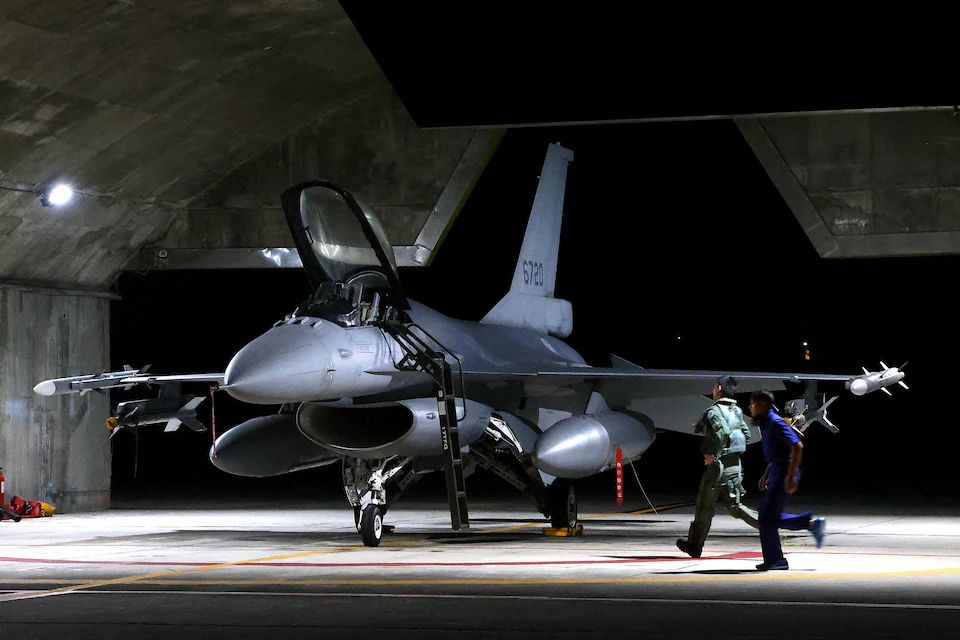
Once all the aircraft are delivered, Taiwan’s F-16 fleet is expected to exceed 200 jets.
However, the programme has experienced delays, including problems involving the aircraft’s software.
Taiwan’s Defence Minister Wellington Koo said more aircraft would arrive before the end of the year, although he did not provide a specific delivery schedule.
“Of course we won’t only have delivered these two by year-end,” Koo told reporters at Taiwan’s parliament shortly before the aircraft arrived.
The first two aircraft touched down at noon local time at Chihhang Air Base, located on Taiwan’s mountainous eastern coast.
The delivery represents the beginning of a new phase for Taiwan’s F-16 fleet, which already includes upgraded aircraft from an earlier modernisation programme.
Existing F-16 fleet already upgraded
Taiwan completed an upgrade programme for its existing F-16 fighter jets in 2023.
The newer F-16V Block 70 aircraft, however, include more advanced avionics, radar and weapons systems.
These capabilities are designed to improve the aircraft’s ability to operate against modern air threats.
The F-16Vs will also provide Taiwan with a more capable fighter platform as the island’s air force continues to respond to Chinese military activity.
The aircraft are equipped with systems intended to help them counter advanced Chinese aircraft, including the J-20 stealth fighter.
The United States has nevertheless not supplied Taiwan with its most advanced fighter aircraft, such as the F-22 or F-35.
Taiwan China military tensions remain a concern
Taiwan has increasingly focused on strengthening its air defences as China continues military activity around the island.
Beijing claims Taiwan as part of its territory and has repeatedly opposed US arms sales to Taipei.
Taiwanese officials say China’s military pressure remains a serious security concern.
“China’s intention to annex Taiwan by force has never changed,” Defence Minister Koo said.
Taiwan’s air force frequently scrambles aircraft to monitor and respond to Chinese military activity around the island.
The arrival of the new F-16Vs therefore comes as part of Taipei’s broader effort to maintain a modern and capable air force.
US says policy on Taiwan has not changed
The latest delivery also comes shortly after US President Donald Trump met Chinese President Xi Jinping in Washington.
Trump had previously said in May that he was holding a new $14 billion arms package for Taiwan in abeyance.
His administration had nevertheless approved an $11 billion package for Taiwan in December 2025.
The timing of the F-16V arrival has therefore attracted attention in Taiwan amid concerns about the Trump administration’s continued commitment to supplying weapons to Taipei.
Washington has said there has been no change in its Taiwan policy.
“We continue standing with friends and allies across the Indo-Pacific to advance our shared prosperity, security, and values — that includes Taiwan,” a US State Department spokesperson said when asked about the new F-16s.
China opposes US arms sales to Taiwan
China has repeatedly demanded that Washington stop supplying weapons to Taiwan.
Beijing regards US arms sales to Taipei as interference in China’s internal affairs and a challenge to its territorial claims over the island.
China’s Foreign Ministry did not immediately respond to a request for comment on the arrival of the F-16Vs.
The delivery nevertheless demonstrates the continuing military relationship between Washington and Taipei despite the absence of formal diplomatic relations.
Under US law, Washington is required to provide Taiwan with the means to defend itself, although the exact nature and scale of arms transfers remain subject to US policy decisions.
F-16V jets add advanced capabilities
The F-16V Block 70 is an advanced version of the F-16 fighter aircraft.
The aircraft incorporates upgraded avionics, radar and weapons systems designed to improve its ability to detect, track and engage threats.
For Taiwan, the new aircraft are intended to complement the upgraded F-16s already operating in its air force.
The addition of new aircraft will also gradually expand the number of modern fighter jets available to Taiwan as it manages an increasingly demanding operational environment.
The first two jets are only the beginning of the 66-aircraft programme.
Taiwan is expected to receive additional F-16Vs in the coming months, with Defence Minister Koo indicating that deliveries will continue before the end of 2026.
US-Taiwan weapons deliveries face delays
The F-16V programme has also highlighted a broader issue facing Taiwan’s defence procurement.
Taipei has complained about delays affecting some weapons ordered from the United States.
The delays have become a concern because Taiwan is attempting to strengthen its military capabilities while Chinese military activity continues around the island.
The F-16V delivery therefore represents both a major addition to Taiwan’s air force and progress on a weapons programme that has taken longer than originally expected.
US sees Chinese invasion before 2028 as increasingly unlikely
The F-16V delivery comes as US officials assess the possibility of a Chinese invasion of Taiwan.
People familiar with US thinking told Reuters that an invasion before 2028 is increasingly considered unlikely.
Taiwan is scheduled to hold its next presidential election in early 2028.
The assessment does not remove concerns about military pressure around Taiwan, however, and Taiwanese officials continue to stress the importance of maintaining defensive capabilities.
The new F-16Vs are consequently arriving at a time when Taiwan is balancing military preparedness, weapons procurement and its increasingly complex relationship with both Washington and Beijing.
Taiwan expands air defence capability
The arrival of the first two F-16V Block 70 aircraft marks an important stage in Taiwan’s long-running effort to modernise its fighter fleet.
Read also: Christa Pike execution attempt: Death row inmate receives life-saving care after failed lethal injection
The remaining aircraft from the 66-jet order will be delivered in stages, according to Taiwan’s defence minister.
Once the programme is complete, Taiwan’s F-16 fleet will number more than 200 aircraft, combining newly built F-16Vs with aircraft that have undergone extensive upgrades.
For Taipei, the expanded fleet will provide additional modern aircraft for air defence and military readiness missions.
For Washington, the programme remains part of its broader security relationship with Taiwan.
For Beijing, however, the delivery is another US military support measure that China has consistently opposed.
The arrival of the first two new fighters therefore places Taiwan’s F-16V programme at the intersection of its defence modernisation efforts, US arms policy and continuing tensions across the Taiwan Strait.