Cameroon erupted in chaos after the Paul Biya re-election was officially confirmed, triggering violent clashes nationwide and raising fears over the country’s fragile democratic institutions, political legitimacy, and human rights violations.
The Constitutional Council declared that President Paul Biya, in power since 1982, had secured 53.66 percent of votes, while opposition candidate Issa Tchiroma claimed 35.19 percent, denouncing the results publicly.
Tchiroma, a seasoned politician and former government spokesperson, previously declared victory, citing internal party tallies, accusing authorities of manipulation, and warning that the Paul Biya re-election could provoke widespread instability.
Protests erupted in Douala, Cameroon’s largest city, leaving at least four people dead as security forces confronted demonstrators demanding credible election verification and accountability for alleged fraud and irregularities.
Following the announcement, Tchiroma claimed civilians were targeted with gunfire outside his home in Garoua, condemning authorities for “blatant impunity” and warning that violence would continue after the Paul Biya re-election.
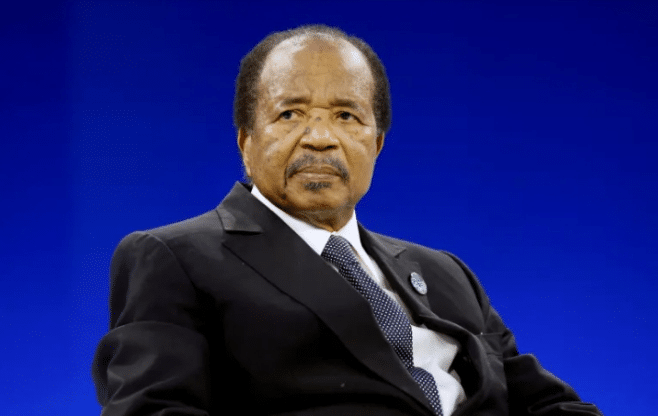
Biya, at 92, now embarks on a new seven-year term, consolidating power further and extending his unprecedented rule, reinforcing authoritarian control while suppressing dissent and limiting political competition.
Observers warned that delays in vote counting fueled suspicions of fraud, spreading civil unrest to Yaounde, Douala, and other cities, with dozens of activists reportedly detained by government security forces.
Desmond Ngala, head of Civic Watch Cameroon, described Biya’s victory as “more or less expected,” but warned that continued unrest could paralyze governance, escalate violence, and destabilize Cameroon’s fragile political landscape.
Authorities and the ruling party dismissed allegations of interference, insisting that the Paul Biya re-election was transparent, legitimate, and reflective of the democratic choice of Cameroonian citizens nationwide.
Tchiroma’s campaign, supported by opposition coalitions and civic groups, mobilized large crowds, emphasizing transparency, political accountability, and denouncing state-sanctioned violence following the official declaration of Biya’s victory.
Security forces reportedly used excessive force against civilians protesting the Paul Biya re-election, raising concerns over human rights violations and the potential for further escalation of violent demonstrations nationwide.
Partial results reported by local media showing Biya in the lead triggered protests across multiple cities, highlighting deep political divisions and undermining confidence in Cameroon’s electoral institutions.
Opposition activists warned that continued unrest could cripple governance, disrupt commerce, and provoke regional instability, while authorities maintained a hardline approach to quelling post-election demonstrations across Cameroon.
Tchiroma criticized security forces for targeting civilians, writing that shooting “point-blank at your own brothers” reflects a culture of impunity after the Paul Biya re-election, and warned of escalating resistance.
Civil society organizations expressed alarm that persistent violence and authoritarian consolidation could erode democratic institutions, undermine rule of law, and suppress opposition voices across Cameroon indefinitely.
Analysts noted that removing presidential term limits in 2008 allowed Biya to extend his power, laying the foundation for the controversial Paul Biya re-election and decades-long political dominance.
The opposition’s claims of voter manipulation, intimidation, and delays illustrate systemic flaws, increasing distrust in Cameroon’s electoral institutions after yet another Paul Biya re-election victory.
International observers highlighted concerns over transparency, post-election violence, and restricted civic space, noting that unrest in urban centers threatens Cameroon’s stability and could draw global attention.
Protesters continue to confront authorities, demanding credible verification, accountability, and freedom from electoral manipulation, emphasizing rejection of results perceived as rigged during the Paul Biya re-election period.
Security analysts warned that ongoing violence risks radicalizing opposition movements, further destabilizing urban centers, and escalating political tension in response to Biya’s controversial re-election and extended rule.
Economic observers cautioned that prolonged unrest could disrupt markets, halt investment, and damage livelihoods, as political instability following the Paul Biya re-election undermines confidence in Cameroon’s economy.
Tchiroma’s supporters argued that civilian targeting by security forces is unacceptable, warning that international scrutiny may increase following repeated instances of post-election violence in Cameroon’s urban centers.
Local activists emphasized that the Paul Biya re-election represents entrenched authoritarianism, threatening democratic reforms and signaling the government’s unwillingness to tolerate political dissent or opposition challenges nationwide.
Human rights organizations raised alarms over the use of force, detentions, and media restrictions, highlighting growing authoritarian consolidation following Cameroon’s disputed Paul Biya re-election announcement.
Communities across Cameroon have voiced anger over corruption, economic hardship, and lack of public services, linking these grievances to political stagnation reinforced by the Paul Biya re-election victory.
Political analysts warned that failure to address civic dissatisfaction could create conditions for prolonged unrest, undermining public trust, and intensifying tensions after the controversial Paul Biya re-election announcement.
The country’s youth, who represent a majority of the population, have increasingly participated in protests, expressing frustration at limited opportunities and exclusion from political decision-making following the Paul Biya re-election.
Observers noted that continued suppression of dissent, coupled with Biya’s extended tenure, risks alienating opposition parties, discouraging citizen participation, and consolidating elite control after the Paul Biya re-election period.
Civil society leaders highlighted that international scrutiny and media attention are critical to monitoring abuses, especially in light of repeated post-election violence after the Paul Biya re-election announcement.
In conclusion, the Paul Biya re-election cements Africa’s longest-serving leader’s dominance, sparking nationwide protests, international concern, and fears of political violence, repression, and enduring instability across Cameroon’s fragile democracy.
About The Author