Pope Leo’s Nuclear Appeal: A Final Plea to Save the World’s Last Arms Control Pact
As the world stands on the brink of a historic arms control vacuum, Pope Leo XIV has stepped into the global spotlight with a stark warning: the expiration of the last remaining nuclear weapons treaty between the United States and Russia could unleash a dangerous new era of rivalry, mistrust and strategic instability.
Speaking during his weekly general audience at the Vatican, the pontiff urged Washington and Moscow to renew the New START agreement, the final binding framework limiting the world’s two largest nuclear arsenals.
His appeal comes just hours before the treaty’s expiry, underscoring growing international anxiety over the collapse of decades-long nuclear restraint.
The pope’s intervention is significant not only because of the gravity of the moment, but also because of who he is. As the first pope from the United States, Leo XIV carries a unique moral authority in addressing both sides of the nuclear divide.
His message was direct: the current global climate demands cooperation, not confrontation.
A world at a nuclear crossroads
The impending expiration of New START would mark the end of more than half a century of formal arms control agreements between Washington and Moscow.
From the Cold War’s darkest moments to post-Soviet recalibrations, these treaties have acted as guardrails, preventing miscalculation and unchecked escalation.
Without them, analysts warn that the world could slide into an unconstrained nuclear competition, with devastating implications for global security, defence spending and diplomatic trust.
Pope Leo framed the issue not merely as a strategic concern, but as a moral one. He warned that fear-driven policies and suspicion among nations risk entrenching divisions at a time when humanity faces shared challenges ranging from climate change to economic inequality.
“It is more urgent than ever,” the pope said, “to replace the logic of fear and distrust with a shared ethic, capable of guiding choices toward the common good.”
Why the New START nuclear arms treaty matters
The New START nuclear arms treaty, signed in 2010, places strict limits on the number of strategic nuclear warheads and delivery systems deployed by both the United States and Russia.
It also provides for on-site inspections and data exchanges, mechanisms that experts say are as important as the numerical caps themselves.
By fostering transparency, the New START nuclear arms treaty reduces the risk of misinterpretation and accidental escalation. Military planners on both sides can make decisions based on verified information rather than worst-case assumptions, a stabilising factor in an increasingly volatile geopolitical environment.
If allowed to lapse, there would be no legally binding constraints on the nuclear forces of either country for the first time since the early 1970s. Arms control specialists caution that this could trigger rapid weapons modernisation programmes, heighten alert levels, and undermine non-proliferation efforts worldwide.
Russia has signalled openness to a temporary extension, with President Vladimir Putin proposing an informal one-year continuation. However, as of the pope’s address, the United States had yet to formally respond, fuelling uncertainty among allies and rivals alike.
Beyond Washington and Moscow
The implications of the treaty’s collapse extend far beyond the two signatories. Europe, already grappling with heightened military tensions, would face increased security risks. Asia-Pacific nations, watching the US-Russia dynamic closely, could reassess their own defence postures.
For non-nuclear states, the erosion of the New START nuclear arms treaty sends a troubling signal: that global powers are retreating from their disarmament commitments. This could weaken the credibility of the Nuclear Non-Proliferation Treaty (NPT) and embolden countries seeking nuclear capabilities.
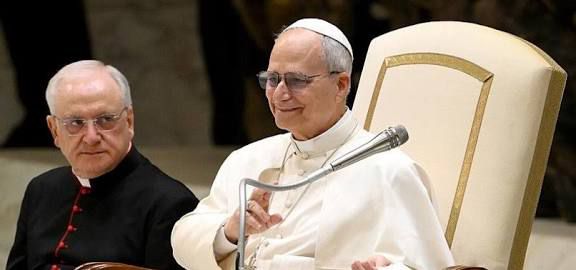
Pope Leo’s call reflects growing concern among religious leaders, diplomats and civil society groups that the world is drifting toward a more fragmented and militarised order, where deterrence replaces dialogue and arms control gives way to unilateralism.
A moral voice in a strategic debate
The Vatican has long positioned itself as an advocate for peace and disarmament, but Leo XIV’s remarks carry added weight given the timing and his background.
His appeal reframes nuclear arms control as a humanitarian issue, emphasising the catastrophic consequences any renewed arms race would have for civilians, economies and future generations.
He warned that resources poured into weapons systems divert attention and funding from urgent human needs, particularly in developing countries already burdened by debt, food insecurity and climate shocks.
By urging leaders not to let the treaty lapse, the pope sought to inject ethical urgency into what has often been a technocratic policy debate.
Even if New START expires, diplomatic channels remain open. However, rebuilding trust after a lapse would be far more difficult than extending the existing framework.
Arms control experts argue that even a short-term extension could provide breathing room for broader negotiations, including discussions on emerging technologies such as hypersonic weapons and cyber capabilities.
The coming days will reveal whether Washington and Moscow heed the pope’s call or allow the world’s last nuclear guardrail to fall away.
For now, Pope Leo XIV has issued a clear warning: the cost of inaction may be far higher than the political price of compromise.
About The Author