

Polish jets intercepts Russian aircraft in a tense moment over the Baltic Sea, highlighting the escalating regional friction tied to the Ukraine-Russia war’s relentless grind.
Poland’s military confirmed that its air force engaged a Russian Il-20 reconnaissance plane flying without a transponder or flight plan in international airspace early Wednesday.
“The aircraft did not violate Polish airspace, but it ignored essential international aviation rules,” a Polish Army spokesperson said, emphasizing that interception procedures were routine yet necessary.
The Polish Air Force scrambled its jets after radar systems detected the Russian plane’s movement northwest of Gdańsk, an area of frequent NATO surveillance missions.
Officials said the Russian aircraft’s transponder was switched off, raising immediate safety concerns among air controllers and prompting swift coordination between Polish and NATO command centers.
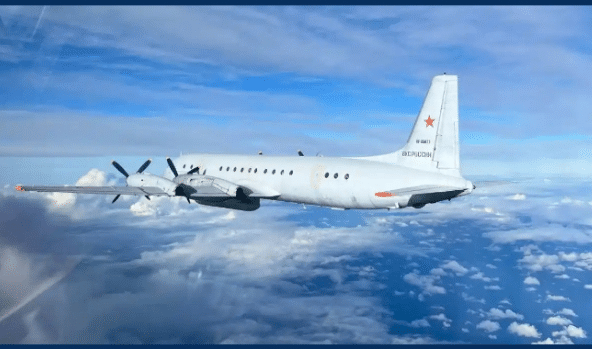
This incident underscores a sharp uptick in aerial confrontations across the Baltic, a region increasingly sensitive due to ongoing military exercises and proximity to the Ukraine-Russia war.
The Polish Ministry of Defense stated that the intercept lasted roughly 20 minutes, during which the Russian aircraft maintained altitude and exited the monitoring zone without incident.
Observers say Poland’s response reflects both vigilance and restraint, balancing NATO’s deterrence posture with efforts to avoid direct confrontation with Moscow’s unpredictable maneuvers.
A senior NATO official told Reuters that such aerial encounters have multiplied since 2023, describing them as “a dangerous pattern of intimidation designed to test Western resolve.”
In Moscow, state media dismissed the episode as “routine reconnaissance,” but analysts view these missions as part of Russia’s broader campaign to signal military dominance.
Meanwhile, inside Ukraine, President Volodymyr Zelensky said Russian forces outnumber Ukrainian defenders eight to one in the embattled eastern city of Pokrovsk.
“Imagine how many Russian troops are there,” Zelensky remarked. “But they have still not achieved the results they planned,” he added, addressing his nightly audience.
The fierce Pokrovsk fighting has become symbolic of Ukraine’s determination to hold strategic ground in Donetsk, even as its resources and manpower come under severe strain.
Reports from the front line indicate relentless artillery duels, with both sides sustaining heavy casualties as Russia attempts to consolidate its territorial ambitions under Vladimir Putin.
Polish jets intercepts Russian aircraft against this backdrop of turmoil, revealing how the Ukraine-Russia war’s tensions now ripple well beyond the combat zone.
Security analysts say Russia’s reconnaissance flights near NATO borders serve multiple objectives: intelligence gathering, intimidation, and testing allied radar and air defense responses.
“They are probing our reactions, measuring our discipline, and watching how quickly we scramble,” said a former Polish Air Force commander now advising the defense ministry.
Warsaw’s swift communication with NATO allies after the interception demonstrated a unified response mechanism, reflecting lessons learned since Russia’s full-scale invasion in 2022.
Across Europe, governments are reassessing air patrol readiness and updating radar systems amid concerns that Russia’s incursions could trigger unintended escalations.
In Brussels, a NATO spokesperson reaffirmed collective defense principles, saying: “Every member’s airspace and regional integrity remain sacrosanct. Any threat is met with cohesion and clarity.”
Polish jets intercepts Russian aircraft not just as a technical operation but as a political message—one signaling that NATO borders are being closely guarded.
Zelensky, in a separate address, said Ukraine’s long-range strikes had cut Russia’s oil refining capacity by 20 percent, citing Western intelligence confirmation.
He credited Ukrainian-made weapons for over 90 percent of the strikes and urged allies to sustain financial aid to produce more long-range precision systems.
“We just need to work on this every day,” he said, noting that Kyiv’s resilience depended on continuous international support and industrial innovation.
In Moscow, officials accused Ukraine of “state terrorism” over drone attacks on its territory, while Ukraine countered that such strikes target legitimate military and industrial assets.
The latest drone campaign saw 57 drones intercepted within three hours overnight near Moscow, with air traffic briefly disrupted at two airports, Russian authorities said.
Despite these defenses, Ukraine’s persistence in hitting Russian infrastructure has eroded parts of Moscow’s war economy, underscoring the conflict’s evolving technological dimensions.
Polish jets intercepts Russian aircraft at a moment when Europe’s airspace feels more crowded, with tensions stretching from the Black Sea to the Arctic frontier.
In Crimea, local officials reported a Ukrainian drone strike setting ablaze a fuel depot in Simferopol, though no casualties were recorded.
Such incidents amplify regional volatility, convincing European nations to tighten intelligence-sharing protocols and update crisis communication channels across their militaries.
Japanese Prime Minister Sanae Takaichi reportedly told U.S. President Donald Trump that banning Russian LNG imports would be “extremely difficult,” citing Japan’s 9 percent energy dependency.
The conversation, disclosed by Nikkei, illustrates how the Ukraine-Russia war’s ripple effects extend even into global energy diplomacy and economic realignments.
Vladimir Putin, meanwhile, endorsed a year-round military conscription law to replenish troop numbers, aiming for a total active force of 1.5 million by 2026.
Human-rights monitors allege that draftees are being coerced into volunteer contracts for Ukraine deployment, despite official denials from the Russian Defense Ministry.
“Russia’s approach combines legal mobilization with quiet coercion,” said an analyst at the European Council on Foreign Relations. “It’s pressure through both law and fear.”
For NATO allies, including Poland, these developments intensify anxiety over potential cross-border spillovers, making intercept missions part of routine defense vigilance.
Polish jets intercepts Russian aircraft, but the psychological effect resonates farther—reaffirming that air defense is now central to Europe’s collective deterrence doctrine.
Poland’s Defense Minister emphasized that every air defense response, however small, is a component of the continent’s broader strategy to prevent Russian escalation.
“Each reaction signals readiness,” he said. “That readiness keeps peace. It tells Moscow that Europe’s skies are not a playground.”
As winter approaches, both Russia and Ukraine brace for a renewed phase of attrition—drones, missiles, and supply routes shaping the battlefield’s rhythm.
Polish jets intercepts Russian aircraft today, but tomorrow’s encounters may involve more complex engagements as technology, geography, and politics collide in unpredictable ways.
Across Europe, citizens have grown accustomed to air raid alerts and headlines of interceptions, yet each new event rekindles fears of accidental escalation.
Analysts warn that one misinterpreted radar signal or missile lock could ignite a chain reaction between nuclear-armed powers already operating at the brink.
For now, calm prevails. The Russian aircraft turned away. Polish pilots returned to base. But the message from the Baltic skies remains unmistakable: vigilance is survival.
About The Author


