


Palestinians in Gaza are burying bodies returned by Israel amid the fragile Israel Gaza ceasefire, struggling with humanitarian collapse as aid restrictions deepen and suffering intensifies daily.
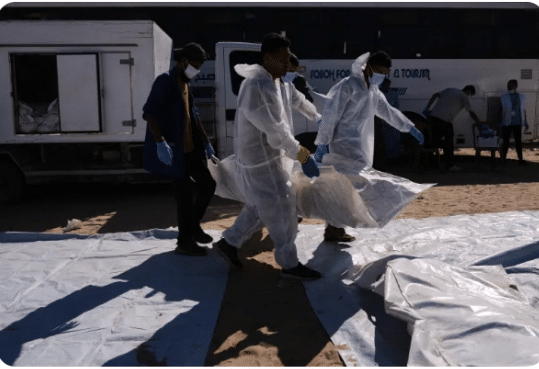
Dozens of corpses were delivered through the Rafah crossing in a grim exchange involving the remains of Israeli captives, reigniting anger and despair across the war-torn enclave.
Witnesses say many of the bodies are unrecognisable, bearing signs of torture, mutilation, and severe burns, underscoring the lingering brutality from Israel’s prolonged campaign in Gaza.
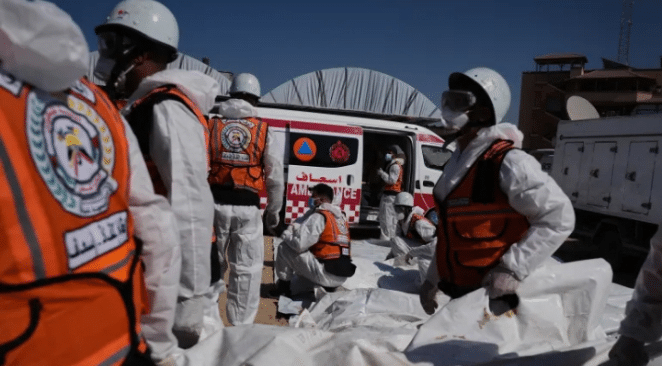
Palestinian officials and humanitarian workers described chaotic scenes at hospitals and makeshift morgues as families attempted to identify loved ones among the returned bodies under dim lights.
Funerals were held under bombardment-scarred skies as grieving relatives buried the bodies in mass graves, symbolising both closure and continued defiance amid the broken Israel Gaza ceasefire.
Hamas confirmed that the returned remains were part of an ongoing prisoner exchange process facilitated by Egyptian and Qatari mediators under the current fragile ceasefire arrangement.
However, the militant group said 13 Israeli captives remain unaccounted for, prompting searches in both northern Gaza and adjacent Israeli-controlled areas in cooperation with the Red Cross.
Teams equipped with limited resources continue scouring debris and collapsed structures in Khan Younis and Rafah, where intelligence suggests more remains could still be buried beneath rubble.
Israel has not commented publicly on the physical condition of the returned Palestinians, but forensic specialists say some display evidence of violent handling and deliberate mutilation before death.
Human rights organisations condemned what they described as potential war crimes, urging independent investigations into the treatment of Palestinian detainees during the devastating war on Gaza.
Over two weeks since the Israel Gaza ceasefire took effect, basic necessities remain scarce, with food, fuel, and medical supplies blocked by Israeli restrictions despite international appeals.
The United Nations and humanitarian agencies warn of a mounting catastrophe as Israel continues to defy the International Court of Justice ruling demanding unrestricted aid access into Gaza.
Palestinians in Gaza describe long queues at water points and breadlines stretching across bombed neighbourhoods, where families now live amid ruins without sanitation or stable shelter.
Hospitals operate at minimal capacity, relying on diesel smuggled through tunnels or donated by aid groups, while patients die for lack of medicine and functioning medical equipment.
The ongoing blockade has transformed the Israel Gaza ceasefire into a hollow truce, where survival replaces recovery, and daily existence remains defined by hunger, grief, and uncertainty.
Doctors in northern Gaza report rising cases of malnutrition among children and dehydration among elderly residents as clean water sources remain contaminated or destroyed by repeated strikes.
Electricity remains absent for most of the enclave, plunging entire districts into darkness and forcing residents to rely on candles, batteries, or makeshift generators for minimal lighting.
Humanitarian convoys allowed through Egypt are heavily restricted, with Israel approving only a fraction of requested shipments, leaving warehouses empty and distribution networks overwhelmed.
Israel insists that aid must be monitored to prevent supplies from reaching Hamas, a stance critics argue collectively punishes civilians under the guise of security enforcement.
The UN Relief and Works Agency warned that continued aid obstruction could trigger famine-like conditions, particularly in southern Gaza, where displaced families rely solely on external assistance.
Despite the declared Israel Gaza ceasefire, sporadic gunfire and air incursions have been reported near border zones, heightening fears that fighting could easily resume at full scale.
Residents in Rafah and Deir el-Balah recount Israeli drones circling overhead nightly, violating the spirit of the truce and keeping the population in constant psychological distress.
The war on Gaza has already killed at least 68,527 people and wounded 170,395, according to Gaza’s Health Ministry, though officials believe many casualties remain undiscovered.
Thousands more are missing beneath collapsed apartment blocks and schools destroyed during Israel’s year-long military campaign, which began after Hamas’s October 7, 2023, assault on Israel.
That attack left 1,139 people dead and around 200 taken captive, sparking Israel’s massive retaliation that has since reshaped Gaza’s landscape and displaced nearly two million residents.
Now, Palestinians returning to their neighbourhoods face a new lethal threat — unexploded ordnance scattered across streets, fields, and ruins left by Israel’s withdrawal forces.
The United Nations Mine Action Service reports at least 53 people killed and hundreds injured in recent weeks while unknowingly handling or stepping on hidden explosives.
These dangers have slowed reconstruction and humanitarian efforts, as rescue workers must clear debris cautiously while searching for bodies and restoring partial infrastructure access.
Hamas officials accuse Israel of deliberately leaving behind volatile remnants to deter repopulation of key areas, though Israel denies intentional planting of unexploded munitions.
The Gaza Civil Defence says its deminers lack protective equipment, relying on rudimentary tools to neutralise thousands of shells and missiles buried across residential zones.
Each detonation reverberates through already traumatised communities, where families wonder if the Israel Gaza ceasefire means genuine safety or merely another pause before renewed destruction.
Cemeteries in Gaza have expanded rapidly, some overtaking parks and playgrounds, as constant burials turn once-lively neighbourhoods into vast fields of sorrow and remembrance.
Among the newly buried are children, journalists, doctors, and teachers whose deaths continue to fuel outrage across the Arab world and solidarity protests from Cairo to Istanbul.
International pressure mounts on Israel to ease its Gaza blockade and adhere fully to the terms of the ceasefire agreement brokered by Egypt, Qatar, and the United States.
However, Israeli Prime Minister Benjamin Netanyahu faces domestic criticism from right-wing factions opposing any concessions to Hamas, demanding stricter border control and reduced prisoner swaps.
Hamas, meanwhile, seeks to use the return of bodies and captives to project resilience and political legitimacy after suffering immense losses during the year-long Israeli assault.
Both sides accuse each other of violating the ceasefire’s humanitarian clauses, with mistrust deepening as each incident of gunfire or delayed aid delivery threatens renewed escalation.
The International Criminal Court and human rights observers have reiterated calls for accountability, urging both Israel and Hamas to cooperate with evidence collection for war crimes investigations.
European diplomats warn that the fragile Israel Gaza ceasefire cannot hold without substantive economic relief and credible international supervision of aid, reconstruction, and prisoner exchanges.
In Gaza’s devastated neighbourhoods, survivors cling to small acts of normalcy — repairing bicycles, painting ruins, or reopening makeshift schools beneath tents stitched from UN tarps.
Yet optimism remains faint. Most Palestinians say they no longer trust any ceasefire announcements, describing each truce as a countdown to the next inevitable wave of violence.
Aid volunteers recount emotional breakdowns among displaced mothers unable to feed their children or bury relatives properly because cemeteries are overflowing and shrouds have run out.
The collapse of Gaza’s social order has intensified gender-based violence, child labour, and trafficking risks as economic desperation pushes families into dangerous coping mechanisms.
Despite international pledges, only a fraction of reconstruction funds promised during earlier ceasefires has materialised, leaving Gaza’s recovery dependent on unstable donor politics.
UN Secretary-General António Guterres warned that Gaza risks becoming “uninhabitable” if the current restrictions persist, transforming the enclave into a humanitarian wasteland even under ceasefire conditions.
Meanwhile, Israeli officials argue that Hamas continues rearming under the cover of the Israel Gaza ceasefire, smuggling weapons and rebuilding tunnel networks beneath densely populated areas.
Analysts say these mutual suspicions illustrate why every truce since 2023 has collapsed, as neither side fully trusts the other’s commitment to de-escalation or reconstruction.
As international mediators push for a broader political settlement, families in Gaza continue exhuming rubble, searching for the missing, and burying the dead returned from Israeli custody.
For them, the Israel Gaza ceasefire offers no peace — only temporary silence punctuated by funerals, hunger, and the haunting memory of a war without closure or justice.
About The Author
