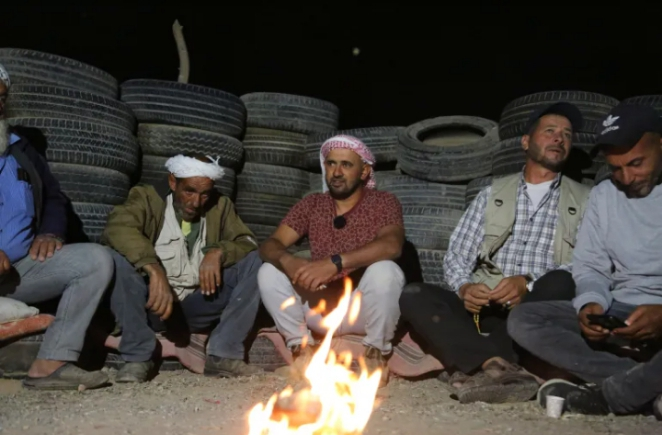
At dusk, night guardians of the mountain in the occupied West Bank gather silently, preparing for hours of watchfulness as darkness settles over villages threatened by settler violence.
In al-Mufaqara, a small village in Masafer Yatta, night no longer signals rest but responsibility, as men abandon sleep to protect families and ancestral land.
The village rests in a rugged landscape south of Hebron, where hills provide both shelter and exposure to nearby settlements expanding relentlessly.
As the sun dips behind the ridges, the guardians climb a strategic hill overlooking homes, fields and grazing areas vulnerable to surprise attacks.
Old tyres form makeshift windbreaks, while flickering torches cast shadows that mirror the uncertainty defining life in the occupied West Bank.
A fire crackles steadily, heating sage tea that simmers all night, sustaining bodies and spirits against winter cold and creeping fear.
Each man has a role, some monitoring movement, others managing alarms, while a few prepare meals to maintain strength through the long vigil.
Laughter occasionally breaks the tension, but every sound echoes uneasily, as silence often signals danger rather than peace.
“Our task isn’t easy, but it’s necessary,” one guardian says quietly, eyes fixed on distant settlement lights.
“The night is ours as long as we guard it,” he adds, summarising their unspoken oath to the village.
Al-Mufaqara is home to roughly 23 families, about 220 people whose livelihoods depend on herding, farming and animal husbandry.
Generations have survived here through simplicity, but repeated demolitions and harassment have turned ordinary life into a daily struggle.
Residents describe relentless attacks involving arson, land seizure, intimidation and, at times, deadly violence.
Awda al-Hathalin, a respected villager, was recently killed by an Israeli settler, deepening collective grief and resolve.
“His death changed everything,” a neighbour says. “It reminded us that no one else will protect us.”
In response, villagers formed the Mountain Guardians Committee, a volunteer group of around 30 young men.
They rotate nightly shifts from sunset to sunrise, observing movements and warning residents of approaching threats.
The elevated hill allows visibility over settlements and newly erected outposts, some illegal even under Israeli law.
Teams coordinate carefully, assigning scouts, cooks, light managers and messengers to ensure constant readiness.
Elders support the effort, delivering coffee or sunflower seeds, symbols of solidarity shared beneath open skies.
“This is how we survive,” an elder explains. “We stand together or we disappear.”
For mothers like Hamida Ali Hamamda, the guards offer fragile reassurance amid unrelenting fear.
The 51-year-old mother of nine remembers a time before terror shaped every decision.
“Life was sweet and simple,” she says, staring at the hills beyond her window.
“Then fear arrived, and it never left.”
Since October 7, 2023, Hamida says settlers storm homes, hurl insults, release livestock onto Palestinian land and threaten displacement.
“They told my husband this is not Palestinian land,” she recalls. “As if history can be erased overnight.”
Families now fortify homes with metal grates, barbed wire and barking dogs to deter intrusions.
“If it weren’t for the guards, we wouldn’t sleep at all,” Hamida says.
“They are our first line of defence.”
Each night, Hamida contributes by sending homemade sweets to the guardians through a village baker.
“They guard us, so we share what little we can,” she explains.
Her granddaughter Asala, just 11, has learned fear before play.
“When settlers attack, we hide in the cave,” the child says, pointing to a hole in the ground.
“In my dreams, they come again. I want school without fear.”
Her grandfather Qassem Hamamda surveys the horizon crowded with new outposts encircling the village.
“Before, there were two settlements,” he says. “Now there are five more.”
“They told me to leave,” he adds. “I told them I will die on my land.”
He credits the protection committee with restoring limited calm.
“I feel safer knowing the young men are watching,” he says, “but winter is harsh, and they need shelter.”
Among those guarding is Muath al-Hamamda, a 32-year-old farmer and father of three.
“We stay awake because attacks at night are the most dangerous,” he explains.
He estimates the committee has reduced attacks by more than 80 percent.
“When settlers see us, they hesitate,” he says.
If alarms sound, plans activate immediately.
One team escorts women and children to underground caves.
Another secures livestock, while others confront settlers until help arrives.
“We know settlers are merciless,” Muath says, “but abandoning land is death to us.”
Nearby, Jalal al-Amour stirs a pot over the fire, cooking for the guards.
The cave behind him was once his family home, now marked by an Israeli flag.
“They forced us out and destroyed everything,” he says bitterly.
“When we complained, police said it was a military zone.”
Cooking nightly is his quiet act of resistance.
“Fire and smoke are all that remain of home,” he says.
As dawn approaches, tired faces soften as light returns to the hills.
Guardians descend quietly, returning to sheep, fields or brief rest.
Between moonrise and sunrise, the night guardians of the mountain in the occupied West Bank have fulfilled their duty.
Their watch embodies survival, solidarity and the refusal to surrender land or identity.
Read also:Collapse: India’s Alang ship-breaking industry faces a slow death as work dries up
About The Author