Nigeria’s financial system recorded a slight contraction in liquidity at the start of 2026 as broad money supply declined marginally in January, reflecting tighter monetary conditions implemented by regulators.
Fresh monetary data released by the Central Bank of Nigeria indicates that the country’s broad money supply — commonly referred to as M3 — fell to about N123.36 trillion in January from roughly N124.4 trillion recorded in December 2025.
The development signals a modest tightening of liquidity within the banking system as the apex bank continues to implement policies aimed at controlling inflation and stabilising the foreign exchange market.
Financial analysts say the slight contraction may also reflect reduced seasonal spending following the heavy cash demand typically experienced during the year-end festive period.
Nigeria money supply decline reflects tighter monetary policy
The Nigeria money supply decline highlights the impact of the monetary tightening measures being pursued by the Central Bank of Nigeria in recent months.
Broad money supply measures the total amount of money circulating within an economy, including cash held by the public, demand deposits, savings accounts, time deposits, and foreign currency deposits within the banking system.
Economists consider this metric an important indicator of overall liquidity conditions and economic activity.
According to the latest statistics, the modest Nigeria money supply decline suggests that policy efforts aimed at managing inflation and exchange rate volatility may gradually be taking effect.
The central bank has intensified liquidity management through instruments such as Treasury bill issuances and open market operations designed to absorb excess funds from the banking system.
These actions are intended to reduce inflationary pressures and support macroeconomic stability.
Cash outside banks drops as festive spending slows
Another notable development accompanying the Nigeria money supply decline is the reduction in cash held outside the banking system.
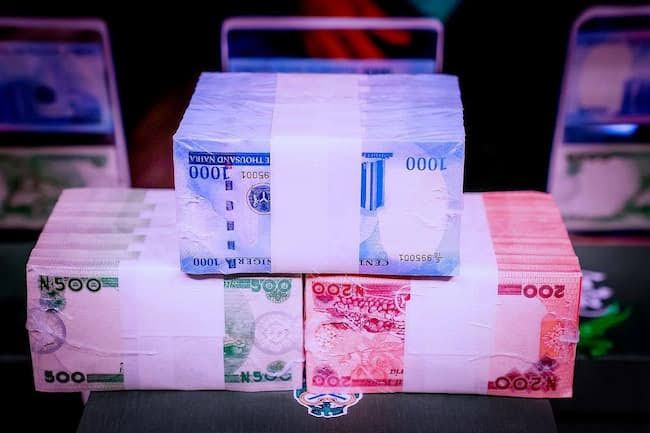
Data from the central bank shows that currency outside banks fell by approximately 3.66 percent to N5.21 trillion in January from about N5.41 trillion recorded in December.
The decline largely reflects reduced consumer spending after the festive season when households typically withdraw more cash to finance travel, celebrations, and other end-of-year activities.
Total currency in circulation also showed slight moderation during the period, settling around N5.73 trillion.
Despite the decline, analysts say Nigeria continues to experience a relatively high level of physical cash usage compared to many other emerging economies.
The persistence of cash transactions is largely linked to the size of the informal sector, which remains a dominant component of the country’s economic activity.
Domestic assets offset decline in foreign assets
A deeper breakdown of the components of money supply reveals diverging trends between foreign and domestic assets within the financial system.
Net foreign assets within the banking sector declined significantly to around N29.6 trillion during the review period.
This reduction was mainly attributed to lower foreign currency holdings amid ongoing adjustments in the external sector.
However, the Nigeria money supply decline was partly cushioned by an increase in net domestic assets, which rose to about N93.76 trillion.
Domestic credit expansion, including lending to government and private sector borrowers, helped sustain overall liquidity levels in the economy.
Economic analysts say this balance between declining foreign assets and rising domestic assets illustrates the complexity of managing monetary conditions in a volatile economic environment.
Seasonal pattern continues in cash demand
Historical trends indicate that fluctuations in currency circulation often follow predictable seasonal patterns in Nigeria.
Cash outside banks tends to rise sharply during the final months of the year due to increased consumer spending and informal sector transactions.
For example, cash outside banks climbed significantly in December 2025 following a steady increase from November.
A similar pattern was observed in previous years as businesses and households increased cash withdrawals during the festive period.
Following the holiday season, however, cash levels typically decline as spending normalises and funds gradually return to the banking system.
The January Nigeria money supply decline therefore aligns with this seasonal cycle observed in the country’s financial system.
Implications for inflation and economic stability
Economists say the contraction in liquidity may support efforts by policymakers to moderate inflation and stabilise the national currency.
Nigeria has been grappling with persistent inflationary pressures, driven by rising food prices, energy costs, and exchange rate volatility.
Reducing excess liquidity within the economy is one of the key tools used by central banks to control price growth.
However, analysts caution that overly aggressive tightening could also slow economic expansion if credit availability becomes too restricted.
Maintaining the right balance between controlling inflation and sustaining economic growth remains a major challenge for policymakers.
Digital payment push faces structural hurdles
The Nigeria money supply decline also highlights ongoing challenges in transitioning the economy toward digital financial systems.
While regulators have promoted electronic payments and financial inclusion initiatives, many Nigerians — particularly in rural communities — continue to rely heavily on cash.
Infrastructure gaps, limited banking access, and low digital literacy levels remain barriers to fully modernising the payment ecosystem.
Financial experts say improving digital infrastructure and expanding financial services could gradually reduce dependence on physical cash.
Such changes would help enhance transparency, strengthen financial inclusion, and improve the effectiveness of monetary policy tools.
For now, the latest liquidity data suggests that the central bank’s tightening measures are beginning to influence money supply trends while the broader economy continues to adjust to evolving financial conditions.
About The Author