Merz China ties came into sharp focus on Wednesday as Germany’s chancellor Friedrich Merz urged closer cooperation with China while pressing Beijing on fairer trade practices and its potential role in ending the war in Ukraine.
Merz arrived in Beijing for a tightly scheduled two-day visit that signals Berlin’s intent to maintain engagement with China despite growing political, economic and strategic tensions. The trip marks his first official visit to China since taking office and comes at a time of heightened scrutiny over Europe’s economic exposure to Beijing.
Meeting China’s top leadership, Merz acknowledged fundamental differences between the two countries but argued that dialogue and cooperation remained essential. He said Germany was prepared to work with China “wherever possible” while also defending European interests and rules-based trade.
The German chancellor’s remarks reflect a broader recalibration in Berlin’s China policy, balancing economic pragmatism with increased caution. Germany remains deeply intertwined with China through trade and investment, yet political pressure has grown to reduce dependencies in critical sectors.
During talks with Chinese president Xi Jinping, Merz highlighted what he described as “great opportunity” in Sino-German relations. He pointed to the shared responsibility of two major industrial economies to contribute to global stability and sustainable growth.
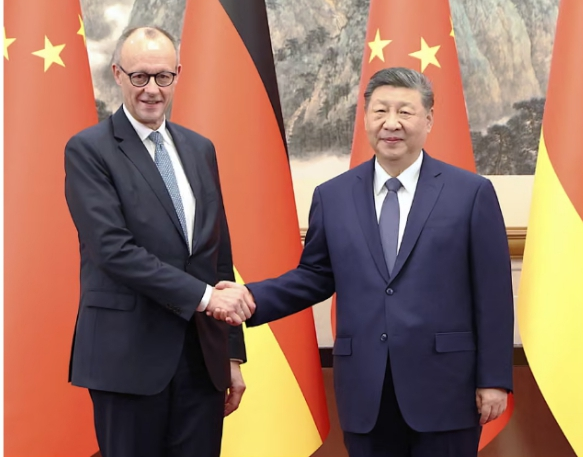
“We are two of the world’s three largest industrial nations,” Merz said, describing the relationship as both a responsibility and an opportunity. His comments underscored Germany’s desire to remain economically competitive while navigating geopolitical realities.
Xi responded by reaffirming China’s commitment to its partnership with Germany. He said Beijing placed high importance on relations with Berlin and expressed readiness to advance the comprehensive strategic partnership to what he called “new levels”.
Chinese state media portrayed the meeting as constructive, emphasising mutual respect and long-term cooperation. Official statements avoided direct reference to points of friction, focusing instead on shared economic interests and multilateral coordination.
Trade, however, remains one of the most sensitive issues in the relationship. German officials have repeatedly raised concerns about market access, industrial subsidies and what they describe as unequal competitive conditions for European firms operating in China.
Merz echoed these concerns, calling for fairer trade rules and reciprocity. German manufacturers, particularly in the automotive and machinery sectors, have warned that heavy Chinese state support for domestic industries is distorting global markets.
The chancellor’s visit comes as the European Union intensifies its scrutiny of Chinese exports, especially electric vehicles and renewable energy technologies. Berlin has sought to balance EU-level trade enforcement with its own economic interests.
Germany is China’s largest trading partner in Europe, and German companies have invested heavily in Chinese production and supply chains. Any abrupt shift in policy could carry significant economic consequences for both sides.
At the same time, German policymakers are under pressure from allies to reduce strategic dependencies, particularly in critical infrastructure, advanced technologies and raw materials. Merz has signalled support for “de-risking” rather than full decoupling.
Ukraine featured prominently in the discussions, reflecting Europe’s expectation that China play a constructive role in ending the conflict. Merz urged Beijing to use its influence to support diplomatic efforts and respect international law.
Germany views China as a key global actor whose position on Ukraine carries weight, particularly given Beijing’s close relationship with Russia. Western officials have repeatedly called on China to distance itself from Moscow’s war effort.
China has positioned itself as a neutral party, calling for peace talks while maintaining economic and political ties with Russia. This stance has drawn scepticism in Europe, where officials question Beijing’s willingness to exert meaningful pressure.
Merz’s decision to raise Ukraine during the visit signals Berlin’s intent to integrate security concerns into its economic diplomacy. It also reflects growing recognition that trade and geopolitics can no longer be treated as separate spheres.
Beyond Ukraine, discussions touched on global challenges such as climate change, supply chain resilience and multilateral cooperation. Both sides emphasised the importance of stability in an increasingly fragmented international system.
Germany has long advocated engagement with China as a means of encouraging responsible global behaviour. However, critics argue that economic interdependence has failed to moderate Beijing’s political positions.
Merz has sought to position himself as pragmatic rather than ideological, arguing that dialogue remains necessary even amid disagreement. His approach contrasts with calls from some European capitals for a more confrontational stance.
Within Germany, the visit has prompted debate over how far economic cooperation should go. Business groups have largely welcomed continued engagement, while human rights organisations have urged a firmer line on political values.
China’s human rights record, including issues related to Xinjiang and Hong Kong, remains a point of contention. German officials have raised these concerns in the past, though they were not central to the public messaging around the visit.
The optics of the trip were carefully managed, with images of Merz and Xi shaking hands broadcast widely. Such symbolism underscores China’s desire to project stable relations with major European economies.
For Berlin, maintaining access to the Chinese market is critical for key export sectors. At the same time, the government is investing in diversification strategies to reduce over-reliance on any single partner.
Merz’s visit also comes as Germany faces domestic economic challenges, including slowing growth and pressure on its industrial base. Strengthening external trade relationships remains a priority for the new chancellor.
European unity is another underlying factor. Germany’s approach to China often shapes broader EU policy, making Merz’s signals closely watched in Brussels and other capitals.
Some EU members favour tougher measures against China, while others prioritise economic engagement. Germany’s position has traditionally leaned toward dialogue, though with increasing emphasis on safeguards.
The chancellor’s comments suggest continuity with past policy, albeit with sharper language on reciprocity and risk management. Whether this balance can be sustained remains an open question.
Chinese officials, for their part, have warned against protectionism and urged Europe to keep markets open. They argue that cooperation, rather than confrontation, is the only viable path forward.
As global competition intensifies, both Germany and China face pressure to protect domestic industries while remaining integrated into global trade networks. This tension was evident throughout the visit.
Merz is expected to brief European partners on the outcomes of his talks, potentially shaping upcoming EU discussions on China policy. His handling of the relationship will be a key test of his foreign policy leadership.
Read also: South Africa secures return of 11 men ‘lured’ into Russia-Ukraine war
While no major agreements were announced, the visit underscored the complexity of modern diplomacy, where economic opportunity and strategic rivalry coexist.
For now, Merz China ties remain defined by cautious engagement, mutual dependence and unresolved disagreements. How these dynamics evolve will have significant implications for Europe’s economic and political future.
About The Author