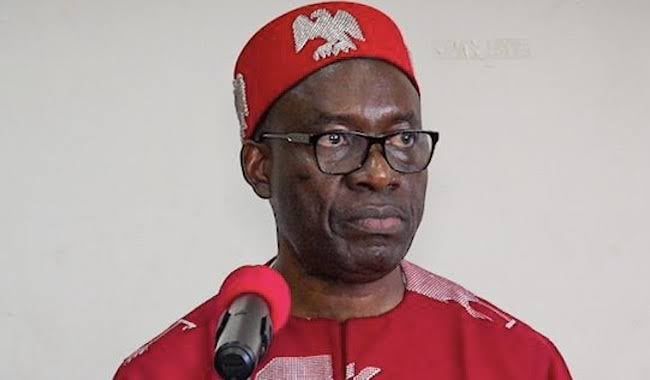
The ongoing cyberstalking case involving 39-year-old Emorioloye Owolemi has stirred conversations about digital expression and legal boundaries in Nigeria.

Owolemi was remanded in correctional custody after being charged in connection with Facebook posts that allegedly targeted the Minister of Interior, Olubunmi Tunji-Ojo.
Court documents obtained from the Federal High Court of Nigeria sitting in Akure indicate that the Federal Republic of Nigeria instituted the case against Owolemi.
The matter, marked Charge No: FHC/AK/3C/26, lists the Federal Government as the complainant, while Owolemi is named as the sole defendant.
According to the charge sheet, the allegations stem from statements allegedly published on Facebook on December 23, 2025.
The posts were reportedly made in Igbokoda, Ilaje Local Government Area of Ondo State.
Prosecutors claim the messages questioned the authenticity of the minister’s academic qualifications and were transmitted to the public through a computer network.
The first count filed against Owolemi accuses him of cyberstalking contrary to Section 24(1)(a) of the Cybercrimes (Prohibition, Prevention, etc.) Act, as amended in 2024.
The prosecution alleges that he knowingly sent electronic communications that were grossly offensive, indecent, obscene, or menacing in character, targeting the Minister of Interior.
The second count relates to alleged cyberstalking by threat and harassment under Section 24(1)(b) of the same Act.
It maintains that Owolemi intentionally disseminated electronic messages to the public in a manner that amounts to harassment under Nigerian law.
Both counts are punishable under the provisions of the amended Cybercrimes Act.
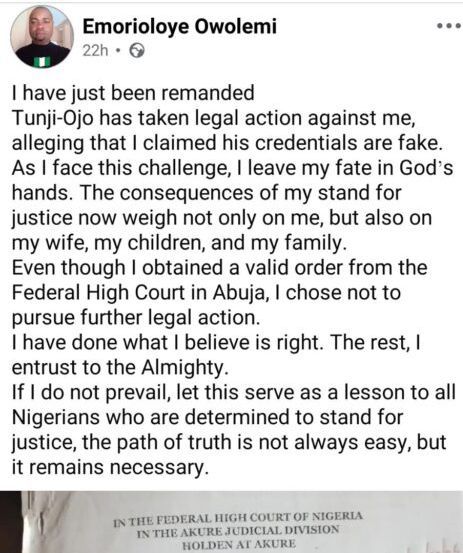
Reacting to the development, Owolemi acknowledged that the legal action followed claims he made online regarding the minister’s credentials.
He stated that the accusations against him arose directly from those publications and expressed disappointment over the turn of events.
In a personal reflection shared after his remand, Owolemi described the situation as deeply challenging.
He noted that the consequences of the cyberstalking charges extend beyond his personal circumstances and have affected his immediate family.
According to him, his wife, children, and relatives are also bearing the weight of the legal battle.
Owolemi further disclosed that he had previously secured an order from the Federal High Court in Abuja.
However, he said he chose not to pursue further legal steps at that time.
In his words, he believes he acted based on his understanding of justice and has decided to leave the outcome of the case in God’s hands.
Legal observers note that the matter underscores the expanding role of Nigeria’s cybercrime legislation in regulating online conduct.
The amended Cybercrimes Act has increasingly been invoked in cases involving digital publications, especially when public officials are involved.
The present cyberstalking prosecution may therefore become another reference point in discussions about freedom of expression and accountability in the digital age.
While the minister has not publicly detailed his position beyond initiating legal proceedings, the prosecution’s stance is clearly outlined in the court filings.
The government contends that the content of the Facebook posts crossed the threshold from permissible commentary into criminal conduct as defined by statute.
The case also raises broader questions about how citizens engage with public figures online.
Social media platforms have become central spaces for political debate and civic scrutiny.
However, legal experts caution that statements perceived as threatening, abusive, or defamatory may attract criminal liability under existing laws.
For now, Owolemi remains in custody pending further proceedings. The court is expected to determine whether the evidence presented by the prosecution satisfies the legal requirements for conviction under the cyberstalking provisions cited in the charges.
As the matter unfolds, many Nigerians are closely watching the developments.
The outcome could influence public understanding of digital rights, responsible speech, and the limits imposed by cybercrime legislation.
Whether the charges will ultimately be sustained in court remains to be seen, but the case has already sparked debate about the balance between protecting reputations and preserving open dialogue in the digital sphere.

About The Author