

Lithuania declares state of emergency over balloons from Belarus as the Baltic nation confronts persistent aerial incursions that have disrupted flights, strained border operations, and raised urgent national security concerns.
The unprecedented measure follows months of rising tension during which Belarus smuggler balloons laden with contraband routinely entered Lithuanian airspace, prompting strong diplomatic protests and intensified security monitoring.
Authorities say the pattern of incursions aligns with broader regional instability and contributes to an escalating Lithuania border security crisis that now requires an elevated government response.
Officials confirm that Lithuanian airspace has seen dozens of unauthorised balloon flights, many carrying smuggled cigarettes, prompting fears that hostile actors may be testing the country’s defensive readiness.
The government emphasised that the emergency declaration is not merely administrative but represents a strategic posture shift based on a comprehensive assessment of hybrid threats from Belarus.
Interior minister Vladislav Kondratovič explained that national institutions must now operate under special coordination powers to prevent further Vilnius airport disruptions caused by repeated airborne intrusions.
He told a government meeting that the breaches represent more than smuggling operations, arguing that state-linked groups may be leveraging low-cost tools to destabilise Lithuanian civil aviation.
Officials said the balloons had been used tactically to evade radar detection while affecting commercial airspace, forcing temporary flight suspensions and causing logistical difficulties for airlines.
In recent months, Vilnius airport disruptions have grown severe enough to attract international attention, with several closures linked directly to balloon-related safety risks that jeopardised routine flight operations.
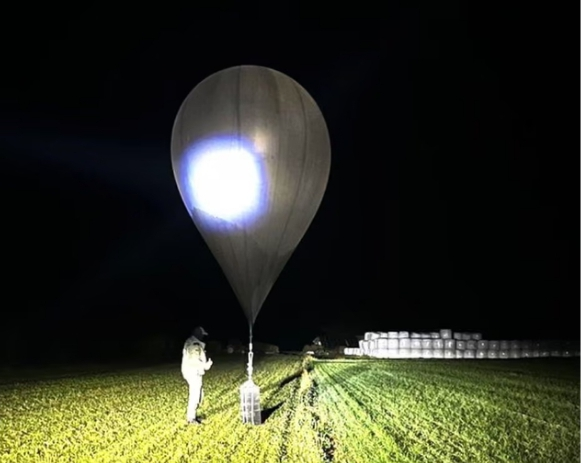
A State Border Guard Service photograph showed officers inspecting a large contraband-carrying balloon, underscoring the scale and organised nature of the cross-border incidents.
Security analysts say Belarus smuggler balloons demonstrate a low-tech but effective method for testing Lithuanian response protocols while generating economic and operational strain on the country.
Kondratovič noted that Lithuania declares state of emergency over balloons from Belarus not solely because of aviation concerns but due to mounting fears about Baltic national security tensions.
Government leaders argue that the incursions constitute a coordinated hybrid attack designed to erode public confidence and disrupt routine governance in a strategically vulnerable NATO member.
Parliament is now being asked to formally authorise military deployment alongside police, border guards, and internal security units for enhanced response capabilities under the emergency framework.
Military officials say they are prepared to assist with airspace monitoring, rapid response operations, counter-balloon interception, and logistical coordination with civil authorities if granted parliamentary approval.
The government insists the measure is defensive, temporary, and necessary to protect critical infrastructure, especially airports and border crossings that have faced persistent disruption episodes.
Border agencies report that the balloons originate deep within Belarusian territory, often launched from remote locations close to forested regions that complicate tracking and interdiction efforts.
Lithuanian officials argue that the timing and scale of the activity indicate involvement or tacit approval by Belarusian state structures, an allegation Minsk forcefully denies.
Belarus has accused Lithuania of fabricating the crisis, describing the emergency declaration as politically motivated and alleging that Lithuania is escalating tensions unnecessarily.
Minsk officials further claim that Lithuania recently used a drone to drop extremist material inside Belarus, an allegation Lithuania strongly rejects as disinformation.
Diplomatic relations between the two neighbours have deteriorated significantly in recent years, fuelled by disputes over migration, sanctions, espionage claims, and now balloon-based airspace breaches.
Experts say these balloon incidents reflect broader Baltic national security tensions shaped by Russian geopolitical ambitions and Belarus’s deepening alignment with Moscow.
Lithuanian defence analysts warn that hybrid attacks often begin with low-level provocations aimed at probing vulnerabilities before evolving into more sophisticated pressure tactics.
The emergency decree grants authorities flexibility to quickly restrict access to sensitive areas, enhance intelligence coordination, and deploy personnel to prevent further incidents.
Officials say they will also strengthen aerial surveillance networks, including radar upgrades, drone detection tools, and cooperation with neighbouring NATO air forces.
The State Border Guard Service has increased patrols along the frontier and stepped up monitoring for signs of balloon launches or suspicious logistics movement inside Belarus.
Security personnel are using thermal imaging, night-vision equipment, and rapid-response vehicles to intercept balloons before they drift into densely populated urban zones.
Environmental conditions have sometimes aided the smugglers, with favourable winds allowing balloons to travel significant distances undetected until they enter key transportation corridors.
The government fears that even if the balloons carry only cigarettes, their ability to disrupt aviation represents a systemic vulnerability that adversaries could exploit more seriously.
Smuggling networks in the region are known to adapt rapidly to enforcement changes, and authorities believe the balloons may soon be used for more than transporting contraband.
Some intelligence reports suggest that criminal syndicates and politically motivated groups within Belarus may be collaborating to destabilise the Lithuanian security environment.
Kondratovič emphasised that Lithuania declares state of emergency over balloons from Belarus only after exhausting routine diplomatic and enforcement channels without achieving meaningful de-escalation.
International observers say the situation highlights the evolving nature of modern hybrid warfare, where inexpensive civilian tools can trigger major geopolitical consequences.
Lithuania is now urging the European Union to issue a collective condemnation of Belarus smuggler balloons and coordinate broader regional countermeasures.
EU officials expressed concern about the implications for aviation safety, internal security, and the integrity of the Schengen border zone, promising further consultations.
NATO spokespersons noted that they are monitoring developments closely but stressed that Lithuania retains sovereign authority to enact emergency measures for national protection.
Aviation experts warn that even small objects drifting into controlled airspace can force costly flight diversions, ground delays, and heightened risk during takeoff or landing.
Vilnius airport disruptions have already caused missed connections, passenger frustration, and additional expenditure for carriers forced to adjust schedules at short notice.
Economic analysts predict that prolonged instability may affect tourism, freight logistics, and business confidence if not addressed decisively.
Neighbouring Poland and Latvia have expressed solidarity with Lithuania, acknowledging that similar provocations could threaten their own border security in the future.
The Lithuanian government insists that the emergency will remain in effect only until balloon incursions stop and airspace safety is fully restored.
Officials maintain that clear evidence links repeated incidents to Belarusian territory, even if Minsk denies operational responsibility or geopolitical motive.
Regional security specialists say the current tensions demonstrate how everyday objects like balloons can become tools for strategic disruption in contested border zones.
The crisis underscores the delicate balance of power along the eastern frontier of the European Union, where political alliances strongly influence security dynamics.
Lithuania says it will continue to coordinate with allies to ensure that Baltic national security tensions do not escalate into broader confrontation.
Government leaders argue that demonstrating resilience against hybrid threats is essential to maintaining stability, economic continuity, and public confidence.
Military planners have begun drafting contingency protocols for rapid response if balloon incursions evolve into more complex aerial provocations.
Intelligence agencies continue to analyze launch patterns, weather data, and smuggling networks in an effort to predict future balloon operations.
The State Border Guard Service reports that its teams remain on high alert and are equipped to respond rapidly to any new violations of Lithuanian airspace.
Authorities reaffirmed that Lithuania declares state of emergency over balloons from Belarus as part of a coherent national security doctrine shaped by recent regional instability.
Officials believe decisive action now will deter future provocations and strengthen long-term security resilience along one of Europe’s most sensitive geopolitical frontiers.
The emergency remains open-ended, with government leaders promising regular reviews based on threat levels, regional developments, and diplomatic outcomes.
As the crisis unfolds, Lithuania continues urging Belarus to halt balloon activity and engage constructively to prevent further deterioration of bilateral relations.
Despite official denials from Minsk, Lithuanian leaders remain convinced that the incursions form part of a coordinated effort to undermine national security.
Observers warn that failure to curb the balloon operations could embolden other hybrid actors across the region to pursue similarly disruptive tactics.
The government maintains that protecting aviation, border operations, and national institutions requires clear, immediate, and robust intervention under emergency authority.
Ultimately, Lithuania declares state of emergency over balloons from Belarus as part of a broader strategy to safeguard sovereignty and ensure uninterrupted functioning of critical infrastructure.


