After suffering four straight defeats, Liverpool captain Virgil van Dijk took decisive action to address the leadership crisis, calling a separate, players-only meeting to spark an immediate turnaround in form.
The modern game places immense scrutiny on managers, but when a superclub like Liverpool faces its worst run of form in years, the burden of internal stability falls squarely on the players’ leadership.
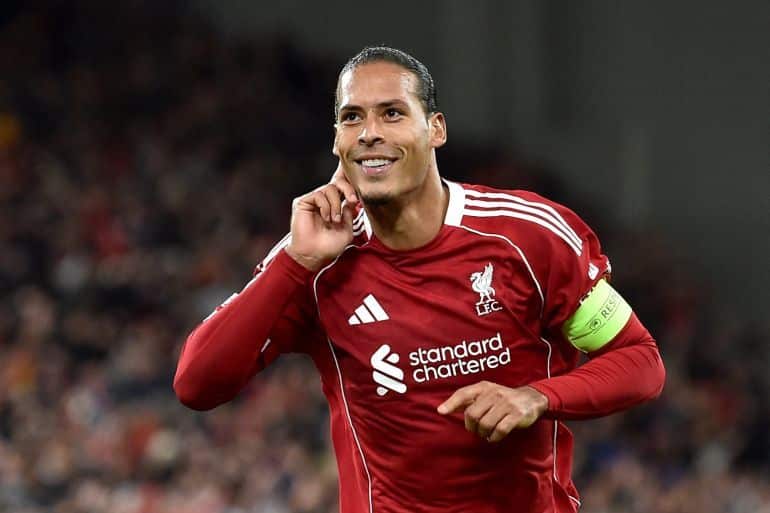
Captain Virgil van Dijk recently revealed the defining moment of internal accountability that followed the damaging 2-1 defeat to fierce rivals Manchester United: a private, players-only debrief, called explicitly to confront the growing Leadership Crisis at the club.
The loss to United capped a shocking sequence of four consecutive defeats across all competitions—an almost unthinkable slump for the Premier League giants. With external noise reaching a fever pitch and media speculation of a genuine ‘crisis’ mounting, the danger was that internal friction would mirror the external chaos. Van Dijk’s immediate response was a classic act of captaincy.
The double debrief: managerial vs. Player leadership
Van Dijk confirmed the standard procedure took place: “After Man United game, we had a proper debrief with the manager but we also had a separate one as players.”
This two-tiered response is crucial to understanding high-level team management. The formal debrief with manager Arne Slot is tactical—a forensic analysis of errors, structure, and system failures.
It addresses what went wrong and how to fix the mechanics of the team.
The players’ meeting, however, served a deeper, more personal purpose. “I wanted to say some things. It’s not something I do after every game. Let’s keep it that way,” Van Dijk stated.
By stepping forward and demanding a conversation away from the coaching staff, the captain enforced an internal accountability that cannot be dictated from above. It was an opportunity for players to address issues of effort, mentality, and collective spirit directly with one another.
This was an exercise in player leadership, creating a safe but honest space where uncomfortable truths could be aired without fear of impacting team selection or career prospects. This moment of confrontation was essential for clearing the air and re-establishing the non-negotiable standards of a title-challenging side.
Blocking out the noise: A call for mental fortitude
The captain’s public comments emphasized the psychological aspect of their downturn, stressing the need to control internal reactions: “We had to stay calm and block out all the noise from the outside because that’s something you can’t control.”
This message was a strategic mandate for focus. During a losing streak, every training session, every misplaced pass, and every defensive lapse is magnified by an expectant fanbase and a demanding media.
Van Dijk recognized that allowing this external pressure to infiltrate the dressing room would be fatal. His Leadership Crisis solution was, therefore, to demand unity and an almost monastic focus on the task at hand.
The only way to stop the negative spiral, he insisted, was to circle the wagons, trust the process, and rely on the character within the squad. This commitment to ‘controlling the controllable’—effort, attitude, and cohesion—was the central theme of his Leadership Call.
The result in Frankfurt confirmed that Van Dijk’s intervention was more than mere talk. It was a decisive demonstration of captaincy that directly impacted performance. In an era where managers often dominate the narrative, Van Dijk reminded the football world that genuine player leadership remains the most crucial factor in navigating the emotional and performance peaks and troughs of a long season.
Read more at: ireport247news.com
About The Author