
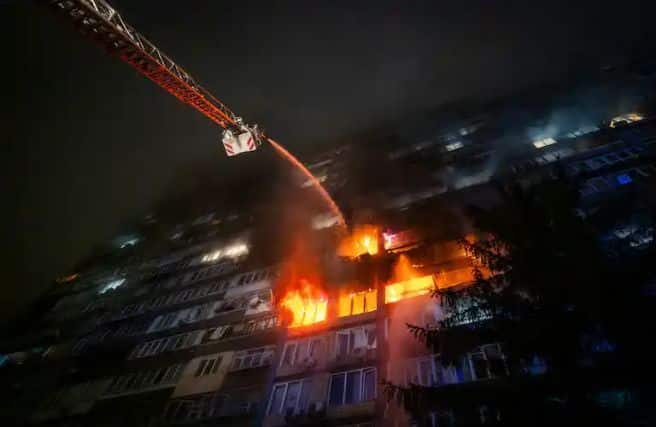
Power was restored to more than 800,000 Kyiv residents on Saturday, following a major Russian offensive that targeted Ukraine’s energy infrastructure and caused widespread blackouts.
Ukraine’s largest private energy company, DTEK, confirmed “the main work to restore the power supply” had concluded, but some localized outages continued to affect the capital.
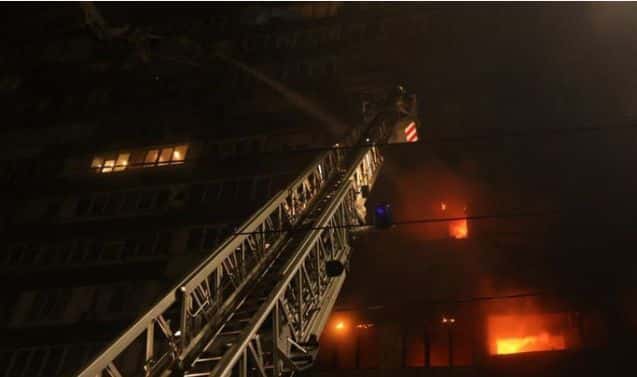
The Russian attacks, which occurred early Friday, involved drones and missiles that damaged residential buildings, wounded at least 20 civilians, and disrupted electricity across swaths of Ukraine.
Prime Minister Yulia Svyrydenko described the offensive as “one of the largest concentrated strikes” ever against Ukraine’s power network, underlining the scale of the ongoing energy war.
Russia’s Defense Ministry said its strikes targeted energy facilities supplying Ukraine’s military, claiming use of Kinzhal hypersonic missiles and strike drones against key infrastructure.
The energy sector has been a strategic target since Russia launched its all-out invasion over three years ago, repeatedly attempting to weaken morale before winter.
Winter temperatures in Ukraine fall from late October through March, with January and February the coldest, heightening the stakes of electricity outages for millions of civilians.
Ukrainian President Volodymyr Zelenskyy criticized Russia for exploiting global attention on Middle East peace talks, urging stronger air defense systems and tighter sanctions against Moscow.
“Russian assets must be fully used to strengthen our defense and ensure recovery,” Zelenskyy said in a video posted to X, emphasizing the need for robust international support.
Meanwhile, British Prime Minister Keir Starmer, French President Emmanuel Macron, and German Chancellor Friedrich Merz issued a joint statement pledging to use frozen Russian sovereign assets in coordination.
The European leaders said the assets would support Ukraine’s armed forces, aiming to pressure Russia into negotiations while working closely with the United States on strategy.
Ukraine’s projected budget and military requirements for 2026 and 2027 are estimated at 130 billion euros ($153 billion), illustrating the scale of resources needed for defense and reconstruction.
Since the war began in February 2022, the European Union has contributed 174 billion euros (around $202 billion) in support, demonstrating a significant ongoing commitment to Ukraine.
Frozen Russian assets remain the largest untapped source of funding, with Belgium holding approximately 194 billion euros ($225 billion) as of June, along with additional sums in Japan, the U.S., the U.K., and Canada.
Ukraine’s air force reported that it intercepted or jammed 54 of 78 Russian drones launched overnight, highlighting the ongoing intensity of attacks and Ukraine’s defensive capabilities.
Meanwhile, Russia claimed to have shot down 42 Ukrainian drones over its own territory, underscoring the cross-border aerial engagements fueling this phase of the conflict.
Zelenskyy said he had a “very positive and productive” phone call with U.S. President Donald Trump, discussing measures to reinforce Ukraine’s air defense against Russian attacks.
In his X post, Zelenskyy stressed the importance of real diplomacy backed by strength, saying discussions with Trump focused on opportunities to strengthen Ukraine’s defensive systems.
The repeated Russian targeting of energy infrastructure signals a deliberate strategy to weaken Ukraine ahead of the harsh winter months, a tactic observed in prior years.
Energy restoration efforts by Ukrainian companies, including DTEK, remain critical to civilian survival and national morale, with rapid repairs following major attacks considered essential to resilience.
European leaders’ willingness to use frozen Russian assets reflects a broader strategy to support Ukraine’s defense financially while leveraging pressure on Moscow to enter negotiations.
The coordination of funds across multiple nations emphasizes the high stakes of the conflict and underscores Ukraine’s need for consistent, substantial international backing.
While Kyiv restores power, ongoing attacks demonstrate the persistent threat to Ukrainian infrastructure and civilians, and the continued strategic importance of European and U.S. support.
Zelenskyy’s engagement with international leaders reflects Ukraine’s strategy of combining defensive readiness with diplomatic leverage, emphasizing strength and preparedness as essential to security.
As winter approaches, Ukrainian authorities stress that timely restoration of electricity is vital for hospitals, residential areas, and heating systems, highlighting the critical human impact of energy attacks.
Russia’s use of hypersonic missiles and drones represents an escalation in the type of warfare targeting civilian and military infrastructure, prompting international condemnation and calls for further sanctions.
Coordination among European powers and the United States to deploy frozen Russian assets marks a historic step in financial and military support for Ukraine, aiming to maintain operational readiness.
Ukraine’s capacity to intercept drones and restore electricity rapidly demonstrates both technological capability and strategic resilience, proving vital in the face of ongoing Russian offensives.
Officials say the international community must act decisively, leveraging frozen assets and sanctions, to ensure Ukraine can sustain its defense and recover quickly from recurring attacks.
The scale of attacks on Ukraine’s energy infrastructure, combined with European financial commitment, signals a continuation of high-stakes engagement with potentially far-reaching consequences for regional stability.
About The Author





