
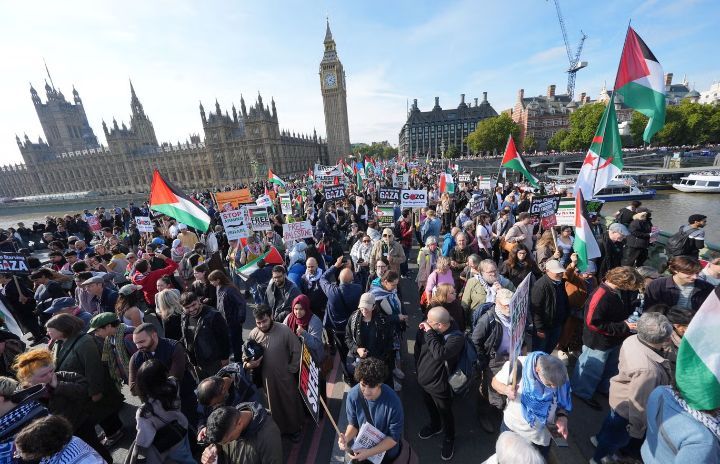
Tens of thousands flooded central London streets on Saturday in a massive pro-Palestinian protest in London, marking two years since the Gaza war erupted in devastation.
The demonstration surged through Embankment and Westminster as banners, chants, and keffiyehs filled the autumn air, demanding “justice for Gaza” and “freedom for Palestine,” echoing global outrage.
Organised by the Palestine Solidarity Campaign, the pro-Palestinian protest in London drew demonstrators from across Britain in one of the largest marches since the 2023 escalation.
Chants of “from the river to the sea, Palestine will be free” reverberated through the city as thousands waved Palestinian flags and held placards denouncing Israel’s military actions.
“It’s not a crime to act against genocide,” read one sign, reflecting the uncompromising anger of protesters who accuse Western governments of complicity in Gaza’s destruction.
A woman in a mobility scooter led the crowd, carrying a sign reading “Palestine. Freedom peace,” while a mannequin behind her wore a keffiyeh — a striking symbol of resilience.
Police estimated hundreds of thousands might attend as the pro-Palestinian protest in London swelled through Embankment toward Whitehall, prompting extraordinary security coordination from Scotland Yard.
Officers imposed conditions under the Public Order Act, restricting movement and preventing potential clashes between pro-Palestinian marchers and a smaller pro-Israel counter-demonstration nearby.
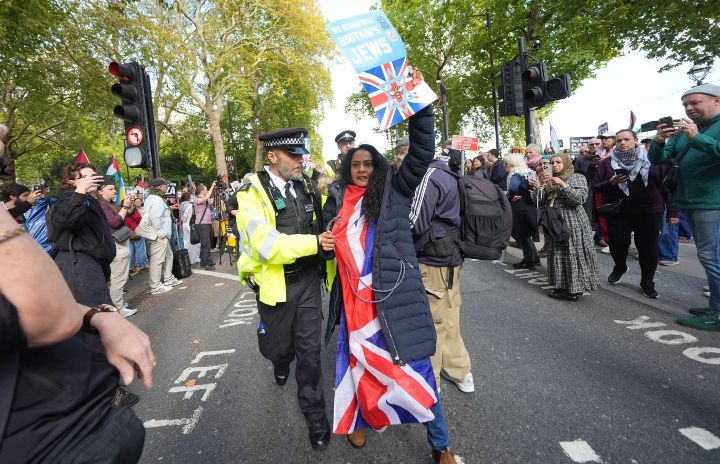
Several counter-protesters holding “We stand with Britain’s Jews” placards were escorted away by police after tensions spiked at Victoria Embankment just before midday, witnesses confirmed.
“Shame!” protesters shouted, waving Palestinian flags as police intervened, adding to the already charged atmosphere surrounding the politically fraught pro-Palestinian protest in London.
Among those leading the march was former Labour leader and Your Party co-founder Jeremy Corbyn, walking alongside organisers under a massive banner reading “National March — Free Palestine.”
Corbyn remained mostly silent but joined chants of “Palestine will be free” when the lead speaker shouted “Netanyahu, you will see,” a defiant cry echoing over Westminster Bridge.
The pro-Palestinian protest in London coincided with renewed diplomatic movement in the Middle East following a fragile U.S.-brokered ceasefire between Israel and Hamas that began Friday.
Thousands of Palestinians have reportedly begun returning to the ruins of their homes in Gaza, even as uncertainty clouds the ceasefire’s durability after two years of bloodshed.
“This protest is not just about Gaza; it’s about decades of occupation,” said activist Samira Khan. “Ceasefire or not, Palestinians still live without justice or sovereignty.”
Police said conditions were “necessary to prevent serious disruption” while affirming the right to protest, noting both rallies were under close surveillance to ensure public safety.
The Metropolitan Police’s visible presence, including mounted units and drones, reflected growing government pressure to curb mass demonstrations viewed as disruptive or inflammatory.
Home Secretary Shabana Mahmood recently pledged new powers for police to restrict protests by considering the “cumulative impact” of repeated large-scale demonstrations across the capital.
Officials claim such gatherings, including the pro-Palestinian protest in London, have caused “considerable fear” among Britain’s Jewish community, prompting a debate over free expression versus public safety.
Protest organisers, however, rejected those assertions as “a deliberate attempt to silence dissent” and vowed continued marches until “Palestinian rights are fully recognised under international law.”
“This movement won’t be intimidated,” said PSC director Ben Jamal. “We will march until Britain ends its support for Israel’s oppression and recognises Palestine’s right to exist.”
The government has also hinted at a crackdown on certain protest slogans, notably “from the river to the sea,” which some interpret as antisemitic and calling for Israel’s eradication.
Protesters dismissed that argument, saying the chant represents a call for equality across all of historic Palestine — “freedom for all people, not destruction of one nation.”
“There’s an effort to criminalise Palestinian identity,” said student organiser Layla Mansour. “When we say ‘from the river to the sea,’ we mean justice without apartheid.”
As the march reached Westminster, police formed cordons separating pro-Israel demonstrators carrying banners that read “Peace for both peoples” and “Stop Hamas terror.”
The pro-Palestinian protest in London unfolded peacefully for the most part, though scattered confrontations were reported between individuals shouting opposing slogans near Trafalgar Square.
Scotland Yard said officers arrested a small number of participants “for public order offences,” but confirmed the overall event remained largely non-violent and well-organised.
For many attending, the protest was personal — a direct response to images of destroyed Gaza neighborhoods and mass civilian casualties that have haunted headlines for two years.
“Every bomb that fell on Gaza tore through our conscience,” said British-Palestinian marcher Ahmed Nasser. “Today, London stands for those who can’t speak under the rubble.”
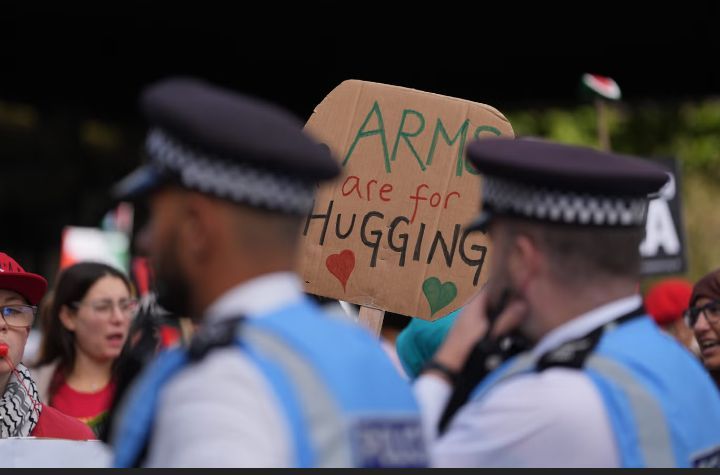
The pro-Palestinian protest in London was the 32nd national demonstration in support of Palestine since October 2023, underscoring how the movement has endured despite government disapproval.
Rallies began at Embankment, passed along Whitehall, and culminated in speeches outside Downing Street, where demonstrators accused Prime Minister Keir Starmer of “having blood on his hands.”
Placards condemned Labour’s stance on Israel, echoing accusations that Britain’s foreign policy continues to shield Israeli leadership from accountability over alleged war crimes in Gaza.
At least 500 people were detained in earlier protests on suspicion of supporting banned organisations, raising concerns over political policing and the suppression of pro-Palestinian activism.
Human rights groups have criticised authorities for what they describe as “selective enforcement” targeting Muslim and Arab demonstrators more aggressively than other political movements.
The scale of Saturday’s pro-Palestinian protest in London reaffirmed that despite the ceasefire, public anger over Gaza’s humanitarian collapse remains deeply rooted in British society.
Speakers at the rally demanded sanctions on Israel, an arms embargo, and recognition of Palestinian statehood — echoing calls made at the United Nations over the past year.
“The war may have paused, but the suffering hasn’t,” said Labour MP Zarah Sultana. “Our government must stop selling weapons that are used to bomb Palestinian families.”
Crowds erupted in applause as organisers reminded them of Gaza’s death toll — more than 35,000 killed, according to Palestinian authorities — and the ongoing displacement crisis.
Analysts say the timing of the protest, coming days after the ceasefire, underscores widespread skepticism about whether Washington’s mediation can deliver any lasting peace.
For demonstrators, the pro-Palestinian protest in London was both commemoration and warning — a reminder that Western complicity continues to fuel cycles of violence and despair.
By dusk, chants of “Free, free Palestine” echoed down Whitehall as thousands held phone lights aloft, illuminating a movement refusing to fade into silence.
One marcher summed up the sentiment bluntly: “If London doesn’t speak, Gaza dies unheard. This protest tells the world — Palestinians will not be erased.”
Despite warnings of tougher laws, activists vowed more protests across Britain, saying solidarity with Gaza would not be intimidated or legislated out of public consciousness.
“This isn’t just politics,” said protester Tariq Hussain. “It’s humanity. And if humanity offends power, then power has failed.”
As crowds dispersed peacefully, the message of the pro-Palestinian protest in London remained clear — the fight for Palestinian freedom continues, on Britain’s streets and beyond.
About The Author





