Israeli death penalty bill violates international law, Palestinian analysts say, as critics argue the proposal formalises lethal punishment against Palestinians under occupation, breaching global humanitarian conventions.
Palestinian legal experts describe the Israeli death penalty bill violates international law framework as discriminatory, arguing it targets one population while shielding others from equivalent accountability and judicial scrutiny.
The proposed legislation emerged amid intensified conflict, prisoner abuses, and political rhetoric that rights groups say normalises extreme measures against Palestinians held in Israeli custody.
According to analysts, the bill empowers Israeli civil and military courts to impose capital punishment for crimes defined by political or nationalistic motives.
Such definitions, Palestinian lawyers argue, are vague, elastic, and easily applied to criminalise resistance while excluding comparable acts committed by Israeli citizens.
The Israeli death penalty bill violates international law by undermining due process, critics say, removing longstanding safeguards that previously limited irreversible sentences.
Under the draft, judicial panels would no longer require unanimous decisions before imposing death sentences on Palestinian defendants convicted of killing Israelis.
The bill also strips executive authorities of pardon powers, eliminating a final layer of review traditionally considered essential in capital cases worldwide.
Palestinian prisoners already endure harsh detention conditions, with rights organisations documenting deaths, medical neglect, and alleged torture within Israeli prisons.
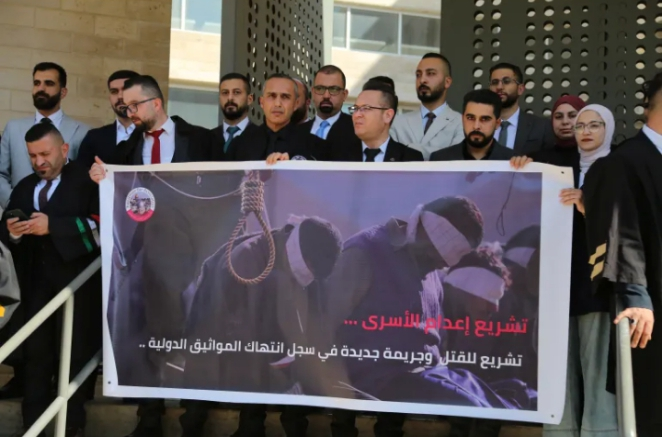
Analysts argue the bill risks transforming these existing abuses from unofficial practices into formally sanctioned outcomes endorsed by legislation.
Farid al-Atrash of the Independent Commission for Human Rights warned the law punishes Palestinians for pursuing self-determination under occupation.
He said the Israeli death penalty bill violates international law by treating political struggle as a criminal act warranting execution rather than protected resistance.
Palestinian activists fear the proposal signals a broader attempt to erase their status as protected persons under international humanitarian law.
Under the Geneva Conventions, occupied populations retain specific protections, including prohibitions on execution without stringent legal guarantees.
Legal scholars stress that international law restricts capital punishment, particularly in occupied territories governed by military courts.
The Israeli death penalty bill violates international law, they argue, because it applies discriminatory standards and denies Palestinians equal legal protections.
Hassan Breijieh of the Wall and Settlements Resistance Commission described the bill as legislation designed to normalise killing through formal legal mechanisms.
He said the move reframes Palestinian fighters as ordinary criminals, stripping their actions of political context recognised under international norms.
Amjad al-Najjar from the Palestinian Prisoners’ Club called the bill a double violation, combining racism with breaches of humanitarian law.
He argued that executing detainees from an occupied population contradicts established legal principles governing warfare and occupation.
Former judge Saeed al-Awiwi highlighted how access to lawyers for Palestinian detainees has steadily diminished in recent years.
He warned that without adequate legal representation, the risk of wrongful convictions and irreversible punishment increases dramatically.
The Israeli death penalty bill violates international law, al-Awiwi said, because it codifies execution amid systemic denial of fair trial guarantees.
Israeli officials defending the bill claim it serves as a deterrent against attacks and aims to enhance national security.
Government committees argue that harsher penalties will discourage violence and protect Israeli civilians from future harm.
Human rights organisations dispute this rationale, citing global evidence that capital punishment fails to deter politically motivated violence.
Amnesty International and other groups have condemned the bill as institutionalised discrimination targeting Palestinians exclusively.
They note that Israeli perpetrators of violence against Palestinians rarely face equivalent penalties or convictions.
This disparity, critics argue, illustrates how the Israeli death penalty bill violates international law through unequal application of justice.
International legal experts warn that the bill could expose Israel to increased scrutiny and potential accountability mechanisms abroad.
Universal jurisdiction principles allow foreign courts to investigate grave breaches of humanitarian law committed in occupied territories.
By legalising executions, analysts say Israel risks reinforcing claims of systemic violations rather than isolated misconduct.
Palestinian communities view the proposal as part of a wider pattern of punitive legislation enacted by far-right political factions.
These measures, they argue, aim to entrench control over occupied territories while suppressing dissent through fear.
The Israeli death penalty bill violates international law by collapsing distinctions between combatants, civilians, and protected detainees, lawyers insist.
Such collapse undermines the post-World War II legal order designed to prevent abuses against occupied peoples.
Experts caution that once executions are normalised, other extraordinary measures may follow under the guise of security.
They warn that legal thresholds for lethal punishment could gradually expand to encompass broader categories of Palestinian activity.
For families of prisoners, the bill intensifies existing anxieties about detention, trial fairness, and survival under occupation.
Many fear loved ones could face death sentences following proceedings lacking transparency and independent oversight.
The Israeli death penalty bill violates international law, analysts reiterate, because occupation authorities lack legitimacy to impose such punishments.
They argue no occupying power holds moral or legal authority to execute those resisting its control.
Palestinian leaders say the proposal challenges the credibility of international institutions tasked with upholding humanitarian standards.
Read also: US seizes second oil tanker off Venezuela’s coast as tensions escalate over Trump blockade
Failure to respond, they warn, could signal tolerance for eroding protections afforded to occupied populations globally.
Ultimately, the debate reflects broader questions about justice, power, and whether international law can restrain states during protracted conflicts.
For Palestinians, the bill represents a decisive moment testing whether global norms endure or yield to political expediency.