The Israel Iran conflict intensified sharply on Sunday as expanding airstrikes, missile exchanges and political threats pushed the region closer to a wider confrontation.
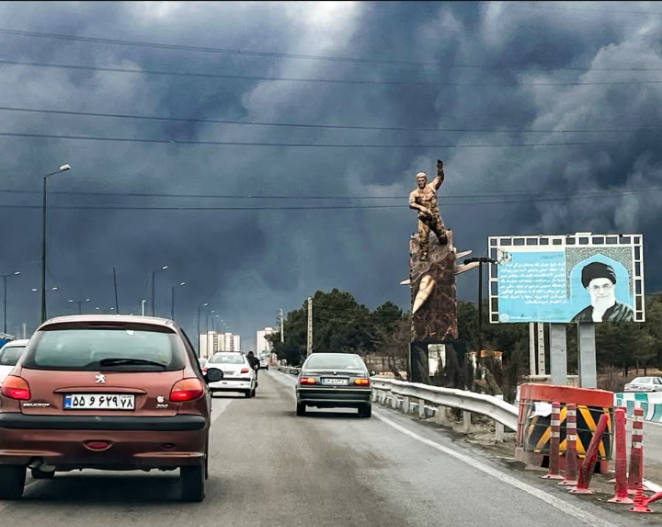
Thick black smoke covered large parts of the skyline in Tehran after coordinated strikes hit multiple oil storage and fuel facilities around the Iranian capital, marking one of the most significant attacks on the country’s energy infrastructure since hostilities escalated.
Iranian officials confirmed that at least five oil-related sites were struck overnight. Authorities said the facilities suffered serious damage but emergency crews were able to contain the fires after several hours.
Images from the capital showed dense smoke clouds drifting over highways and residential districts, disrupting traffic and raising concerns about air pollution and civilian safety.
The attacks form part of a broader campaign targeting Iran’s fuel and energy network, infrastructure considered essential for transportation, electricity generation and military logistics.
Security analysts say continued strikes on oil depots and refining facilities could weaken Iran’s domestic supply chains and complicate its ability to sustain prolonged military operations.
Tensions escalated further after the Israeli military issued a direct warning regarding Iran’s political leadership. Israeli officials declared they would pursue any individual involved in appointing a successor to Ali Khamenei, who was reported killed in joint operations conducted by Israel and the United States.
The statement represents one of the clearest indications yet that Israel’s strategy may expand beyond military targets to include political decision-makers linked to Tehran’s leadership structure.
In Tehran, a powerful clerical body responsible for selecting the country’s next supreme leader reportedly reached a decision but did not publicly reveal the chosen figure.
The delay in announcing a successor has intensified speculation about internal political negotiations and concerns over how leadership changes during wartime could influence Iran’s military posture and diplomatic calculations.
Israeli leaders responded by stating that political transition would not shield decision-makers from military action if they continued to support hostile operations. The warning underscored Israel’s intention to prevent Iran from reorganizing its command structure in ways that could sustain or intensify regional attacks.
The humanitarian toll of the conflict continued to rise beyond Iran’s borders. Lebanon’s health ministry reported that fatalities from Israeli airstrikes over the past week climbed significantly, with women and children representing a substantial portion of those killed.
Medical services across parts of the country remain under heavy strain as emergency units respond to repeated bombardments.
In Beirut, an airstrike hit a hotel on Sunday, killing at least four people according to Lebanese health officials. Rescue teams searched through damaged sections of the building while ambulances transported injured civilians to nearby hospitals already struggling with limited capacity and supply shortages.
Iran’s health ministry also released updated casualty figures, stating that hundreds of civilians have been killed since large-scale military operations began.
Officials said many of the victims were women and children and reported extensive damage to hospitals, emergency centers and medical supply networks. The destruction of healthcare infrastructure has made it more difficult to treat the wounded and respond quickly to new strikes.
International criticism intensified as reports of civilian harm mounted. Martin Pfister, Switzerland’s defence minister, said the United States and Israel had violated international law through their military actions on Iranian territory.
Switzerland has traditionally maintained neutrality in global conflicts, and the statement reflected growing unease among international observers over the legal and humanitarian implications of the escalating campaign.
Regional instability widened after a wave of Iranian missile and drone strikes targeted several Gulf states. Saudi Arabia, United Arab Emirates, Qatar, Bahrain and Kuwait all reported attacks.
While air defence systems intercepted several incoming projectiles, infrastructure damage was recorded in multiple areas.
Authorities in Bahrain confirmed that a desalination facility was damaged during one strike, raising concerns about water supply security. Gulf nations rely heavily on desalination plants for fresh water, and any prolonged disruption could affect millions of residents and strain emergency resources.
Iran’s president, Masoud Pezeshkian, warned that Tehran could expand retaliatory attacks against American-linked targets across the region if joint US-Israeli air campaigns continue. His remarks suggested that military responses may extend beyond direct confrontations with Israel to include strategic assets associated with Washington.
At the same time, Pezeshkian attempted to ease tensions with neighboring countries affected by Iranian strikes. He apologized to regional governments and said Iran would avoid targeting them unless attacks on Iranian territory originated from their soil. The statement appeared aimed at limiting diplomatic fallout while maintaining deterrence against perceived threats.
Security analysts say the rapid escalation of military exchanges, combined with leadership uncertainty and multi-country involvement, has heightened the risk of miscalculation.
The presence of numerous armed actors operating across overlapping conflict zones increases the possibility that local incidents could trigger broader regional escalation.
Read also: Israeli special forces raid in Nabi Chit leaves dozens dead during high-Risk recovery operation
The Israel Iran conflict now spans direct airstrikes, missile warfare, infrastructure targeting and political threats aimed at influencing leadership outcomes. Civilians across Iran, Lebanon and the Gulf continue to face mounting disruption, including damage to utilities, transportation networks and essential public services.
Diplomatic efforts remain fragile as international mediators call for restraint while preparing contingency plans for evacuations and humanitarian assistance.
Observers note that the eventual announcement of Iran’s next supreme leader could prove decisive in shaping the direction of the conflict, either intensifying confrontation or opening limited space for negotiations.
For now, thick smoke continues to hang over Tehran while military alerts echo across borders, underscoring the volatile trajectory of a crisis that shows little sign of easing.
About The Author