Iran’s complete control of the Strait of Hormuz has triggered a global oil shock, sending maritime traffic into freefall and raising fears of prolonged energy supply disruption.
The strategic waterway — a vital artery for global oil and gas exports — has seen shipping movements drop by as much as 80 to 94 per cent following escalating military confrontation between Iran and the United States.
As the crisis deepens, markets are bracing for a potential oil price surge that could ripple across economies worldwide.
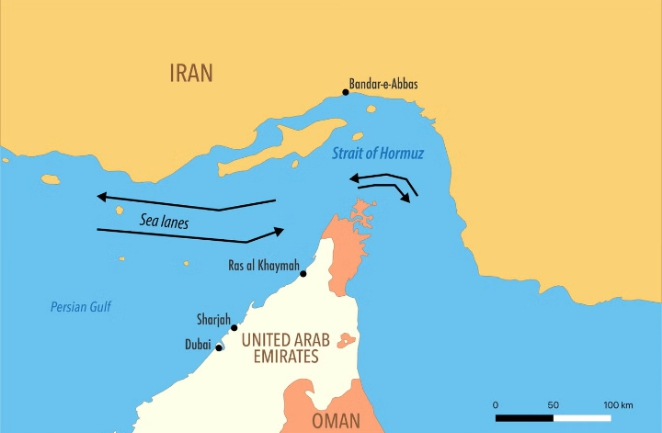
The Strait of Hormuz connects the Persian Gulf to the Gulf of Oman and serves as one of the most critical maritime chokepoints on earth.
Roughly one-fifth of global oil consumption — around 20 million barrels per day — flows through its narrow shipping lanes, alongside nearly a third of the world’s liquefied natural gas supplies. At just 21 miles wide at its narrowest point, the strait is geographically vulnerable and strategically indispensable.
Iranian officials have declared the waterway under full naval authority, warning that vessels attempting to pass without coordination could face retaliation.
The Islamic Revolutionary Guard Corps navy has issued statements asserting dominance over the passage, escalating tensions that had already intensified after reported US missile strikes on Iranian assets. The result has been a maritime traffic collapse unseen in decades.
Shipping intelligence data indicates that only a handful of vessels transited the strait on peak disruption days, compared with the normal daily average of more than 130 ships.
Dozens of tankers have dropped anchor near Gulf ports, while insurers have withdrawn coverage amid fears of further strikes. Reports suggest multiple tankers have sustained damage in recent days, further amplifying the global oil shock.
The economic consequences of energy supply disruption could be profound. Energy analysts warn that even a short-term bottleneck lasting one to two weeks would tighten supply chains and push crude prices sharply higher.
A prolonged closure of a month or more, however, could send oil prices well into triple digits and drive European natural gas markets back toward crisis-era volatility.
Oil-exporting states bordering the strait — including Saudi Arabia, the UAE, Kuwait, Iraq and Qatar — depend heavily on the route for exports to Asian markets such as China, India and Japan.
Although limited pipeline alternatives exist in parts of Saudi Arabia and the UAE, most volumes passing through the strait lack viable alternative export routes, leaving global markets exposed.
US President Donald Trump has vowed to ensure the “free flow of energy,” announcing that US naval forces would escort oil tankers if necessary.
The Pentagon has signalled readiness to expand maritime protection operations, though analysts caution that convoy systems could themselves become flashpoints in an already volatile conflict zone.
Beyond oil markets, the maritime traffic collapse threatens broader supply chains. Cargo vessels carrying industrial materials, food products and manufactured goods have also been delayed, compounding inflationary pressures in economies still recovering from previous global shocks. Freight rates are climbing as insurers price in war risk premiums, adding further cost burdens to international trade.
Financial markets have responded with volatility. Energy stocks have surged, while airline shares and energy-intensive industries have fallen amid concerns over rising fuel costs. Emerging markets that rely heavily on imported fuel face the prospect of currency strain and fiscal pressure if oil prices continue climbing.
China and Japan, both heavily dependent on Gulf energy flows, have called for immediate de-escalation. Beijing has indicated it will take necessary measures to safeguard energy security, while Tokyo has engaged in diplomatic outreach aimed at stabilising maritime transit.

The disruption underscores the geopolitical leverage inherent in Iran’s complete control of the Strait of Hormuz at a moment of heightened regional confrontation.
Historically, threats to the strait have rattled markets but stopped short of sustained closure. Even during prior regional conflicts, transit continued under heavy naval monitoring. The current maritime traffic collapse, however, represents one of the sharpest contractions in passage through the waterway in modern history.
As missiles and naval deployments reshape the strategic landscape, the world is confronting a stark reality: a narrow stretch of water just miles wide holds the balance of global energy stability.
Whether Iran’s complete control of the Strait of Hormuz proves temporary or evolves into a prolonged standoff will determine the scale of the oil price surge — and the durability of the global oil shock now unfolding.
About The Author