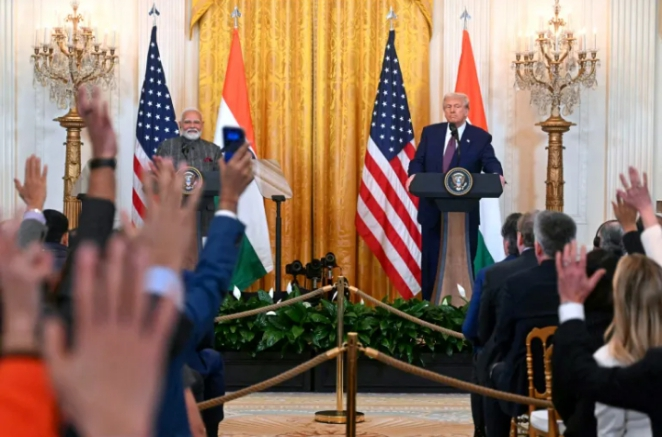
The newly announced India US trade deal has triggered intense debate in New Delhi and Washington after United States President Donald Trump claimed a breakthrough agreement had been reached with Prime Minister Narendra Modi, while Indian officials stopped short of confirming many of the central claims.
Although both leaders presented the announcement as a step toward repairing strained relations, the lack of documentation, diverging statements, and unanswered economic questions have left analysts uncertain about what the deal actually contains.
President Trump said the agreement would dramatically lower tariffs on Indian exports to the United States, cutting cumulative duties from 50 percent to 18 percent. According to the US president, the reduction followed India’s decision to stop purchasing Russian oil and instead increase energy imports from American suppliers.
Trump framed the announcement as a personal understanding reached during a phone call with Modi, presenting it as a symbol of renewed cooperation after a year of escalating trade tensions.
However, the Indian government’s public messaging differed noticeably. Modi confirmed that tariffs on Indian-made goods entering the US would be reduced but avoided describing the announcement as a comprehensive trade agreement.
He did not acknowledge any commitment to halt Russian oil purchases, nor did he confirm Trump’s claim that India would buy more than $500bn worth of American goods across sectors such as energy, agriculture, coal, and technology.
This divergence has fueled skepticism among economists and policy observers, many of whom argue that the announcement resembles a political declaration rather than a finalized trade pact.
No formal text has been released, no timelines clarified, and no parliamentary approval sought in either country. Without these elements, critics say it is premature to label the announcement an India US trade deal in the traditional sense.
Trade relations between India and the US have deteriorated significantly over the past year as Trump expanded his global tariff campaign. India was hit especially hard after Washington imposed additional duties as punishment for New Delhi’s continued imports of Russian oil following Moscow’s invasion of Ukraine.
Those measures pushed tariffs on some Indian goods as high as 50 percent, prompting retaliation fears and diplomatic strain.
Despite the tension, the US remains India’s largest trading partner.
Bilateral trade reached approximately $129bn last year, narrowly surpassing India’s trade volume with China. Unlike its trade relationship with Beijing, India enjoys a relatively favorable balance with Washington, exporting nearly $87bn worth of goods while importing around $41bn.
Pharmaceuticals, electrical machinery, and precious stones dominate Indian exports, while US sales to India are led by energy products, high-end machinery, and medical equipment.
Trump’s assertion that India would purchase over $500bn in US goods has drawn particular scrutiny. Analysts note that such a figure would represent an extraordinary increase in imports, far exceeding historical trade patterns and approaching the scale of India’s entire annual government budget. Without official confirmation from Indian authorities, many economists view the figure as politically aspirational rather than economically realistic.
Concerns are especially acute around agriculture, a sector that has long complicated trade talks between the two countries. The US has consistently pushed India to open its market to American agricultural products, including genetically modified crops. Successive Indian governments have resisted, citing the livelihoods of millions of small farmers and the political fallout of liberalizing the sector too quickly.
Modi himself has previously framed farmer protection as a personal red line, particularly after mass protests forced his government to repeal controversial agricultural reforms earlier in his tenure.
Against that backdrop, reports that India may grant broader access to US agricultural goods have alarmed farm unions and opposition politicians, even as New Delhi remains publicly silent on the issue.
American officials have been more forthcoming. The US agriculture secretary welcomed the announcement, stating that expanded access to India’s vast consumer market would help reduce America’s agricultural trade deficit and raise incomes for US farmers. Indian economists counter that such gains could come at significant cost to domestic producers if safeguards are weakened.
Another unresolved issue is whether the India US trade deal includes changes to India’s intellectual property laws. US negotiators have long sought stronger patent protections, particularly in pharmaceuticals and digital services.
Critics warn that concessions in this area could raise medicine prices and weaken India’s generics industry, which plays a vital role in global healthcare supply chains.
There is also uncertainty around digital taxation. India has signaled plans to expand taxes on foreign digital service providers, a move opposed by major US technology firms.
Whether those companies would receive exemptions under the new arrangement remains unclear, adding to concerns that key policy areas may have been negotiated behind closed doors.
While the reduced tariff rate places India in a more favorable position compared to some regional competitors, analysts caution that the advantage may be overstated.
Several neighboring countries benefit from US trade preference programs that allow duty-free access for selected goods, a privilege India lost in 2019 amid earlier trade disputes. Without restoration of those benefits, the long-term competitiveness impact remains uncertain.
Political reactions within India have been sharply divided. Senior figures within Modi’s party hailed the announcement as historic, arguing it would boost investment, employment, and India’s global standing.
Opposition leaders, however, accused the government of surrendering leverage without transparency and demanded that full details be presented to parliament.
Rahul Gandhi, leader of India’s main opposition party, claimed the lack of clarity suggested undue compromise and warned that workers and farmers could bear the costs of an imbalanced agreement. His remarks echoed broader concerns that the deal’s benefits may be overstated while its risks remain hidden.
From a geopolitical perspective, the announcement signals a tentative thaw after months of friction over immigration, visa policies, and regional security issues. Trump has repeatedly highlighted his personal rapport with Modi, presenting the relationship as central to stability in the Indo-Pacific.
Indian officials, while welcoming improved ties, have traditionally emphasized strategic autonomy and resisted being drawn too deeply into US-led pressure campaigns.
Experts suggest that Trump’s framing of the India US trade deal may be driven as much by domestic political considerations as by economic substance.
With elections looming, showcasing foreign policy victories plays well with his base. Modi, meanwhile, faces the delicate task of projecting strength abroad while managing domestic sensitivities at home.

For now, the announcement appears to mark the beginning of negotiations rather than their conclusion. Markets, businesses, and policymakers are waiting for concrete documentation that clarifies tariff schedules, sectoral commitments, and legal obligations. Until that happens, the so-called deal remains more promise than policy.
Whether this moment evolves into a comprehensive free trade agreement or fades into another episode of diplomatic ambiguity will depend on what follows next.
What is clear is that the India US trade deal, as currently described, raises as many questions as it answers, leaving both countries navigating uncertainty at a critical moment in their economic relationship.
Read also: Epstein secret child claim emerges as new files reveal vast web of global connections
About The Author