Honduran presidential election candidate Salvador Nasralla has widened his narrow lead over conservative rival Nasry Asfura, with vote counting extending into a tense fourth day, raising concerns.
With 80.29 percent of ballots tallied, Nasralla of the centrist Liberal Party held 40.23 percent, while Asfura, backed by US President Donald Trump, had 39.69 percent.
The difference between the two front-runners remained fewer than 14,000 votes, highlighting the razor-thin margin that has intensified political uncertainty and heightened tensions across Honduras.
Rixi Moncada of the leftist LIBRE Party remained in third place with 19.01 percent, trailing both leading candidates in the fiercely contested election marked by national division.
The National Electoral Council (CNE) stressed that the vote is still too close to call, as ballots from remote and hard-to-access regions continue to trickle in slowly.
Vote counting has been repeatedly suspended due to technical problems with the tabulation platform, leaving election officials scrambling to resume the process amid growing domestic and international scrutiny.
CNE official Cossette Lopez-Osorio described the latest counting halt as “inexcusable,” citing unscheduled maintenance as the cause, and emphasizing the need for transparency and timely updates to the public.
Nasralla, a 72-year-old television personality and former sports journalist, expressed confidence in his victory despite the delays, telling supporters on social media, “Either way, we’re going to win this election.”
Election observers from the European Union, the Organization of American States, and local authorities have urged calm and patience, as the final vote tally is expected to take several more days.
Early preliminary results initially showed Asfura with a slight lead of around 500 votes, prompting the CNE to declare a “technical tie” and warn that some votes would have to be counted manually.
As counting continued, Nasralla overtook Asfura, a shift that further fueled speculation of irregularities and intensified debate about the accuracy and reliability of the Honduran electoral system.
Trump publicly accused Honduran authorities of attempting to manipulate the election outcome without providing evidence, warning that the United States might cut its foreign aid if Asfura did not win.
In 2024, the United States provided Honduras with $193.5 million in aid, a factor that amplifies concerns about potential political pressure on the election and the influence of external actors.
Moncada criticized the electoral system as flawed and non-transparent, while condemning Trump’s fraud allegations as a violation of international norms and an unwelcome intervention in Honduran democracy.
The controversy surrounding Trump’s involvement follows his recent pardon of former Honduran President Juan Orlando Hernandez, who had been serving a 45-year sentence in the United States for drug trafficking.
Hernandez, a 57-year-old lawyer and former National Party president, thanked Trump publicly, calling the pardon life-changing, but said he would delay returning to Honduras due to security concerns.
Ballots continue to arrive from isolated and difficult-to-access areas, including rural regions only reachable by donkey or river boats, meaning the official winner may not be declared for several more days.
The CNE has up to one month to announce a winner officially, under Honduran law, which grants victory to the candidate with the most votes, regardless of whether they achieve an absolute majority.
Observers warn that the drawn-out vote counting could provoke unrest among citizens who have followed the contest closely and fear manipulation or unfair outcomes.
The political drama highlights Honduras’s fragile democracy and the broader influence of the United States in Central American elections, especially via aid and public endorsements.
Analysts note that a Nasralla victory would represent a centrist shift in Honduran politics, while an Asfura win would maintain the conservative status quo supported by the National Party and Trump.
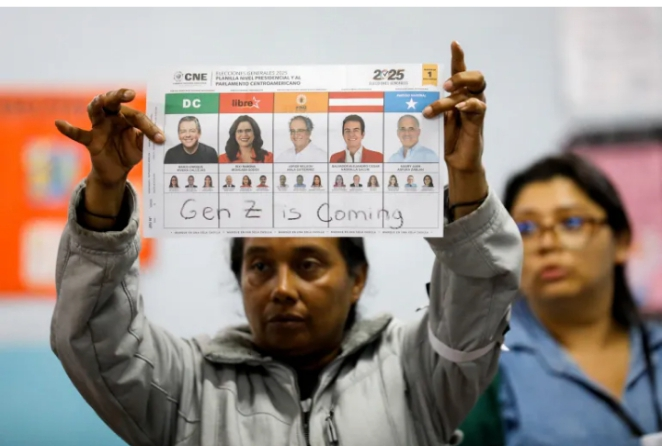
Nasralla’s campaign has emphasized anti-corruption measures and economic reforms, which have resonated with younger voters, particularly those mobilized under slogans like “Gen Z is Coming.”
Meanwhile, Asfura’s campaign has leaned heavily on promises of security improvements and continued cooperation with the United States, seeking to leverage Trump’s endorsement to boost credibility.
Moncada, in third place, has criticized both front-runners for failing to address systemic inequality and has called for reforms that would strengthen democratic institutions and social protections.
CNE officials continue to face logistical challenges, including technical failures in the vote transmission system, which have prompted multiple suspensions of counting and sparked widespread criticism from political parties.
International observers are closely monitoring proceedings, noting that Honduras’s elections are a critical test of democracy in Central America, particularly given the ongoing influence of external political actors.
Trump’s involvement has been particularly controversial, with threats to cut aid raising questions about sovereignty and the potential impact of foreign interference on domestic political outcomes.
As ballots are processed and manual counts completed, tensions remain high in Tegucigalpa and other major cities, with supporters of all three candidates demonstrating patience but also vigilance over potential irregularities.
Political analysts stress that Honduras’s electoral system must prioritize transparency and fairness to maintain public confidence, noting that mismanagement or perceived bias could erode democratic legitimacy.
The coming days will be decisive, with election authorities working under intense pressure to verify results accurately and issue an official winner while ensuring both domestic and international credibility.
Honduran voters have turned out in high numbers, demonstrating engagement and determination to influence the country’s political direction, even as the process stretches over several challenging days.
Amid these uncertainties, international media continue to follow developments, emphasizing that the outcome of this election could have lasting implications for US-Honduras relations and regional stability.
Political commentators predict that regardless of the winner, the narrow margins reflect a deeply polarized electorate and the need for dialogue and reconciliation between competing factions.
For now, Hondurans and observers alike await the official announcement, with both Nasralla and Asfura pledging to respect the results, though tensions and debates over legitimacy persist.
The election also serves as a reminder of the continuing role of international actors in domestic politics, with Trump’s public statements and pardons influencing perceptions and political calculations.

Ultimately, the final outcome will hinge on the remaining ballots from remote areas, as well as the integrity and efficiency of the CNE’s verification process, which remains under intense scrutiny.
The Honduran presidential election stands as a critical moment for the country, testing democratic institutions, voter confidence, and the influence of external powers on national sovereignty.