

Falz asks President Tinubu to resign over insecurity
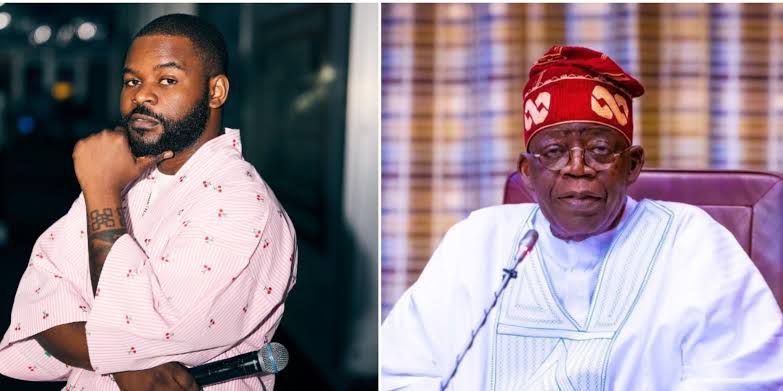
Nigerian rapper and social activist, Folarin Falana, popularly known as Falz, has called on President Bola Ahmed Tinubu to resign from office over what he described as the administration’s persistent failure to address the worsening insecurity affecting several parts of the country.
His remarks have intensified public discourse on the government’s response to the rising wave of violence, especially terror-related attacks targeting rural communities and religious groups.
Falz issued the call on Tuesday after resurfacing an old tweet from President Tinubu posted on 6 November 2014.
In that tweet, Tinubu — who was then a leader of the opposition — demanded the resignation of former President Goodluck Jonathan over his handling of terrorism and the Boko Haram insurgency.
By sharing the post, Falz sought to draw a parallel between Tinubu’s earlier criticism and the country’s current security challenges.
In his statement, the rapper accused the President of failing to fulfil his constitutional responsibility to safeguard lives and property, insisting that the government’s promises of reforms had not translated into meaningful protection for ordinary Nigerians.
“You have consistently shown your unwillingness to protect the lives and property of our people despite pretending to care in the past.
Resign now!” he wrote, stating that the situation has reached a level that demands accountability rather than political rhetoric.
Falz, who has built a strong reputation as a civic advocate, particularly since the 2020 #EndSARS protests, said the President’s silence on several attacks and kidnappings has further eroded public confidence.
He added that Nigerians were increasingly losing hope as armed groups continue to unleash violence across communities without adequate government intervention.
Growing International Attention to Nigeria’s Insecurity Crisis
His comments come at a time when Nigeria’s security crisis is drawing heightened global concern.
ireport247news.com reported that international organisations, including religious freedom bodies, have documented rising jihadist attacks primarily targeting Christian communities in the northern and central regions.
Several analysts say such attacks have become more coordinated in recent months, prompting calls for improved security measures and intelligence capabilities.
During a UN forum held on Tuesday, American rapper Nicki Minaj — appearing alongside the US ambassador to the United Nations, Michael Waltz — highlighted the urgent need for global attention on the persecution of Nigerian Christians.
She emphasised the importance of religious freedom and called for renewed international cooperation to address violent extremism in West Africa.
Minaj also expressed appreciation to US President Donald Trump for consistently voicing concern over attacks on vulnerable groups in Nigeria.
Her remarks have added another layer of global scrutiny to Nigeria’s internal security situation, signalling a growing international impatience with the country’s fluctuating response to terrorism and communal violence.
A Renewed Debate on Accountability and Leadership
Falz’s demand for President Tinubu to resign has sparked mixed reactions among Nigerians. While some supporters argue that the call is a necessary push for accountability, others say the rapper’s message is politically motivated.
However, many security analysts maintain that the country is indeed grappling with a worsening situation that requires urgent and strategic action.
In recent months, multiple states have suffered mass kidnappings, attacks on religious centres, and ambushes on security operatives, leaving families grieving and communities traumatised.
Critics argue that federal responses have been largely reactive rather than preventive, a pattern they say mirrors previous administrations’ shortcomings.
Civil society groups have repeatedly called for a comprehensive overhaul of Nigeria’s security architecture, including increased recruitment, improved welfare for personnel, enhanced surveillance capacity, and the deployment of advanced technology to track organised criminal networks.
Falz’s intervention, they note, amplifies these demands and increases pressure on the government to demonstrate tangible progress.
Public Expectations Amid Rising Tensions
For many Nigerians, Falz’s comments reflect growing frustration over insecurity that has persisted despite political transitions and repeated campaign promises.
Residents of affected communities continue to advocate for stronger military presence and more coordinated government efforts to restore peace.
Whether the President will respond directly to the rapper’s call remains unclear. However, the renewed debate underscores a national urgency that cannot be ignored.
With global attention now intensifying and domestic pressure mounting, stakeholders insist that the government must adopt a more decisive approach to restoring security and public confidence.
As insecurity continues to dominate national conversation, Falz’s statement has reinforced the broader call for transparency, accountability, and effective leadership — principles many Nigerians believe are essential for navigating the country out of its current crisis.


