President Volodymyr Zelenskyy addressed the nation with a somber message following the latest Russia attack, describing extraordinary destruction across multiple regions and urging stronger global intervention immediately.
Zelenskyy opened his remarks by outlining the unprecedented scale of overnight strikes, emphasizing the heavy pressure placed on already strained emergency services nationwide.
He confirmed Russia launched more than 470 attack drones, overwhelming defensive positions and targeting civilian areas in synchronized waves meant to maximize disruption and devastation.
Alongside the drones, Russian forces fired 48 missiles of varying types, including one ballistic missile and numerous cruise missiles directed at population centers and infrastructure networks.
The intensity of the bombardment showcased ongoing escalation, further demonstrating Russia’s continued reliance on mass missile and drone strikes to disrupt Ukrainian life and weaken resistance.
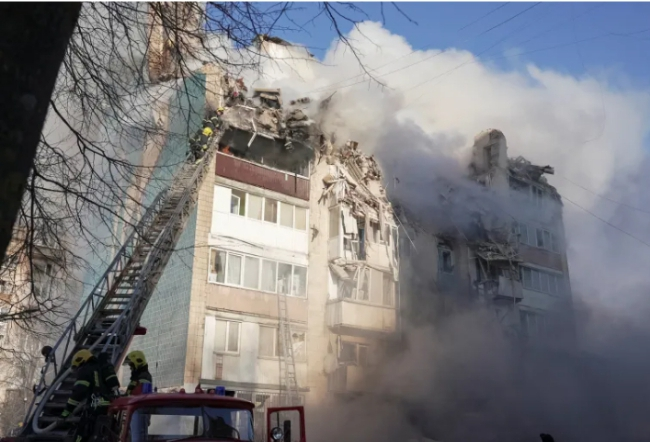
Ternopil suffered some of the most severe damage, with residential nine-story buildings struck directly, igniting dangerous fires that spread quickly through multiple occupied floors overnight.
Emergency responders rushed into hazardous conditions, battling heat, smoke, and collapsing structures as they searched for survivors trapped beneath shattered concrete and twisted metal.
Zelenskyy confirmed dozens were injured during the chaos, while nine fatalities were officially recorded, with authorities warning that the death toll may rise further.
Rescue teams continued searching through rubble, facing challenges from unstable walls, falling debris, and lingering flames threatening to reignite within the devastated residential complex.

Residents described terrifying moments as explosions shattered windows, filled hallways with smoke, and left entire families disoriented while trying to escape collapsing stairwells.
In Kharkiv, a massive assault began early in the evening and escalated relentlessly, leaving dozens injured, including several children who suffered shrapnel wounds and building-collapse injuries.
Critical infrastructure was heavily damaged throughout Kharkiv, with energy installations, public transportation links, and residential districts experiencing repeated strikes throughout the night.
Many neighborhoods lost power after substations were hit, complicating rescue operations and forcing medical teams to rely on backup generators during emergency treatment efforts.
Kharkiv residents reported widespread destruction, including collapsed roofs, shattered balconies, and burned vehicles scattered along previously busy residential streets.
In the Ivano-Frankivsk region, energy facilities were also targeted, leaving three wounded, including two children, and triggering additional concerns about the nation’s power stability.
Zelenskyy stressed that persistent targeting of energy infrastructure increases the likelihood of widespread outages, especially worrying as Ukraine approaches colder seasonal temperatures.
Electrical engineers immediately began assessing damage, though recurring bombardments have made long-term repairs increasingly difficult and dangerous for technical teams.
The Lviv region also faced significant strikes, as critical infrastructure and energy facilities were targeted despite previous efforts to reinforce regional defenses against renewed missile activity.
One person was injured in the Donetsk region, continuing a pattern of daily assaults affecting eastern communities facing near-constant bombardments since early stages of the conflict.
Kyiv, Mykolaiv, Cherkasy, Chernihiv, and Dnipro regions were all struck as well, highlighting Russia’s coordinated objective of overwhelming Ukrainian defenses across multiple regions simultaneously.
Zelenskyy emphasized that nearly nationwide strikes aim to exhaust Ukrainian resources, disrupt strategic planning, and deepen psychological pressure on civilians enduring relentless attacks.
He stated that every intentional strike against ordinary life demonstrates that global pressure on Russia remains insufficient to deter escalation effectively or reduce civilian suffering.
The President reiterated that stronger sanctions are required, particularly those capable of restricting access to technology supporting drone and missile manufacturing across Russia’s defense industries.

He warned that loopholes within existing sanctions regimes allow prohibited components to reach Russian factories, enabling continued production of weapons fueling ongoing destruction.
Zelenskyy urged international partners to adopt decisive measures targeting financial networks, supply chains, and foreign intermediaries assisting Russian procurement operations.
He also stressed Ukraine’s immediate military needs, naming air defense missiles as the nation’s top priority due to the overwhelming scale of current aerial threats.
The Ukrainian military requires additional air defense systems to intercept missiles targeting cities, infrastructure, and energy facilities across multiple regions simultaneously.
Zelenskyy emphasized the importance of strengthening combat aviation, arguing that modern aircraft and expanded aerial capabilities are essential for intercepting cruise missiles more effectively.
He also highlighted the urgent need to expand domestic drone production, ensuring faster defensive deployment and improved battlefield reconnaissance supporting frontline operations.
Ukraine’s capacity to neutralize incoming drones and missiles directly affects civilian survival, with every interception preventing additional casualties in already traumatized communities.
Zelenskyy acknowledged the extraordinary resilience demonstrated by Ukrainian civilians, describing them as a source of national strength amid continuous hardship.
Despite repeated waves of violence, communities continue offering support, donating supplies, sharing shelter, and assisting emergency workers operating under dangerous conditions.
The President praised firefighters battling flames, medical teams treating wounded civilians, and volunteers distributing essential items across affected neighborhoods.
Zelenskyy expressed gratitude to international allies providing humanitarian aid, energy equipment, and defensive weaponry essential for protecting civilians and stabilizing critical systems.
However, he noted that Ukraine’s needs have grown dramatically as Russian forces intensify their attacks, making expanded support vital to national survival.
Humanitarian workers across the country are delivering food, blankets, and medical supplies to families displaced by destroyed homes or ongoing structural instability.
Meanwhile, reconstruction teams are assessing damage to apartment blocks, power stations, and transportation networks, estimating repair costs likely exceeding current government resources.
Psychological support teams are also involved, helping traumatized survivors cope with emotional distress caused by explosions, loss, and ongoing uncertainty.
Zelenskyy warned that rebuilding remains difficult because repaired structures may be struck again, creating a cycle of repeated destruction and incomplete recovery.
He argued that breaking this cycle requires robust international cooperation capable of strengthening Ukraine’s defenses enough to reduce future damage significantly.
The President stated that accountability for the recent Russia attack must be enforced through international legal mechanisms ensuring justice for victims of indiscriminate violence.
He urged global institutions to continue documenting evidence, preserving records, and preparing cases addressing attacks on civilian populations and protected infrastructure.
Zelenskyy emphasized that accountability discourages future aggression, enhances global security, and reinforces international law threatened by ongoing hostile actions.
He concluded by reaffirming Ukraine’s unwavering determination to defend its people, safeguard communities, and protect its sovereignty despite overwhelming challenges.
Ukraine, he said, will remain focused on actions strengthening national resilience, improving defensive readiness, and securing long-term support from global partners.
Zelenskyy thanked everyone worldwide contributing supplies, offering military assistance, or advocating for increased aid essential to preserving Ukrainian lives.
He ended his message by urging the world to remain united, resolute, and committed to supporting Ukraine’s fight for survival and freedom.