European leaders reacted with visible unease after the United States seized Venezuela’s president, welcoming the end of authoritarian rule while struggling to defend international law principles long championed across the continent.
Governments across Europe broadly supported a democratic transition in Venezuela, stressing that Nicolás Maduro had lacked legitimacy since disputed elections widely criticised by international observers and opposition groups.
Yet the manner of Maduro’s removal unsettled many capitals, exposing sharp divisions between leaders prioritising geopolitical alignment with Washington and others fearing lasting damage to global legal norms.
Several European officials privately acknowledged relief at Maduro’s fall, but publicly emphasised restraint, wary that endorsing unilateral force could undermine institutions designed to prevent similar actions elsewhere.
The contradiction was evident as leaders praised Venezuelan democratic aspirations while avoiding explicit endorsement of Donald Trump’s decision to capture a foreign head of state.
Europe has refused to recognise Maduro as Venezuela’s legitimate president since the 2024 election, widely described by monitors as fraudulent and deeply flawed in procedure and transparency.
That shared position allowed European governments to argue that Venezuela deserved political change, even as they hesitated to legitimise the methods used to bring it about.
Trump’s rejection of opposition figure María Corina Machado complicated Europe’s stance further, since many European leaders have long treated her as the democratic face of Venezuela’s resistance movement.
By dismissing Machado’s popular support, Trump placed Europe in an awkward position, backing a transition while distancing itself from Washington’s preferred political calculations.
International lawyers argued the US could claim Maduro lacked sovereign immunity, drawing comparisons with the 1989 arrest of Panama’s Manuel Noriega by American forces.
US officials justified the operation as self-defence, alleging links between the Venezuelan government and international drug trafficking networks threatening American security interests.
Prominent legal scholars challenged that rationale, warning it stretched the concept of self-defence beyond recognition under the United Nations charter framework.
Professor Oona Hathaway of Yale University said such reasoning risked dismantling legal limits on force entirely, replacing exceptions with a dangerous new global norm.
“If drug trafficking justifies invasion,” she argued, “self-defence stops being an exception and becomes the rule, eroding the foundations of international order.”
The comments echoed widespread European anxieties that accepting Washington’s argument could legitimise similar actions by other powerful states in future crises.
Greek prime minister Kyriakos Mitsotakis sought to sidestep legal debate, emphasising Maduro’s brutality and calling the regime’s collapse a moment of hope for Venezuelans.
“This is not the time to comment on legality,” Mitsotakis wrote, reflecting a broader European instinct to avoid confrontation with Washington at a sensitive geopolitical moment.
Some of Trump’s ideological allies in Europe were more forthright, with Italy’s prime minister Giorgia Meloni describing the operation as a justified defensive intervention.
Other governments appeared cautious, mindful that open criticism might jeopardise American support for Ukraine amid ongoing war and European security concerns.
EU foreign policy chief Kaja Kallas reiterated that Maduro lacked legitimacy but insisted international law and the UN charter must be respected in all circumstances.
European Commission president Ursula von der Leyen echoed that position, focusing on solidarity with Venezuelans and urging a peaceful, democratic transition grounded in legality.
Germany’s chancellor Friedrich Merz adopted a careful tone, saying the legal assessment of the US intervention was complex and required detailed consideration.
France’s response highlighted Europe’s internal divisions, with President Emmanuel Macron welcoming the end of dictatorship while avoiding direct reference to American military action.
Macron called for a transition led by opposition candidate Edmundo González Urrutia and expressed solidarity with Machado through personal contact.
French foreign minister Jean-Noël Barrot was more explicit, condemning the operation as a violation of the international principle prohibiting the use of force.
“No lasting political solution can be imposed from outside,” Barrot warned, adding that repeated breaches by powerful states would have grave consequences for global security.
Britain’s prime minister Keir Starmer acknowledged the importance of international law but avoided detailing how it should apply to the US seizure of Maduro.
Observers noted that Europe’s hesitation reflected a broader fear: that the rules-based order it champions may be fading under pressure from great-power politics.
Analysts argued the episode symbolised a shifting world where power increasingly trumps principle, and multilateral institutions struggle to constrain unilateral action.
Trump’s approach suggested a new system dominated by a few decisive states, where strategic interests override international consensus and legal restraint.
The US secretary of state Marco Rubio intensified those fears by warning that Cuba could be next, reinforcing perceptions of an aggressive regional doctrine.
Supporters of international law now face uncomfortable questions about past failures, particularly the inability of multilateral mechanisms to deliver change in Venezuela.
Atlantic Council fellow Nizar El Fakih argued years of diplomacy, sanctions and investigations failed to produce a negotiated transition despite mass civic mobilisation.
He noted the International Criminal Court has yet to issue indictments despite extensive documentation of alleged crimes against humanity by Venezuelan authorities.
For many Europeans, the US action exposed both the fragility of international law and the limits of multilateralism when confronted by entrenched authoritarian regimes.
The dilemma remains unresolved: how to welcome the fall of a dictatorship without endorsing methods that could unravel the global rules Europe depends upon.
Read also: Democrats condemn Trump’s military raid on Venezuela as unlawful, reckless
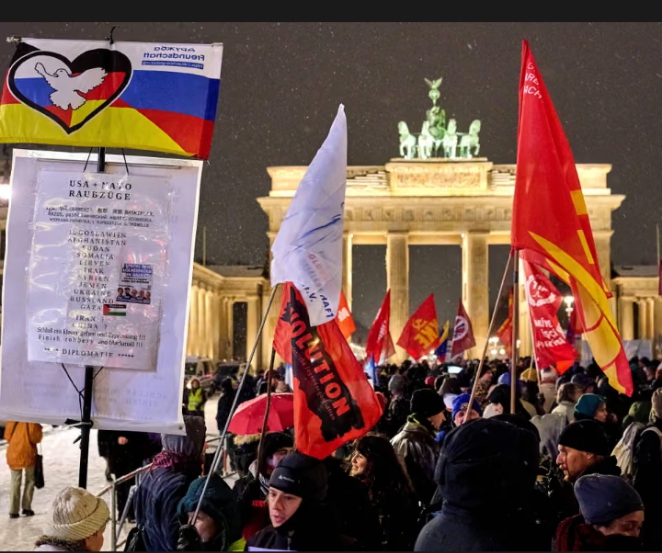
As celebrations and protests spread worldwide, European leaders continue walking a tightrope between moral satisfaction and legal unease.
Whether this moment marks a turning point or a troubling precedent may depend on how the next crises are handled by the world’s most powerful states.
For now, Europe’s response reflects a continent torn between ideals and realities, applauding change while mourning the erosion of the order that once promised restraint.