At least thirteen people were killed and twenty others injured following the Delhi Red Fort blast, prompting authorities to invoke India’s stringent anti-terror legislation amid widespread shock nationwide.
The explosion erupted near the Mughal-era Red Fort late Monday evening, sending flames and smoke through Old Delhi’s narrow streets, and shattering one of the city’s busiest quarters.
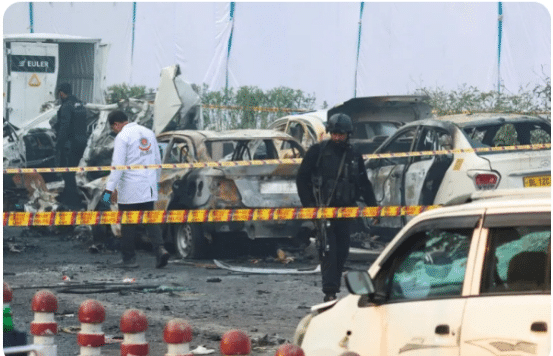
Witnesses described scenes of horror as burning vehicles blocked roads, with locals rushing to help victims trapped in the wreckage until emergency services arrived moments later.
Police confirmed that the area was cordoned off immediately, while teams from multiple agencies began securing evidence from the debris scattered across the centuries-old historic district.
Authorities invoked the terrorism law in India known as the Unlawful Activities (Prevention) Act, suggesting the blast might have been deliberate and coordinated rather than a mere accident.
Home Minister Amit Shah announced that a comprehensive investigation was underway, emphasizing that “no stone will be left unturned in identifying those responsible for this act of terror.”
He visited Lok Nayak Hospital, meeting the injured and their families, while assuring them that “justice will be delivered swiftly, and India will stand united in grief.”

The New Delhi explosion shook the old quarters shortly before 7 p.m., causing a series of secondary fires that took firefighters hours to control, witnesses reported Tuesday morning.
“Everything went dark instantly, then fire filled the air,” said an eyewitness, describing “a wall of flames” that tore through cars parked near the Red Fort’s outer wall.
Authorities ordered the closure of the Red Fort for three days, a rare move underscoring the seriousness of the situation and the potential national security implications.
Security personnel and forensic experts scoured the site through the night, collecting metal fragments and chemical residues in search of clues about the type of explosive used.
Forensic investigators later confirmed that the blast originated from within a car, possibly using a high-grade explosive material, and ruled out initial speculation of a gas-cylinder accident.
Officials from the India National Investigation Agency (NIA) arrived early Tuesday, assuming control of the case after initial police reports suggested the possibility of a suicide operation.
A senior NIA officer stated that “all possibilities are being examined, including organized networks operating beyond Delhi,” promising a full update once preliminary forensic analysis is complete.
Police detained the registered owner of the vehicle, traced to Gurugram, though it remains unclear whether the car was stolen or deliberately abandoned before the Red Fort attack occurred.
Defence Minister Rajnath Singh condemned the explosion as “a cowardly act against peace and humanity,” pledging that “India’s resolve against terrorism remains unbroken, and justice will be swift.”
Security alerts were issued nationwide, particularly across major railway stations and airports, following intelligence warnings of potential follow-up threats after the Delhi Red Fort blast.
Commuters reported heightened checks at metro stations, where police dogs and explosive detectors were deployed. “Delhi feels tense again,” one traveler remarked while waiting for inspection.
Hospitals were placed on emergency footing, as doctors treated burns and shrapnel injuries consistent with high-impact detonation. Several victims remain in critical condition, officials confirmed Tuesday.
Eyewitnesses recounted chaos and confusion after the explosion, with panicked residents running through smoke-filled alleys. “We thought it was another earthquake,” said one shop owner nearby.
Independent journalist Amit Baruah described the attack as “a direct challenge to the capital’s security apparatus,” warning that complacency in densely populated zones could prove costly.
Analysts said the swift use of the terrorism law in India indicated government confidence that the explosion was a coordinated terror act rather than criminal or accidental in nature.
Investigators are studying CCTV footage from nearby traffic lights and shops, hoping to identify suspicious movements or vehicles moments before the fatal New Delhi explosion occurred.
Authorities also requested technical assistance from national cyber units to track online communication that may reveal whether any extremist groups discussed Delhi in recent weeks.
Experts suggested the use of industrial-grade explosive compounds based on the size of the crater and radius of damage recorded around the vehicle that caused the Red Fort attack.
As dawn broke over Delhi, soldiers and police officers maintained a heavy presence near Chandni Chowk and Red Fort, restricting public entry amid fears of potential secondary devices.
Crowds gathered outside barricades carrying flowers and candles, mourning the dead while chanting patriotic songs. “Delhi will never bow to fear,” one mourner said tearfully.
The Red Fort, built by Mughal Emperor Shah Jahan in 1648, remains a symbol of India’s sovereignty, serving as the site for annual Independence Day addresses by prime ministers.
Local historians called the strike “symbolically devastating,” noting that “attacking the Red Fort means attacking the heart of India’s identity,” amplifying the blast’s psychological effect nationwide.
The India National Investigation Agency continues to coordinate with Delhi Police and intelligence agencies. Early findings suggest external financing may have supported those who orchestrated the attack.
A security official said “electronic trails, including financial transfers and communications, are being traced internationally,” as India seeks foreign cooperation to identify any global terror link.
Political leaders from across parties condemned the tragedy. Opposition figures urged unity, saying “national security should rise above politics” as debates began over domestic counterterror preparedness.
Prime Minister Narendra Modi, briefed early Tuesday, expressed condolences and ordered an urgent review of urban security protocols, promising reforms to close gaps revealed by the Delhi Red Fort blast.
The government’s crisis management cell met in emergency session, attended by senior army, intelligence, and home ministry officials to map out next steps and ensure public reassurance.
In the aftermath, the NIA confirmed the collection of DNA samples to determine whether a suicide bomber might have been involved. Forensic results are expected within forty-eight hours.
Witness accounts suggest a lone figure exited the car moments before the blast, though authorities have yet to verify that detail. “We’re not ruling anything out,” an investigator said.
Residents of Old Delhi expressed renewed fear. “We’ve lived through tensions before, but this is different,” said a local vendor, his stall destroyed by the explosion’s shockwave.
The Red Fort attack reignited debate over surveillance infrastructure. Experts noted that half the cameras near the blast site were either offline or poorly positioned to capture evidence.
Lawmakers urged modernization of urban monitoring systems. “Every blind spot is an opportunity for those wishing to harm,” a parliamentary member stated, demanding more funding for city security.
Hospitals continued to appeal for blood donations. Volunteers lined up across New Delhi as social media campaigns mobilized thousands offering aid, transport, and emergency supplies to victims.
Grieving families waited outside the coroner’s office for identification. “He went to deliver food to customers and never came back,” said a brother of one deceased delivery worker.
By late evening, police cleared the final stretch of debris while confirming that explosives experts found fragments resembling detonator caps, a critical lead in reconstructing the bombing sequence.
The terrorism law in India mandates severe penalties for those aiding or abetting such attacks, and authorities warned that “anyone connected will face the full force of the law.”
Internationally, nations across Asia and Europe condemned the incident, offering assistance. “We stand with India in combating terror,” said one European diplomat in a joint statement of solidarity.
Security think tanks suggested that Delhi may now review cross-border intelligence sharing frameworks and upgrade rapid-response units to prevent recurrence of large-scale attacks near heritage landmarks.
Throughout Tuesday night, emergency lights illuminated the Red Fort’s closed gates as investigators worked under floodlamps. Smoke lingered over the skyline like a shadow of collective grief.
At hospitals, survivors shared stories of narrow escapes. “The fire was everywhere,” said one injured man. “Someone dragged me out before the second car caught fire.”
In Parliament, lawmakers observed a minute’s silence before approving a motion expressing national condolences and commending rescue teams for their “courage and professionalism” amid dangerous conditions.
As Delhi mourned, citizens emphasized unity. “We have faced worse, and we will rise again,” said one teacher laying flowers beneath the Red Fort’s blood-red sandstone walls.
The India National Investigation Agency announced plans to release interim findings within seventy-two hours, with top security officials reviewing threat patterns linked to other Indian metros.
Officials urged the public to avoid misinformation and allow the investigation to proceed. “We need facts, not fear,” said the Delhi Police Commissioner, addressing growing online speculation.
Experts warned that urban resilience must become a priority. “Technology alone cannot replace vigilance,” said a retired officer. “Citizens must remain alert to protect communities from future harm.”
By midnight, the government reaffirmed that the Delhi Red Fort blast investigation was its “top national priority,” emphasizing transparency and accountability to maintain public confidence in security institutions.
The Red Fort stood silent as dawn approached again, its walls darkened by night but glimmering faintly under floodlights — a symbol of grief, endurance, and an unbroken national spirit.
About The Author