

A devastating car explosion in Delhi near the historic Red Fort has left at least eight people dead and several others injured, sparking widespread panic across the city.
The incident occurred close to the Red Fort metro station on Monday afternoon, with eyewitnesses describing a thunderous blast followed by plumes of smoke and flames rising above parked vehicles.
Firefighters and emergency services rushed to the area as authorities quickly cordoned off the zone, fearing possible secondary explosions amid chaos and confusion at the scene.
According to local police, preliminary reports suggest that the car explosion in Delhi may have originated from a parked vehicle, though the cause remains under active investigation.
Police spokesperson Sanjay Tyagi confirmed that eight people lost their lives while several others sustained injuries, describing the blast as “a deeply tragic event requiring full investigation.”
The Red Fort, a UNESCO World Heritage Site, is among Delhi’s most visited tourist attractions, making the car explosion in Delhi especially alarming for residents and visitors alike.
Local news channels aired footage showing charred vehicles, shattered glass, and thick black smoke drifting above one of the capital’s busiest historical districts.
A witness living near the site recounted hearing “a window-shattering sound,” adding that the shockwave was strong enough to rattle nearby buildings and cause minor structural damage.
“I saw flames engulfing at least three cars in seconds,” said Rajesh Kumar, a shopkeeper, who claimed to have helped carry injured people to safety before fire trucks arrived.
Delhi Fire Services reported dispatching six fire engines to the area within minutes of the call, saying the quick response helped prevent an even larger disaster.
However, the car explosion in Delhi still resulted in multiple casualties and extensive damage to surrounding property, with emergency personnel working for hours to cool the burning debris.
The area around the Red Fort metro station was quickly sealed off, with metro services temporarily suspended as bomb disposal teams conducted a thorough sweep for additional explosives.
Authorities emphasized that while early signs point to a mechanical or fuel-related issue, deliberate sabotage has not yet been ruled out pending forensic analysis.
Forensic experts from the National Investigation Agency and Delhi Police’s Special Cell have been deployed to gather samples and reconstruct the sequence of events surrounding the explosion.
According to investigators, the car explosion in Delhi appeared to have an intense ignition point at the rear section of the vehicle, suggesting possible fuel tank combustion.
A police official stated, “It’s too early to determine whether this was an accident or an intentional act. Every possibility remains open at this stage.”
Hospitals across Delhi received multiple injured victims suffering from burns, lacerations, and impact wounds. Doctors at Lok Nayak Hospital described several cases as “critical but stable.”
Crowds gathered outside emergency wards as families desperately searched for loved ones who had not returned home following the explosion near the Red Fort.
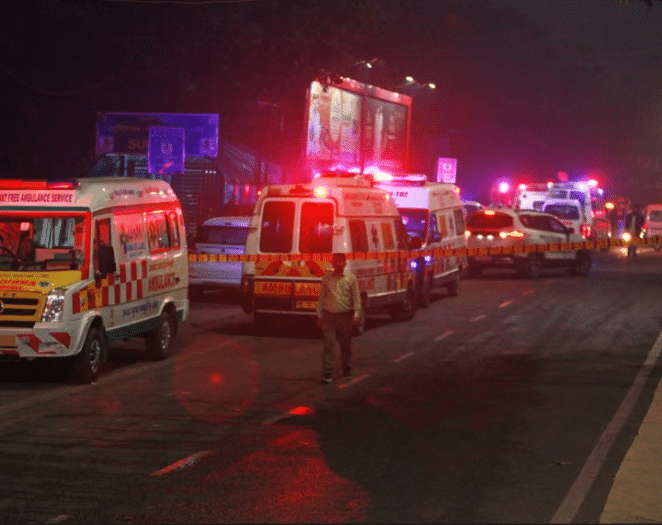
Local residents said the blast could be heard from as far as Chandni Chowk, nearly two kilometers away, underscoring the magnitude of the car explosion in Delhi.
Social media platforms flooded with videos showing the aftermath—flames flickering in the dusk, police sirens blaring, and people screaming as debris littered the streets.
Delhi Chief Minister Arvind Verma expressed condolences to the victims’ families and promised that “no stone would be left unturned” to uncover the truth behind the incident.
Prime Ministerial spokesperson Meera Sharma condemned the explosion, calling it “a shocking and tragic event that has shaken the heart of India’s capital.”
In response, the government ordered heightened security around major monuments, transport hubs, and markets, fearing the car explosion in Delhi could be part of a broader threat pattern.
Police have reviewed CCTV footage from surrounding areas, hoping to trace vehicle movements or suspicious activity that might clarify how the explosion was triggered.
Early footage reportedly shows a white sedan pulling over near the metro gate minutes before the blast, though officials have yet to verify the vehicle’s registration details.
Security analysts have warned that Delhi’s dense urban setup and heavy traffic often make it difficult to maintain real-time monitoring, complicating investigations into sudden incidents.
The car explosion in Delhi has reignited discussions about urban security protocols, particularly in areas frequented by tourists and government employees.
Professor S.K. Rao, a public safety expert, said, “This incident exposes serious vulnerabilities in emergency preparedness around historical landmarks that attract thousands daily.”
He added that increased surveillance, vehicle screening, and better coordination between transport and security departments are essential to prevent similar disasters in the future.
Meanwhile, eyewitnesses commended local citizens who rushed to assist victims before official help arrived, describing them as “the real heroes of the Red Fort tragedy.”
Residents formed human chains to pull trapped individuals from burning cars, using buckets of water and extinguishers from nearby shops to contain the flames.
Several NGOs have mobilized volunteers to support victims’ families, offering food, medical supplies, and psychological counseling in the wake of the car explosion in Delhi.
Emergency shelters were set up in nearby community halls to accommodate those affected, while local authorities initiated a helpline for inquiries about missing persons.
As the investigation unfolds, security officials are focusing on fuel samples, residue analysis, and digital evidence that may explain what triggered the catastrophic event.
The Delhi Police Commissioner said in a briefing, “We urge the public not to speculate. Every lead concerning the car explosion in Delhi will be pursued thoroughly.”
While some residents fear a terrorist motive, others suspect negligence, such as illegal gas cylinder modifications—a known risk factor for car fires in urban India.
Experts note that unauthorized car conversions involving compressed natural gas (CNG) tanks have previously caused explosions, raising concerns that lax enforcement might again be to blame.
Environmental activist Priya Das remarked, “Urban pollution policies pushed many to adopt CNG, but without strict safety checks, such choices can have devastating consequences.”
The Red Fort area, now heavily patrolled, has reopened partially, though security remains tight with restrictions on parking and large public gatherings.
Shop owners nearby described substantial financial losses due to temporary closures but said safety must come first after the car explosion in Delhi.
A small memorial of candles and flowers has appeared near the metro entrance, where citizens continue to gather and pay tribute to those who lost their lives.
Families of the victims have called for government compensation and stronger oversight on vehicle safety inspections to prevent another tragedy of this scale.
As night fell over Delhi, rescue teams continued clearing wreckage while investigators examined fragments for traces of explosive materials or ignition accelerants.
Authorities confirmed that detailed reports from forensic labs would determine whether the explosion was accidental or deliberate, shaping the next phase of the investigation.
The car explosion in Delhi has left a lasting scar on the city’s collective memory, reminding citizens of the fragility of safety in a bustling urban environment.
For many, the tragedy underscores the urgent need for improved infrastructure resilience and better coordination between transport, safety, and law enforcement agencies.
Authorities have also urged citizens to report any unusual activity or suspicious vehicles near crowded areas, emphasizing vigilance in the aftermath of the car explosion in Delhi.
Security forces have temporarily increased patrolling around schools, hospitals, and tourist spots, particularly near the Red Fort, where public anxiety remains palpable.
Residents living within a one-kilometer radius described sleepless nights as helicopters hovered overhead, and sirens pierced the early hours of Monday following the explosion.
“I keep reliving that terrifying moment,” said Meena Agarwal, a teacher, who witnessed the blast from her apartment across the street, calling it “a nightmare no one should experience.”
The Delhi government has promised financial aid for the families of victims, including immediate compensation and long-term medical support for those seriously injured in the blast.
Investigators are also examining whether faulty parking regulations, unauthorized vehicle modifications, or overcrowded roadside conditions contributed to the car explosion in Delhi.
Security cameras across surrounding streets are being analyzed to trace movements leading up to the blast, with forensic experts reconstructing the timeline to determine the exact cause.
A senior Delhi police official said, “Every lead will be investigated thoroughly. We are leaving no stone unturned in understanding the nature of this tragedy.”
Social media campaigns have emerged, calling for stricter urban safety laws and vehicle inspection protocols to prevent future accidents similar to the car explosion in Delhi.
Meanwhile, eyewitness accounts continue to pour in, with many describing the bravery of citizens who rescued victims before emergency services could reach the site.
“I saw people forming a chain to pull victims from flames,” said Ravi Sharma, a local shopkeeper, praising community courage during an unprecedented disaster.
Local NGOs have also coordinated with hospitals, offering transportation for injured victims and organizing volunteer groups to provide psychological support and first aid.
Experts stress that such incidents highlight the need for both preventive infrastructure measures and rapid emergency response planning in India’s densely populated urban centers.
Urban safety analyst Priya Nair explained that high-density traffic zones combined with historical landmarks pose unique risks, requiring both surveillance and public awareness campaigns.
Authorities are reviewing emergency drills in metro stations, bus stops, and nearby schools to ensure evacuation plans are effective in crises following the car explosion in Delhi.
The Ministry of Home Affairs has also deployed additional bomb disposal squads and specialized forensic teams to Red Fort and surrounding areas to prevent secondary threats.
Transport officials have temporarily restricted parking and vehicle entry near the Red Fort, limiting public access until authorities can guarantee safety for visitors.
Meanwhile, citizens have organized online vigils and support initiatives for families affected by the blast, highlighting solidarity and community resilience amid tragedy.
Several eyewitnesses reported that the explosion’s intensity caused minor injuries even in vehicles several meters away, highlighting how sudden and powerful the detonation was.
The police investigation is focusing on fuel quality, vehicle maintenance records, and the possibility of electrical faults in the exploded car as part of the forensic analysis.
Delhi’s municipal authorities are considering installing automatic fire detection and suppression systems in high-traffic historical areas, citing lessons learned from the car explosion in Delhi.
The Red Fort administration has temporarily suspended guided tours to ensure visitor safety and allow investigators to complete their work without interference.
Public safety campaigns are being amplified to educate citizens about emergency procedures, first aid, and reporting mechanisms in case of urban disasters or accidents.
Some security experts suggest that routine vehicle checks and stricter CNG regulations could prevent similar incidents in the future, especially in densely packed metropolitan areas.

Emergency response teams praised the coordination among fire, police, and medical services, noting that rapid intervention prevented the casualty count from being significantly higher.
Authorities have warned the public against spreading rumors about potential terrorist involvement until official reports are released, emphasizing reliance on verified information.
Meanwhile, residents near the Red Fort continue coping with shock, grief, and the lingering smell of smoke, while authorities work tirelessly to restore normalcy in the area.
The car explosion in Delhi has prompted renewed debates on urban planning, infrastructure safety, and disaster preparedness in megacities facing constant population pressure.
Civil society groups are calling for stricter compliance with fire safety laws, mandatory vehicle inspections, and improved public awareness to avoid repeat tragedies.
As forensic teams continue to analyze vehicle fragments and surrounding debris, officials assure that findings will guide both immediate responses and long-term policy adjustments.
Delhi police and government officials have urged citizens to remain calm, cooperate with authorities, and report any information that could aid the investigation into the car explosion in Delhi.
Local historians noted that while the Red Fort has survived centuries of upheaval, modern urban risks such as vehicle explosions present unprecedented threats to heritage sites.
“This incident is a grim reminder that even historical landmarks are not immune to modern urban hazards,” said Dr. Anil Mehta, a heritage conservationist in Delhi.
Families affected by the blast have begun receiving support from relief agencies, while authorities continue coordinating rehabilitation efforts and long-term aid programs.
Despite the tragedy, the quick mobilization of Delhi’s emergency services has been widely praised as a demonstration of effective disaster response under challenging conditions.
The car explosion in Delhi continues to dominate national headlines, with authorities committed to ensuring a full, transparent investigation and strengthening urban safety protocols across the capital.
About The Author


