Thousands of people filled the streets of Belém during the Cop30 summit, demanding governments urgently act on the climate crisis and protect communities, ecosystems, and future generations worldwide.
The Belém climate protest marked the first major demonstration outside the talks in four years, highlighting public frustration as previous summits in Egypt, Dubai, and Azerbaijan limited protest activities.
Indigenous leaders led chants beneath massive inflatable globes, emphasizing the intersection of climate change, land rights, and social justice in Brazil’s Amazon region, calling on authorities to implement meaningful solutions immediately.
Among the protesters, Raquel Wapichana traveled nine hours from Roraima, holding a sign saying “Let’s struggle,” demanding protection of rivers, forests, and communities constantly threatened by mining and agribusiness expansion.
The march featured a theatrical “funeral for fossil fuels,” with participants dressed in black mourning coal, oil, and gas, stressing the urgent need to abandon fossil fuel dependency worldwide.
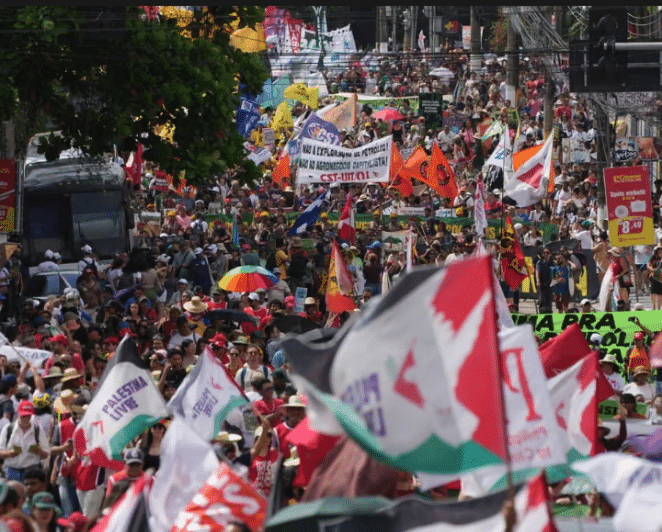
Artistic performances punctuated the Belém climate protest, including elaborate puppets and banners, allowing activists to convey messages about environmental collapse, anti-capitalist critiques, and the moral responsibility of nations to act decisively.
One area displayed a large banner criticizing Brazil’s energy transition policies, calling them a farce, and highlighting continued reliance on Amazon oil while claiming environmental collapse is rooted in capitalist systems.
Participants also expressed solidarity with Palestine, carrying flags and chanting, showing how global social justice concerns increasingly intersect with environmental activism during international gatherings like the Cop30 summit in Belém.
Classic Brazilian songs, including popular tracks by Alceu Valença, filled the streets, creating a festive yet urgent atmosphere that emphasized culture, resilience, and determination in confronting climate and social crises.
The Belém climate protest occurs during a week of intense negotiations over climate finance, trade rules, transparency, and national climate plans, highlighting both political stalemates and the urgency for actionable commitments.
Delegates remain divided on “the big four” issues, leading to separate “presidency consultations” as countries attempt to reconcile differing national priorities with the global climate agenda, heightening public frustration in Belém.
Protesters used visually striking signs showing endangered Amazon wildlife, emphasizing the immediate risks of deforestation, mining, and hydro projects while reinforcing the connection between local ecosystems and global climate stability.
Maria Melia of the Quilombola Movement of Maranhão marched to oppose hydrovia projects cutting through community lands, emphasizing the need for Indigenous rights, environmental protection, and equitable solutions in Amazon development policies.
Activists stressed that climate action must be both urgent and inclusive, linking the Belém climate protest to broader Indigenous climate activism that prioritizes survival, land stewardship, and community empowerment across Latin America.
The funeral for fossil fuels symbolized the end of reliance on coal, oil, and gas, encouraging governments and industries to embrace renewable energy alternatives as central to reducing greenhouse gas emissions globally.

Demonstrators carried banners highlighting Amazon environmental justice, calling for accountability from governments and corporations that continue environmentally destructive practices, showing a fusion of climate awareness and human rights advocacy.
Belém climate protest organizers emphasized non-violent resistance, ensuring the march remained peaceful while sending a powerful message to delegates that public demand for climate responsibility cannot be ignored.
Krishna, an actor from Belém, described her participation as both artistic and activist work, stressing that creative expression can amplify public demands for immediate fossil fuel reduction and climate justice measures.
The Belém climate protest is part of a larger trend where global citizens directly pressure policymakers, demonstrating that environmental collapse is intertwined with social and economic systems requiring comprehensive reform.
Participants warned that the Cop30 summit’s outcomes must go beyond symbolic agreements, urging concrete implementation strategies to prevent catastrophic tipping points and ensure nations meet their climate commitments effectively.
Indigenous voices at the Belém climate protest emphasized ancestral knowledge, biodiversity preservation, and sustainable land practices, calling on the summit to recognize these as essential elements of global climate strategies.
The march also included anti-capitalist messaging, with activists linking environmental degradation to economic inequality, asserting that systemic change is required to achieve both climate mitigation and social justice goals.
Belém climate protest speakers highlighted women’s leadership in climate activism, demonstrating how gender-inclusive approaches strengthen community resilience and foster innovative solutions for environmental and social challenges worldwide.
Global media coverage of the Belém climate protest drew attention to the contrast between public urgency and political gridlock, inspiring similar demonstrations in cities around the world demanding meaningful climate action.
Many protesters documented the event on social media, amplifying Indigenous climate activism narratives and illustrating the role of digital platforms in shaping public perception and encouraging international accountability.
By uniting diverse communities, the Belém climate protest underscored how collaborative grassroots movements can influence policy, challenge corporate interests, and accelerate the transition toward renewable energy and sustainable development.
The Cop30 summit continues amid uncertainty, with organizers emphasizing implementation over formal cover decisions, leaving public pressure from the Belém climate protest as a key motivator for delegates to reach tangible outcomes.
Protest participants stressed that governments cannot delay action, as ongoing deforestation, mining, and fossil fuel extraction threaten both local ecosystems and the global climate, reinforcing the urgent nature of demands.
Belém climate protest messages were amplified by chants, artwork, and music, demonstrating that combining culture and activism can effectively communicate complex environmental issues to broader audiences beyond policymaking circles.
Organizers coordinated logistical efforts to ensure safety, sustainability, and accessibility, highlighting how large-scale demonstrations can be executed responsibly while maximizing visibility and impact at international forums.
The funeral for fossil fuels concluded with symbolic gestures, encouraging delegates to commit to renewable energy adoption, carbon reduction strategies, and protection of vulnerable communities directly affected by climate change policies.

Belém climate protest participants stressed that the fight for the Amazon is inseparable from global climate concerns, emphasizing interconnectedness between local activism, national policy, and international environmental commitments.
Activists called for urgent attention to climate finance gaps, trade inequities, and inadequate national climate plans, underscoring the need for structural reforms to ensure meaningful outcomes from the Cop30 summit.
The Belém climate protest exemplifies how citizens worldwide demand accountability, reminding leaders that environmental responsibility, Indigenous rights, and social justice are inseparable in achieving effective climate solutions.
Participants argued that cultural expression, community mobilization, and public pressure must guide negotiations, insisting that tangible progress is non-negotiable and the future of generations depends on decisive action.
Delegates face pressure to reconcile economic development with environmental sustainability, and the Belém climate protest serves as a reminder that public scrutiny is relentless and demands equitable, actionable solutions.
Protesters concluded the march with a call to action, reiterating that climate change is a global emergency, Indigenous communities are frontline defenders, and fossil fuel dependency must end to protect the planet.
The Belém climate protest represents hope, resilience, and collective power, showing how grassroots movements can amplify marginalized voices and influence international decision-making on climate, energy, and social justice.
By integrating art, music, and storytelling, the Belém climate protest demonstrated creative approaches to advocacy, inspiring delegates, observers, and citizens to engage with climate activism on multiple levels.
About The Author