Arsenal late goals are not a defensive failure, says Mikel Arteta, but a symptom of attacking wastefulness and missed chances earlier in games.
Arsenal’s recent habit of conceding late equalisers and winners has sparked familiar debates about concentration, mentality and defensive stability. Yet inside the club, the diagnosis is very different. According to Mikel Arteta, Arsenal late goals are not evidence of a defence in decline, but the inevitable outcome of an attack that has failed to take control of matches when it mattered most.
It is a viewpoint that shifts responsibility away from the back line and places it firmly on what happens at the other end of the pitch.
The pattern that keeps repeating
Across domestic and cup competitions, Arsenal have dominated possession, dictated tempo and limited opponents for long stretches only to see their advantage evaporate in the closing minutes. Matches against the likes of Crystal Palace, Wolves, Aston Villa and Sunderland followed a similar narrative: control without comfort.
From the outside, the conclusion seems obvious. Teams that concede late must be switching off defensively. But Arteta argues that this interpretation misses the bigger picture. In his view, Arsenal should not be clinging to narrow leads deep into games in the first place.
“The game should be dead”
Arteta’s frustration has been consistent. Time and again, he has pointed to missed chances and a lack of ruthlessness in the final third. When asked about another late concession, his response was telling: if Arsenal had scored the goals their performance deserved, the final minutes would not carry such weight.
This is where Arsenal late goals become a consequence rather than a cause. When a team dominates but fails to extend its lead, pressure builds naturally. The opposition gains belief, pushes higher and commits more bodies forward, knowing one moment can change everything.
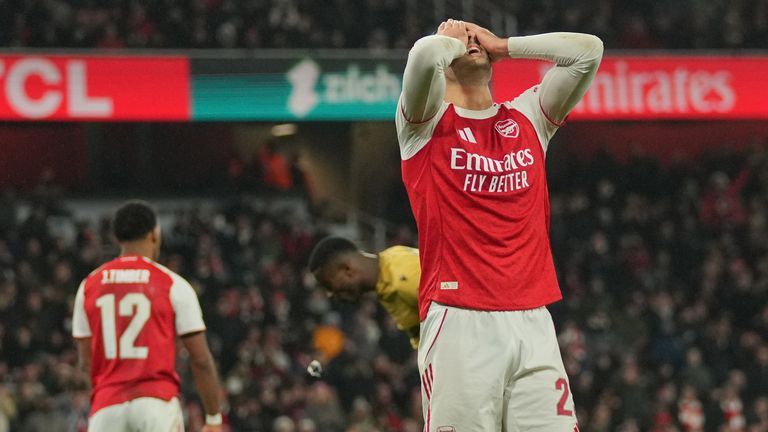
Attacking dominance without decisive output
Statistically, Arsenal have often done enough to win matches comfortably. Shot counts, territory and expected goals frequently favour them. Yet football is decided by goals, not patterns of play, and Arsenal’s recent attacking output has fallen short of elite standards.
Long spells without non-penalty goals have exposed a reliance on set-pieces, deflections or opposition errors. For a side with title ambitions, that margin is too thin. One missed chance early can grow into a defining moment late.
Arteta sees this imbalance clearly. The defensive structure, he believes, is functioning as designed. The issue lies in turning control into certainty.
Football history repeatedly shows that a 1–0 lead is the most fragile scoreline. It keeps opponents alive and invites risk. Arsenal’s late concessions have often come not from sustained pressure, but from single moments , a set-piece, a loose ball, a late surge into the box.
In those situations, even well-organised defences are vulnerable. This is why Arteta refuses to single out defenders. In his eyes, Arsenal late goals are the price paid for allowing games to remain open far longer than they should.
Beyond tactics, there is a mental element at play. When chances are missed, tension creeps in. Players hesitate, crowds grow anxious and momentum subtly shifts. Arsenal have often looked composed for 80 minutes, only to appear edgy as the clock winds down.
Arteta has repeatedly emphasised emotional control continuing to attack, continuing to threaten, even when leading. Sitting back is not always a tactical instruction; sometimes it is the natural response of a team unsure how to finish what it started.
This hesitation feeds directly into late drama.
There is also an uncomfortable sense of familiarity. In previous seasons, Arsenal were criticised for failing to close out decisive matches during title races. Those experiences linger, both for players and opponents.
Teams now approach Arsenal believing that persistence will be rewarded. That belief grows with every missed chance. When Arsenal fail to score a second goal, doubt replaces authority and Arsenal late goals once again dominate the narrative.
Despite the noise, Arteta has shown little interest in reshaping his defence or abandoning his principles. There has been no talk of drastic tactical changes or reactive selection choices at the back.
Instead, training emphasis remains on sharper decision-making in the final third, better movement in the box and greater composure in front of goal. Solve those issues, Arteta believes, and the defensive questions disappear naturally.
This approach reflects long-term thinking rather than short-term fear.
The fine margins of elite football
At the highest level, matches are decided by moments. Arsenal’s recent run highlights how thin the margins truly are. Dominance without goals offers no protection. One lapse, one delivery, one second-ball can undo an otherwise controlled performance.
Arteta’s message is not an excuse, it is a challenge. The team must learn to turn superiority into security. Until that happens, Arsenal late goals will continue to overshadow good work elsewhere on the pitch.
What happens next will define Arsenal’s trajectory. Elite teams do not just play well ,they punish opponents when on top. That ruthlessness is learned, not inherited.
For Arteta, the solution lies in bravery rather than caution. Keep attacking. Keep demanding more. Finish games early. If Arsenal take that step, late goals become irrelevant footnotes instead of defining moments.
Late concession are easy to blame and difficult to forget. But they rarely tell the whole story. Arsenal’s challenge is not defensive collapse, but attacking conviction. When goals arrive in volume, calm follows naturally.
Until then, the spotlight will remain on the final minutes even if the real issues were decided much earlier.
Read more news at: ireport247news.com
About The Author