

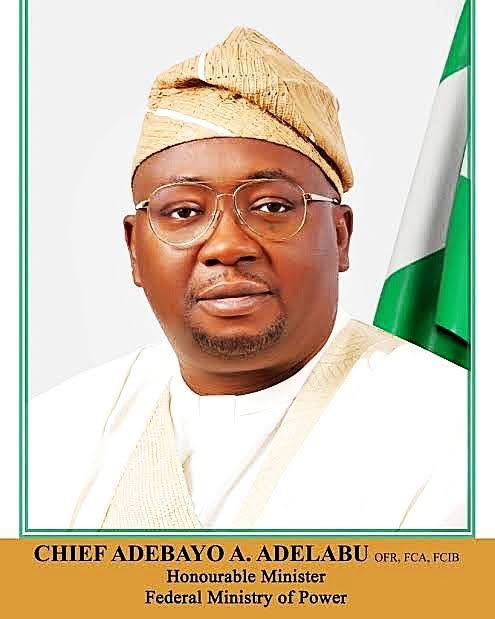
Adebayo Adelabu resignation
The resignation of Adebayo Adelabu, Nigeria’s Minister of Power, has drawn significant national attention following his formal exit from President Bola Ahmed Tinubu’s cabinet ahead of a planned governorship bid in Oyo State.
In a letter dated April 22, 2026, Adelabu confirmed he would leave office on April 30, 2026, in order to ensure a smooth transition within the Ministry of Power.
The development comes at a time when Nigeria’s electricity sector continues to face operational challenges, including intermittent national grid disturbances and ongoing concerns over supply stability. His tenure had been widely associated in public discourse with persistent pressure on the national power infrastructure.
Resignation letter: “It has been a rare honour”
Adelabu expressed appreciation to President Tinubu in his resignation letter, describing his time in office as meaningful and nationally significant.
“I write with a deep sense of honour and profound gratitude to formally tender my resignation as the Honourable Minister of Power of the Federal Republic of Nigeria.”
He further stated:
“It has been a rare honour to contribute to national development under your leadership.”
The letter, transmitted through the Office of the Secretary to the Government of the Federation in Abuja, emphasized gratitude for the opportunity to serve at a critical point in Nigeria’s economic reform agenda.
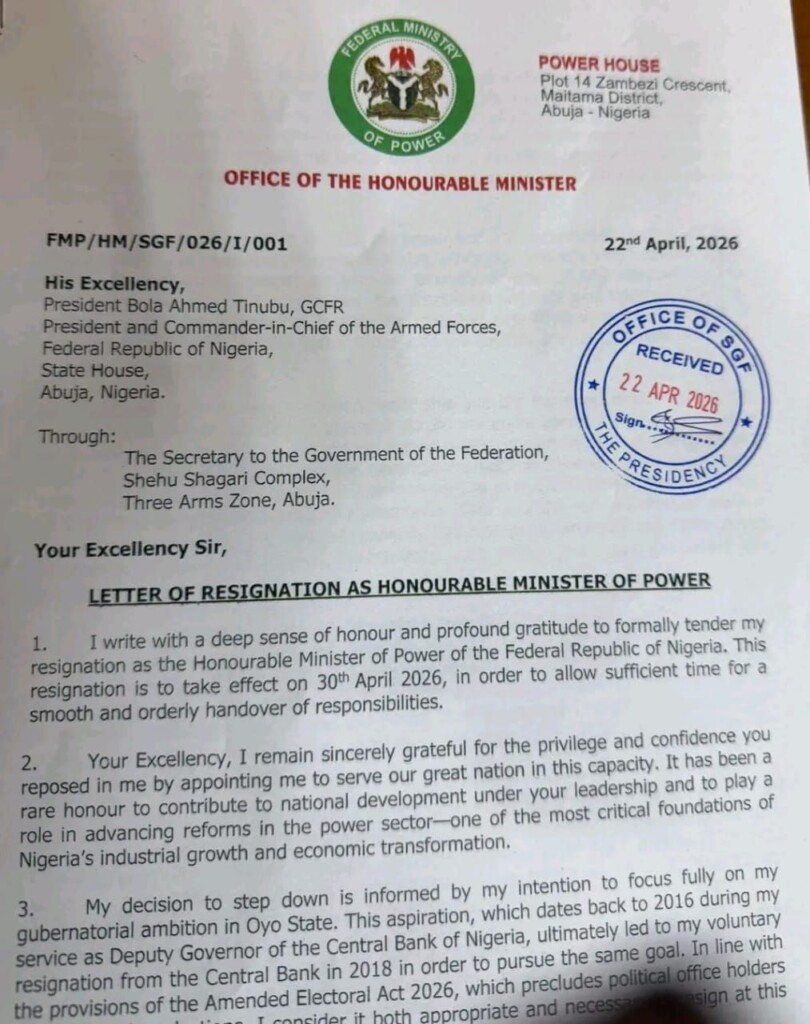
Oyo governorship ambition drives exit
Adelabu confirmed that his resignation is linked to his political ambition in Oyo State.
“My decision to step down is informed by my intention to focus fully on my gubernatorial ambition in Oyo State,” he wrote.
He traced the ambition to earlier political engagements, noting that it dates back to his time in national economic leadership roles.
He also referenced his earlier voluntary resignation from the Central Bank of Nigeria in 2018, describing it as part of a consistent political trajectory.
Power sector performance and public scrutiny
Adelabu’s tenure at the Ministry of Power was closely watched due to Nigeria’s ongoing electricity challenges.
The sector experienced repeated grid instability, transmission constraints, and public frustration over inconsistent supply. These issues placed the ministry under constant scrutiny throughout his period in office.
According to recent reporting trends in major Nigerian newspapers such as The Punch and ThisDay, public debate around the power sector intensified during his tenure, particularly regarding the pace of reform implementation and the reliability of electricity supply across the country.
While reforms were ongoing, outcomes remained mixed in public perception, with many consumers still experiencing frequent outages.
Political implications for Tinubu administration
The exit of the Minister of Power introduces a key cabinet vacancy in one of Nigeria’s most strategic economic portfolios.
The power sector is central to the Tinubu administration’s industrial and infrastructure agenda, particularly in efforts to attract investment and improve national productivity.
Policy analysts suggest the resignation may prompt a cabinet reassessment, especially given the sensitivity of the electricity sector to economic growth and public confidence.
Attention is now focused on who will succeed him and whether existing reform directions will be maintained or adjusted.
Oyo State politics and emerging realignment
The resignation is already reshaping political calculations in Oyo State ahead of the next governorship cycle.
Adelabu’s entry into the race is expected to intensify political competition, particularly within party structures and among established aspirants.
His supporters view his federal experience as an advantage, while critics are likely to scrutinize his ministerial record in the power sector as part of the emerging political debate.
Electoral Act 2026 compliance
Adelabu’s resignation also aligns with provisions of Nigeria’s amended electoral framework.
The Electoral Act 2026 restricts public office holders from engaging in active partisan political contests while still serving in executive positions.
By stepping down, he ensures compliance with legal requirements ahead of full participation in the governorship race.
The resignation of Adebayo Adelabu marks a significant political transition, linking federal governance experience with renewed state-level ambition.
Read also: Oyo approves ₦5.8bn circular road compensation after weeks of resident agitation
From his statement that it was “a rare honour” to serve, to his clear pursuit of the Oyo governorship, the development reflects both continuity and repositioning within Nigeria’s evolving political landscape.
As attention shifts to succession in the Ministry of Power, the broader implications for Nigeria’s electricity reform agenda and political realignments remain closely watched.
About The Author
