Zelenskyy tells Europe to stand up for itself after launching a blistering attack on European Union leaders, accusing them of hesitation and overreliance on the United States amid growing geopolitical tensions involving Greenland, Nato, and Russia’s ongoing war against Ukraine.
Speaking at the World Economic Forum in Davos, the Ukrainian president warned that Europe’s security future remains dangerously uncertain if it continues to wait for signals from Washington rather than acting decisively.
Addressing political and business leaders from across the globe, Volodymyr Zelenskyy said that Europe had failed to learn the lessons of recent years, despite repeated warnings about the fragility of the continent’s defence architecture.
He reminded his audience that at the same forum a year earlier, he had urged Europe to understand how to defend itself, yet little progress had been made since then.
Zelenskyy criticised what he described as Europe’s “Greenland mode,” a reference to the diplomatic storm sparked by US President Donald Trump’s remarks and actions concerning Greenland.
According to the Ukrainian leader, the episode exposed a deeper problem within European leadership: an instinct to wait for the United States to set the tone before taking action on issues that directly affect Europe’s security.
The Ukraine president argued that many European leaders appeared uncertain about how to respond to Trump’s increasingly unpredictable foreign policy, particularly on matters involving Nato commitments and territorial influence.
Instead of asserting their own strategic independence, Zelenskyy suggested, they were hoping tensions would fade without forcing difficult decisions.
In his Davos speech, Zelenskyy deliberately avoided launching a direct attack on Trump himself, choosing instead to place responsibility squarely on European capitals.
He said the real issue was not what the White House might or might not do, but Europe’s failure to prepare for scenarios in which American leadership could waver or change course abruptly.
The Greenland controversy, he explained, had drawn intense attention across Europe, yet produced little meaningful action.
Zelenskyy questioned the logic behind sending limited numbers of troops to the Arctic island, arguing that such gestures neither deter adversaries nor reassure allies.
He asked what message these actions sent to Russian President Vladimir Putin, to China, and to Denmark, whose territory Greenland remains a part of.
Zelenskyy warned that symbolic military deployments could even backfire by exposing Europe’s lack of readiness.
In his view, credible defence requires clear strategy, strong coordination, and the willingness to act independently when necessary. Without these elements, Europe risks appearing weak at a time when global power dynamics are rapidly shifting.
Drawing on Ukraine’s own experience since Russia’s full-scale invasion, Zelenskyy stressed that hesitation invites aggression.
He noted that Moscow had repeatedly tested the resolve of Western nations, exploiting delays and divisions to advance its military objectives. Europe, he said, must not repeat these mistakes in other regions.
The Ukrainian leader went further by suggesting that Ukraine itself could contribute to Europe’s defence, even beyond its current battlefield.
Referring to potential Russian naval activity near Greenland, Zelenskyy remarked that Ukrainian forces already know how to respond to such threats, citing their success against Russian warships in the Black Sea near Crimea.
Beyond Greenland, Zelenskyy also criticised Europe’s handling of economic sanctions against Russia. He argued that loopholes had allowed Moscow to continue operating a “shadow fleet” of oil tankers, generating revenue that fuels missile production and sustains the war effort.
According to Zelenskyy, Europe has the tools to shut down these operations but lacks the political will to do so decisively.
He warned that the stakes extend far beyond Ukraine.
In his assessment, the threats facing Europe are existential, particularly for Nato. Zelenskyy questioned whether the alliance could truly function if its deterrent power relies primarily on the assumption that the United States will always intervene.
“Europe relies on belief,” he implied, rather than demonstrated capability. Zelenskyy posed a stark question to his audience: if Russia were to strike a Nato member such as Lithuania or Poland, who would respond first, and with what force? The uncertainty surrounding that answer, he suggested, should alarm European leaders.
Zelenskyy argued that Europe needs more than coordination through Nato; it needs its own united armed forces capable of rapid and decisive action.
Such a force, he said, would not undermine Nato but strengthen it by ensuring that Europe can act even if US leadership becomes distracted or disengaged.
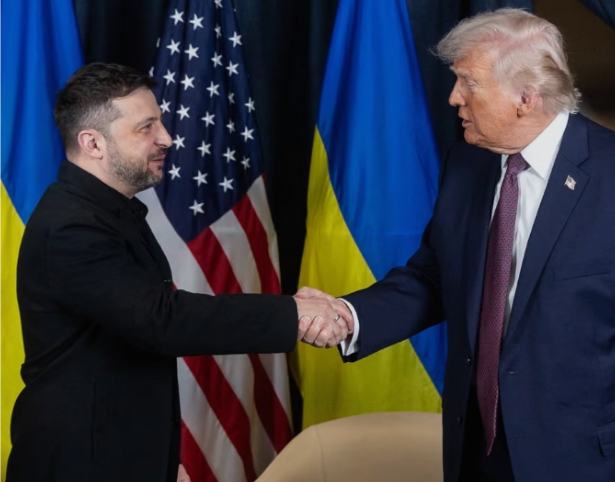
His remarks came at a sensitive diplomatic moment. Shortly before delivering the speech, Zelenskyy had met with Trump in Davos to discuss stalled peace talks aimed at ending the Russia–Ukraine war.
Trump described the meeting as positive but acknowledged that significant obstacles remain before any agreement can be reached.
Trump’s envoy, Steve Witkoff, was scheduled to meet Russian President Vladimir Putin later the same day, a development Trump described as a hopeful sign.
Witkoff suggested that negotiations had narrowed down to a single unresolved issue, implying that a breakthrough might be possible.
Despite these developments, Zelenskyy remained cautious. His Davos speech made clear that Ukraine could not afford to base its future solely on diplomatic promises or shifting political winds in Washington.
Instead, he argued, Europe and Ukraine share a common interest in building a security framework that does not depend on one country’s internal politics.
Zelenskyy’s message resonated with many observers who see Trump’s return to the global stage as a source of uncertainty rather than stability.
His leadership style, often characterised by abrupt shifts and transactional diplomacy, has forced allies to reconsider long-standing assumptions about US foreign policy commitments.
For Europe, Zelenskyy warned, the choice is becoming increasingly stark. Either the continent takes responsibility for its own defence and geopolitical influence, or it remains vulnerable to external pressure from adversaries who are willing to exploit hesitation and division.
By urging Europe to act, Zelenskyy positioned Ukraine not just as a recipient of Western support but as a partner with valuable experience and insight.
His speech framed the Ukraine war as a warning signal rather than an isolated conflict, one that highlights the costs of delayed action and strategic complacency.
As the Davos forum continued, Zelenskyy’s words underscored a broader debate about Europe’s future role in global security. Whether European leaders heed his call to stand up for themselves may shape the continent’s stability for years to come.
About The Author