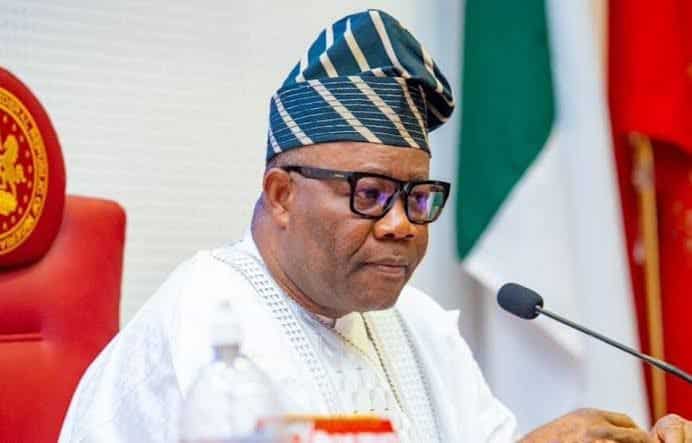
Wole Soyinka U.S. visa revocation sparks global concern as the Nobel Laureate links it to his criticism of Donald Trump’s policies and political intolerance.
Nobel Laureate, Professor Wole Soyinka, has revealed that the United States government has permanently revoked his visa, a decision he believes is connected to his outspoken criticism of U.S. President Donald Trump.
The announcement of the Wole Soyinka U.S. visa revocation was made during a media parley held at Freedom Park in Lagos on Tuesday, where he read aloud the official notification letter issued by the U.S. Consulate.
The letter, which Soyinka received on Thursday, October 23, stated that his B1/B2 non-immigrant visa, issued on April 2, 2024, had been canceled under Department of State Regulation 22 CFR 41.122.
The Consulate explained that “additional information became available” after the visa was granted, rendering it invalid for entry into the United States.

Reading from the official correspondence, the letter addressed to him read partly:
“Dear Mr. Soyinka, this letter serves as official notification from the United States Consulate that the non-immigrant visa listed below has been revoked pursuant to the Department of State Regulations 22 CFR 41.122 and is no longer valid for entry into the United States. This revocation refers only to the visa listed below.”
The celebrated writer and playwright, who now resides in Nigeria, said the Wole Soyinka U.S. visa revocation did not come as a shock. He stated that while he found the action unnecessary, he harbored no personal grudge against the American people or government.
“I have no ill feelings toward the people of the United States,” Soyinka said.
“I will continue to welcome any American to my home in Abeokuta if they have legitimate business with me. My differences lie only with political intolerance, not with individuals.”
Soyinka suggested that the Wole Soyinka U.S. visa revocation could be linked to his past criticisms of Donald Trump’s administration.
In December 2016, after Trump’s election victory, Soyinka made global headlines when he tore his American Green Card in protest of what he described as Trump’s divisive and xenophobic policies.
He explained that his protest was symbolic — a gesture of resistance against policies that threatened global harmony and equality.
“When I tore my Green Card, it was an act of conscience,” he recalled.
“I could not continue to associate myself symbolically with a country that had embraced values opposed to human dignity and justice.”
The Nobel Laureate, who has long been a fearless voice against tyranny, racism, and dictatorship, described the revocation as a reflection of growing political intolerance worldwide.
He stressed that silencing dissenting voices has become a troubling trend, even in nations that pride themselves on democracy and freedom of expression.
“The revocation of a visa does not silence my voice or invalidate my convictions,” he asserted.
“I have always stood for truth, justice, and the defense of human rights. Those values cannot be taken away by a piece of paper.”
Soyinka also noted that he had no plans to contest the decision or apply for a new visa. Instead, he reaffirmed his identity as a global citizen, dedicated to using literature, art, and public engagement as tools for truth and justice.
The Wole Soyinka U.S. visa revocation has since drawn global reactions from academics, diplomats, and civil rights advocates who view the move as politically charged. Many described it as an overreach that contradicts America’s long-standing image as a defender of intellectual and artistic freedom.
Commenting on the issue, human rights campaigners argued that revoking Soyinka’s visa sends the wrong message to the international community about tolerance for criticism.
Some also linked the move to increasing polarization in U.S. politics, where outspoken critics of certain administrations have reportedly faced subtle diplomatic restrictions.
Soyinka, however, maintained his calm and philosophical tone, emphasizing that his advocacy transcends political boundaries. He explained that his criticism of Donald Trump or any government stems from moral conviction, not personal bias.
“As a writer and thinker, I have a responsibility to speak when I see injustice, whether it occurs in Africa, America, or anywhere else,” he said.
“Truth does not recognize nationality. It is universal.”
The press conference, themed “Unending Saga: Idi Amin in Whiteface!”, provided Soyinka an opportunity to reflect on leadership, global hypocrisy, and the ongoing erosion of democratic values.
Attendees described the session as deeply reflective and thought-provoking, consistent with Soyinka’s tradition of confronting power through intellect and art.
As the news of the Wole Soyinka U.S. visa revocation spreads, many have revisited his past struggles against oppression — from his imprisonment during Nigeria’s civil war to his exile under military regimes.
Supporters argue that Soyinka’s life embodies courage in the face of power, and his recent experience with the United States only reinforces that legacy.
He concluded his remarks by encouraging younger generations to never compromise their integrity for convenience.
“The revocation of my visa is insignificant compared to the revocation of one’s conscience,” he said.
“Every generation must choose whether to be silent or to speak for what is right.”
For Wole Soyinka, a man whose pen has battled dictatorships and whose voice has inspired movements, the Wole Soyinka U.S. visa revocation is not an end but another chapter in his lifelong mission — the defense of truth, justice, and human freedom.
More news at ireport247news
About The Author