Winter storms worsen Gaza humanitarian crisis as relentless rain, flooding and cold expose displaced families, while the UN says lifesaving aid remains blocked at crossings.
Winter storms worsen Gaza humanitarian crisis across the besieged enclave, compounding destruction from war with cold, floods and collapsing shelters for displaced Palestinians.
Aid agencies warn that winter storms worsen Gaza humanitarian crisis by overwhelming fragile camps, as Israeli restrictions continue to prevent essential shelter materials entering Gaza.
The United Nations says it has tents, blankets and winter supplies ready, yet border restrictions mean deliveries cannot reach families shivering through freezing nights.
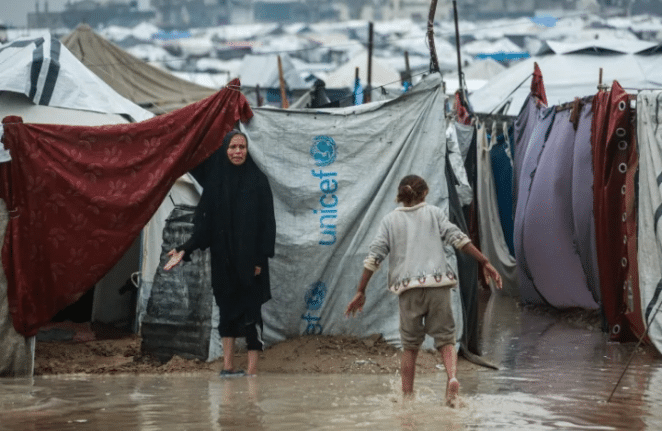
In makeshift camps from Gaza City to Deir el-Balah, rainwater pools around tents, soaking bedding, clothing and food supplies already stretched beyond breaking point.
Video footage from the ground showed children wading through floodwater, their families gesturing helplessly as shelters buckle under heavy rain and gusting winds.
In Gaza City’s Shati refugee camp, the roof of a war-damaged home collapsed during the storm, trapping residents beneath concrete and twisted metal.
Rescue workers said six Palestinians, including two children, were pulled alive from the rubble after frantic efforts under worsening weather conditions.
The collapse highlighted how winter storms worsen Gaza humanitarian crisis by exploiting buildings weakened by months of bombardment and structural damage.
Gaza’s Ministry of Health reported a two-week-old Palestinian infant froze to death, underscoring the lethal consequences of inadequate shelter during winter storms.
Doctors said newborns, elderly people and the sick face the greatest risks as temperatures drop and families lack heating, insulation or dry clothing.
A spokesperson for the UN Secretary-General said storms damaged or destroyed shelters and personal belongings across the territory.
“The disruption has affected approximately 30,000 children across Gaza. Urgent repairs are needed to ensure these activities can resume without delay,” the spokesperson said.
Humanitarian officials stressed that schools, child-friendly spaces and temporary learning centres have also suffered storm damage, disrupting education and psychosocial support.
The Palestinian Civil Defence in Gaza described the situation starkly, saying “what we are experiencing now in the Gaza Strip is a true humanitarian catastrophe”.
Civil defence teams reported responding to dozens of calls as flooded tents collapsed, fires broke out from unsafe heating methods, and families were evacuated.
Aid agencies say winter storms worsen Gaza humanitarian crisis because fuel shortages prevent pumping floodwater or powering heaters in shelters and hospitals.
Many displaced people burn scraps of wood, plastic or fabric to keep warm, releasing toxic fumes inside crowded tents and increasing respiratory illnesses.
Health workers warn that damp conditions accelerate the spread of infections, skin diseases and hypothermia among children sleeping on wet ground.
The UN says it has sufficient supplies staged outside Gaza, including winterised tents, tarpaulins and blankets, but access remains the central obstacle.
Humanitarian officials argue that delays at crossings turn predictable seasonal weather into a life-threatening emergency for hundreds of thousands of people.
The worsening crisis unfolds as diplomatic efforts continue to stabilise a fragile ceasefire and push for expanded humanitarian access.
Qatar’s Prime Minister Sheikh Mohammed bin Abdulrahman bin Jassim Al Thani held talks in Washington, DC, with US Secretary of State Marco Rubio on Gaza.
According to Qatari officials, talks focused on mediation efforts, urgent aid access and moving negotiations towards a second phase of a ceasefire plan.
Observers said Sheikh Mohammed stressed that humanitarian assistance must enter Gaza “unconditionally” to prevent further suffering.
“He said aid has to be taken into Gaza unconditionally, clearly making reference to the fact that a number of aid agencies have said that Israel is blocking the access to aid,” a correspondent reported.
The Qatari prime minister also raised the possibility of an international stabilisation force to operate in Gaza after the war, emphasising impartiality.
“There has been a lot of talk in the US over the past couple of weeks about how this force would work towards the disarmament of Hamas,” the correspondent said.
Sheikh Mohammed urged swift progress towards the second phase of the ceasefire agreement, warning that delays exacerbate civilian suffering.
“He said that stage two of the ceasefire deal has to be moved to pretty quickly,” the correspondent added.
Despite ceasefire discussions, violence has continued on the ground, deepening the humanitarian emergency during harsh winter conditions.
Medical sources reported at least 11 Palestinians wounded in Israeli attacks in central Gaza City amid ongoing tensions.
The Israeli army said it was investigating after a mortar shell fired near Gaza’s so-called yellow line “missed its target”.
Journalists on the ground reported Israeli artillery shelling east of Khan Younis, as medical sources confirmed additional gunfire injuries.
Two people were wounded in the Tuffah neighbourhood of eastern Gaza City, according to local health officials.
In the occupied West Bank, Israeli military and settler violence has also escalated, widening the regional humanitarian toll.
Palestinian news agency Wafa said Israeli troops shot and wounded a man in his 20s in the foot in Qalqilya.
Since October 2023, at least 70,668 Palestinians have been killed and 171,152 wounded in Gaza, according to Palestinian health authorities.
In Israel, 1,139 people were killed during the Hamas-led October 7 attack, with more than 200 taken captive.
Aid groups argue that winter storms worsen Gaza humanitarian crisis by layering environmental disaster onto an already catastrophic war-induced emergency.
They warn that without immediate, unhindered aid access, preventable deaths from exposure, illness and infrastructure collapse will rise sharply.
Read also: US dramatically escalates air strikes on Somalia under Trump this year as campaign surpasses previous administrations
As storms continue, displaced families brace for more rain, fearing each night that weakened shelters may not survive until morning.
Humanitarian agencies insist that political negotiations must translate quickly into action, saying survival should not hinge on diplomatic timelines.
For Gaza’s displaced, winter storms worsen Gaza humanitarian crisis not as an abstract phrase, but as daily lived reality of cold, fear and loss.
About The Author