

US soya bean farmers are raising concerns over Trump’s $20bn Argentina bailout, arguing that it strengthens foreign competitors while leaving American producers struggling to retain market share.
Critics emphasize that the timing of US aid to Argentina coincides with ongoing difficulties for US soya bean farmers, who have lost ground in global soya bean exports due to the ongoing trade war with China.
Caleb Ragland, president of the American Soybean Association, told reporters on September 24, “The frustration among US soya bean farmers is overwhelming. They see rivals benefiting from US-backed policies.”
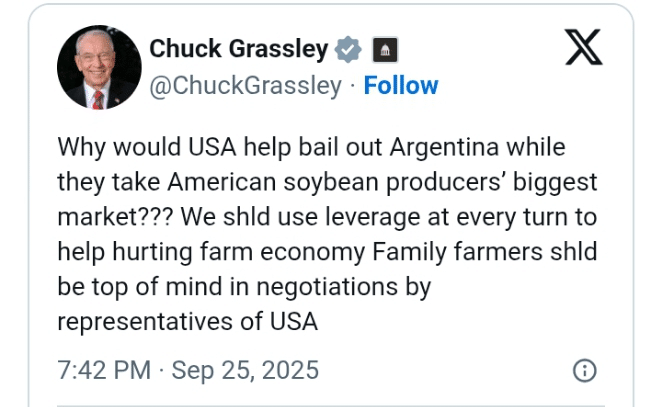
Senator Chuck Grassley from Iowa highlighted the discontent in an X post: “Why would the USA help bail out Argentina while they take American soybean producers’ biggest market???” The message resonated with many farmers.
When asked about the bailout on October 19, Trump defended the financial aid. “Argentina is fighting for its life. Young lady, you don’t know anything about it. … They have no money. They have no anything,” Trump said.
Although US aid to Argentina does not directly reduce domestic soya bean exports, farmers face indirect effects. China has increasingly sourced beans from Argentina, worsening US soya bean farmers’ position amid the ongoing trade war.
Democratic lawmakers have criticized the scale of the bailout compared with domestic priorities. Senators Amy Klobuchar and Adam Schiff noted that funds could alternatively support Affordable Care Act subsidies for struggling American families.
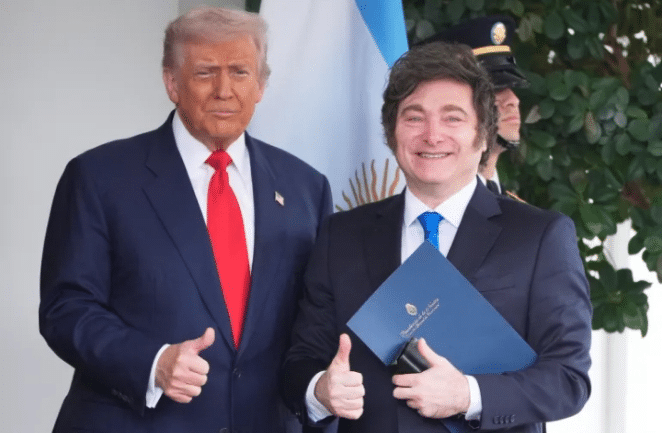
Argentina’s far-right President Javier Milei, an ally of Trump, came to power in December 2023 with a platform promising severe spending cuts, dubbed “chainsaw economics,” yet high inflation and a weak peso have hindered progress.
The $20bn bailout, structured as a currency swap facility, aims to stabilize Argentina’s peso ahead of legislative elections. Treasury Secretary Scott Bessent called it “hope for the future” for the struggling South American nation.
Experts caution that the US could face monetary risks. Brad Setser, senior fellow at the Council on Foreign Relations, wrote, “Buenos Aires’ path back to economic stability requires more than a balanced budget,” highlighting the limitations of US aid to Argentina.
Senator Ruben Gallego warned that Trump may seek to double Argentina assistance. “Trump is DOUBLING his bailout for Argentina. Meanwhile your health care premiums are about to DOUBLE,” he tweeted, drawing comparisons with the Affordable Care Act.
China, traditionally the largest buyer of US soya beans, has increasingly turned to Argentina and Brazil due to tariffs imposed by the US earlier this year. This shift has intensified pressure on US soya bean farmers.
Todd Hubbs, a crop marketing expert at Oklahoma State University, noted that Argentina temporarily lifted export tariffs on agricultural goods, prompting China to purchase approximately 7 million tonnes of soya bean exports almost immediately.
US soya bean farmers feel sidelined. While Trump promised domestic support for farmers affected by his trade war, delays caused by government shutdowns have prevented timely relief, compounding frustrations among producers.
Senator Brian Schatz highlighted the cost comparison between the Argentina bailout and Affordable Care Act subsidies. “For the cost of the Argentina bailout we could cover the ACA tax credits for a year,” he said, emphasizing domestic trade-offs.
Funds for US aid to Argentina come from the Exchange Stabilization Fund, which cannot be redirected to healthcare subsidies, complicating arguments over federal spending priorities and leaving US soya bean farmers questioning policy choices.
Trade analysts argue that the timing of the Argentina bailout was particularly unfortunate. With China’s purchases of Argentinian soya surging, US soya bean farmers lost market share at a critical moment, deepening economic pressures.
“The South American soybean crop was good this year and is expected to grow next year,” said Chad Hart, an Iowa State University economist. “It is large enough to meet Chinese demand, worsening the competitive position of US soya bean farmers.”
The White House maintains that US aid to Argentina is strategically important, ensuring stability in a friendly government and safeguarding broader economic interests in South America, even as domestic farmers express concern.
US soya bean farmers see the bailout as rewarding a competitor rather than supporting domestic industry. Ragland added, “We face falling prices and lost income, while Argentina benefits from US-backed assistance at the same time.”
Global commodity markets have become increasingly competitive. Analysts warn that continued reliance on foreign markets exposes US soya bean farmers to volatility, highlighting the need for careful balance between US aid to Argentina and domestic agricultural stability.
The dispute over the $20bn bailout illustrates the broader tension between foreign policy and domestic economic policy. US soya bean farmers want protection and support for their livelihoods amid international trade war conflicts.
Congressional debates over extending Affordable Care Act subsidies continue alongside scrutiny of US aid to Argentina. Lawmakers question whether funds should prioritize domestic citizens or foreign allies, underscoring the challenge of policy trade-offs.
Ultimately, US soya bean farmers remain frustrated with Trump’s $20bn Argentina bailout. They see foreign aid strengthening rivals while domestic producers confront trade war disruptions, delayed government support, and rising costs.
The situation has become emblematic of larger policy tensions. US soya bean farmers emphasize the need for a coherent approach that balances foreign assistance with domestic agricultural interests and economic stability.
With Trump’s administration defending the bailout, US soya bean farmers continue to push for solutions that protect their income, maintain market share, and address the consequences of global soya bean exports disruptions.
For American producers, the Argentina bailout highlights how international financial decisions can have direct consequences on local agriculture, putting US soya bean farmers in a vulnerable position despite policy assurances.
The $20bn US aid to Argentina may stabilize Milei’s government temporarily, but it also reinforces the perception among US soya bean farmers that Washington prioritizes foreign allies over domestic producers.
As global markets evolve, US soya bean farmers face a complex web of challenges, balancing trade war consequences, competition from Argentina and Brazil, and policy decisions affecting soya bean exports.
Ultimately, US soya bean farmers see the bailout as rewarding a competitor while domestic producers confront ongoing challenges, from delayed government support to tariff-driven market shifts.
For American producers, the Argentina bailout underscores the tension between foreign policy and domestic agricultural needs, highlighting how US aid to Argentina directly impacts soya bean exports.
About The Author


