

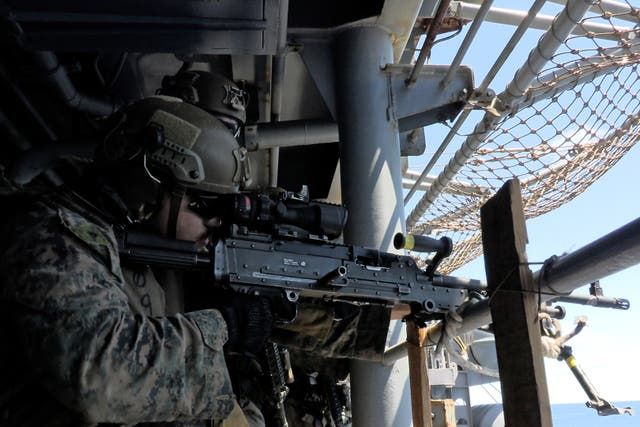
Iran warns US troops as thousands of US Marines arrived in the Middle East this week. Tehran’s parliament speaker, Mohammad Bagher Ghalibaf, issued a stark warning, signaling readiness against any ground invasion.
The US Central Command confirmed that the Marines reached the region aboard the USS Tripoli, carrying amphibious assault ships, transport aircraft, and tactical units ready for immediate action.
Yemen’s Iran-aligned Houthis claimed responsibility for a missile attack on Israel, marking their second strike in under 24 hours. They vowed to continue operations in response to US-Israeli actions.
The Strait of Hormuz remains a critical chokepoint for global oil, with disruptions raising concerns for energy markets. Iran’s posture has halted shipping flows temporarily, affecting crude and LNG transport.
Pakistan, Turkey, Egypt, and Saudi Arabia have initiated talks to mediate the conflict. Diplomatic proposals focus on reopening the Strait safely and reducing regional tensions to avoid escalation.
Iranian Supreme Leader Ayatollah Mojtaba Khamenei expressed support for Tehran’s strategy via state media, while domestic statements emphasized the country’s defensive readiness and potential retaliatory measures.
Royal Navy vessels, equipped with autonomous minehunting drones, have been positioned near the Strait. RFA Lyme Bay acts as a mothership for these drones to secure maritime routes if tensions worsen.
US officials continue to monitor the situation carefully. Military planners are evaluating Tehran’s capabilities and the potential for escalation if diplomatic solutions fail.
The Houthi attacks and Iran’s warnings have caused global oil prices to surge, adding pressure on energy-dependent economies. Traders continue to watch developments in the Strait of Hormuz closely.
Analysts caution that further Houthi or Iranian action could disrupt commercial shipping and intensify regional instability. International coordination remains ongoing to prevent escalation.
US Marines’ deployment signals a commitment to protecting allies, though Tehran perceives the presence as a threat. The standoff underscores the delicate balance in the Middle East.
Diplomatic efforts face hurdles as Tehran remains skeptical of US intentions. Statements indicate that Iran is prepared to act if any intrusion occurs, while avoiding unnecessary escalation.
Maritime insurance rates are climbing due to shipping risks, reflecting the broader economic impact of the Iran-Houthi-US tensions. Shipping companies are rerouting and adjusting coverage accordingly.
Military analysts note that a ground invasion of Iran would be logistically complex. Tehran’s defensive capabilities, regional alliances, and geography pose significant challenges for any direct intervention.
Global observers stress that diplomacy is essential. Missteps could spark a broader regional conflict. The ongoing standoff is a reminder of the volatility in the Persian Gulf and surrounding areas.
In conclusion, the arrival of US Marines, combined with Houthi attacks and Tehran’s warnings, signals a tense standoff. Regional security remains fragile, and all parties face high stakes.
Read also:US base in Syria targeted by Iraq drone attack escalation
International energy markets remain on edge as insurance providers adjust premiums for tankers transiting the Strait of Hormuz. Analysts warn that prolonged disruption could raise global fuel prices further, straining economies already grappling with inflation.
Regional powers, including the UAE and Oman, have offered to provide humanitarian corridors and safe shipping lanes. Diplomats stress that multilateral cooperation is essential to prevent a full-scale escalation while maintaining critical trade routes.
Military intelligence reports indicate that Iran continues to enhance missile and drone defenses along its coastline. Combined with Tehran’s alliances in Yemen, Iraq, and Syria, these measures underscore the complexity of any potential confrontation in the Gulf region.