US warns Diosdado Cabello as Washington intensifies pressure on Venezuela’s inner circle, signaling the powerful interior minister could face consequences if he defies the post-Maduro transition framework.
The warning, first reported by Reuters, places Cabello at the center of a volatile struggle following Nicolás Maduro’s capture, a moment reshaping Venezuela’s political, military, and economic landscape rapidly.
US officials fear Cabello could undermine efforts to stabilize Venezuela while preserving state institutions, particularly security forces, during a managed transition favored by Washington and allies.
A senior US official reportedly said Cabello “must choose stability over sabotage,” underscoring concerns he could mobilize armed loyalists against any US-backed political settlement process.
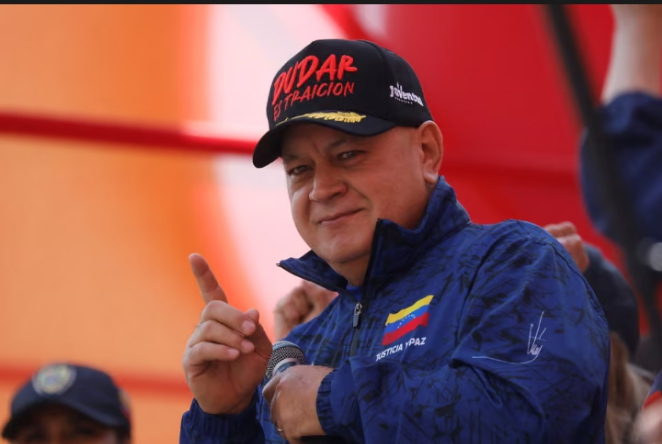
Cabello controls Venezuela’s police, counterintelligence agencies, and armed civilian militias known as colectivos, making him one of the most consequential figures in the unfolding crisis.
The Trump administration has emphasized continuity within state structures, even as it pursues leadership change, unrestricted oil access, and a realignment of Venezuela’s global partnerships.
Donald Trump claimed Venezuela would “turn over” $2bn worth of crude oil to the United States, redirecting shipments from China and easing pressure on domestic production levels.
That oil pledge, according to analysts, is central to Washington’s strategy of combining economic leverage with political pressure to accelerate a controlled transition.
US Secretary of State Marco Rubio outlined a three-step plan, beginning with stabilization after Maduro’s seizure and preventing what he described as “descent into chaos.”
“We don’t want it descending into chaos,” Rubio said, stressing Washington’s priority of order over immediate, sweeping institutional dismantling across the Venezuelan state.
Rubio explained the second phase would ensure “American, western and other companies have access to the Venezuelan market in a way that’s fair.”
He added the plan includes “beginning a process of reconciliation,” involving amnesties, prisoner releases, and returns for exiled opposition figures rebuilding civil society institutions.
“And then the third phase, of course, will be one of transition,” Rubio concluded, outlining elections and political normalization as eventual objectives.
Cabello’s response has been highly visual and muscular, with social media videos showing him commanding armed patrols across Caracas neighborhoods late into the night.
“It’s calm, it’s tranquil,” Cabello said in one video, insisting shops reopened normally and citizens understood “what we must do” to restore national order.
Other clips show armed men chanting “Always loyal, never traitors,” a slogan signaling resistance to concessions perceived as betrayals of Chavismo ideology.
Analysts interpret these displays as both reassurance to supporters and a warning to rivals, including acting president Delcy Rodríguez, installed after Maduro’s capture.
Cabello attended Rodríguez’s swearing-in wearing the same militant slogan, fueling speculation of resentment over his exclusion from the presidency and distrust of negotiations.
Venezuela’s power structure has long been factionalized, with Cabello leading one bloc and the Rodríguez siblings another, coexisting uneasily under Maduro’s balancing rule.
Although widely viewed as Maduro’s second-in-command, experts stress no clear hierarchy existed, complicating Washington’s calculations about loyalty and authority distribution.
María Corina Machado, Venezuela’s leading opposition figure, rejected Rodríguez’s legitimacy and vowed to return home, demanding swift, free, and fair elections.
“In free and fair elections, we will win more than 90% of the votes,” Machado told Fox News, projecting confidence amid uncertainty.
Meanwhile, US enforcement actions escalated, with American forces seizing Russian-flagged tankers accused of transporting Venezuelan oil in defiance of sanctions.
Defense Secretary Pete Hegseth said the US “continues to enforce the blockade against all dark-fleet vessels illegally transporting Venezuelan oil.”
Those seizures reinforce Washington’s message that economic pressure will accompany political demands, particularly regarding oil revenue flows and foreign partnerships.
Cabello’s long record casts a heavy shadow, with human rights groups linking him to extensive abuses under Maduro’s rule.
These abuses include thousands of extrajudicial killings, enforced disappearances, torture allegations, and mass jailing of political opponents over the past decade.
Since Maduro’s capture, colectivos have reportedly intensified patrols, checkpoints, and phone inspections, consolidating control amid fears of dissent.
The government declared a “state of external commotion,” effectively a nationwide emergency targeting anyone accused of supporting the US military action.
At least 16 journalists were detained during initial crackdowns, though most were later released, raising alarm among press freedom advocates.
Acting president Rodríguez declared seven days of national mourning for those killed during the US operation that captured Maduro.
She also reshuffled military leadership, appointing Gen Gustavo González López as commander of the presidential honor guard after criticism of security failures.
Rodríguez hardened her rhetoric, declaring on television that “no external agent governs Venezuela,” directly challenging Trump’s claims of US control.
Her tone marked a sharp shift from earlier conciliatory language, reflecting mounting domestic pressure and nationalist sentiment.
She described the US strike as a “terrible military aggression” and a “criminal attack” violating international law.
Rodríguez called Maduro’s capture a “kidnapping,” accusing Washington of undermining Venezuelan sovereignty through force.
For Washington, Cabello represents the most significant wildcard, capable of stabilizing or violently disrupting the transition.
US intermediaries reportedly warned Cabello that defiance could lead to consequences similar to Maduro’s fate.
Whether Cabello chooses accommodation or confrontation may determine Venezuela’s immediate future and regional stability.
Latin American governments are watching closely, wary of spillover effects, refugee flows, and precedent-setting interventions.
Global energy markets are also monitoring developments, given Venezuela’s vast reserves and renewed export prospects.
Read also: Minneapolis Immigration crackdown shooting sparks outcry as federal operation targets Somali community
For ordinary Venezuelans, daily life remains precarious, shaped by armed patrols, economic uncertainty, and political fear.
As US warns Diosdado Cabello, the standoff underscores how Venezuela’s crisis now hinges on one man’s next move.
The coming days will reveal whether power consolidates peacefully or fractures violently, redefining Venezuela’s trajectory for years ahead.
About The Author