The Federal Government has renewed its resolve to address safety lapses in Nigeria’s downstream petroleum sector, with the Minister of State for Petroleum Resources (Oil), Heineken Lokpobiri, directing the new leadership of the Nigerian Midstream and Downstream Petroleum Regulatory Authority (NMDPRA) to make public safety a top priority.
The minister issued the charge during a familiarisation visit by the newly appointed Chief Executive Officer of the NMDPRA, Saidu Aliyu Mohammed, stressing that the authority must consolidate recent gains while decisively tackling long-standing safety concerns across the petroleum distribution chain.

Lokpobiri said the administration of President Bola Tinubu expects regulators to focus less on bureaucratic bottlenecks and more on outcomes that protect lives, promote business growth, and strengthen national energy security.
Recurring tanker explosions remain a national concern
Recurring tanker explosions and public safety
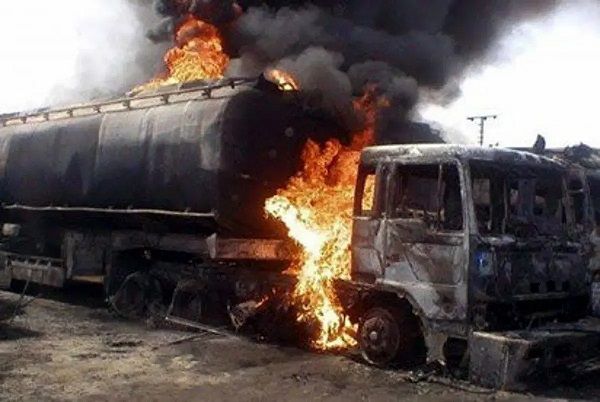
At the centre of the minister’s directive is the need to permanently halt recurring tanker explosions, a problem that has claimed lives, destroyed property, and disrupted fuel distribution across several parts of the country over the years.
Nigeria has witnessed multiple fatal tanker accidents linked to poor road infrastructure, unsafe loading practices, ageing vehicles, and weak enforcement of safety standards.
These incidents, often occurring along major highways and in densely populated communities, have continued to raise questions about regulatory oversight in the downstream petroleum sector.
Lokpobiri acknowledged that some progress has been recorded in recent months but warned that any relapse would be unacceptable.
“The essence of deregulation is not just pricing freedom, but safety, efficiency, and sustainability,” the minister said.
“The issue of recurring tanker explosions must be decisively addressed. Lives are at stake, and Nigerians expect lasting solutions, not temporary relief.”
He urged the NMDPRA to strengthen enforcement of safety regulations, ensure strict compliance with haulage standards, and work closely with relevant agencies to eliminate risk factors associated with petroleum transportation.
Deregulation and the role of regulators
The minister used the occasion to reiterate the broader philosophy behind the deregulation of the downstream petroleum sector, noting that President Tinubu’s reforms were designed to unlock investment, encourage competition, and expand Nigeria’s oil and gas prosperity.
According to Lokpobiri, regulatory agencies would ultimately be judged not by the number of penalties imposed but by how effectively they enable legitimate businesses to operate within a safe and compliant framework.
“Regulatory institutions will be assessed by the number of businesses they enable, not the number of regulations they create,” he said.
“A thriving downstream sector depends on vibrant, compliant operators who are supported by transparent and efficient regulators.”
He stressed that safety enforcement, including measures to stop recurring tanker explosions, must go hand in hand with policies that reduce delays, improve licensing processes, and attract private sector participation.
Assurance of seamless petrol supply
Beyond safety concerns, Lokpobiri assured Nigerians that the Federal Government remains committed to maintaining uninterrupted petrol supply nationwide, despite ongoing reforms in the energy sector.
He noted that collaboration between the Ministry of Petroleum Resources and the NMDPRA has improved operational efficiency, particularly in licensing and approvals.
“Under the Renewed Hope Administration, no licence application stays on my desk for more than 24 hours without attention,” the minister said, emphasising the government’s determination to remove administrative bottlenecks that could hinder fuel availability.
Industry stakeholders have often linked fuel shortages to delays in regulatory approvals, logistics challenges, and safety-related disruptions, including tanker accidents.
Analysts argue that ending recurring tanker explosions would significantly improve distribution efficiency and reduce supply shocks.
Expectations from new NMDPRA leadership
Lokpobiri congratulated Mohammed on his appointment and urged him to bring professionalism, integrity, and innovation to the role, describing the current phase as critical to Nigeria’s evolving energy landscape.
The NMDPRA, established under the Petroleum Industry Act (PIA), is responsible for regulating midstream and downstream petroleum operations, including fuel transportation, storage, distribution, and retail.
Observers say the agency’s effectiveness will largely be measured by its ability to enforce safety standards, stabilise fuel supply, and eliminate hazards such as recurring tanker explosions that undermine public confidence in the sector.
The minister called on the authority to deepen engagement with industry operators, transport unions, and security agencies to ensure compliance with safety rules and best practices.
Industry and public reactions
Energy sector analysts have welcomed the minister’s directive, noting that tanker explosions represent one of the most visible failures in Nigeria’s downstream value chain.
According to industry data, accidents involving petroleum tankers account for a significant share of fire-related disasters on Nigerian highways.
Experts argue that stricter vehicle certification, mandatory driver training, route monitoring, and improved emergency response systems are critical to addressing the problem.
Civil society groups have also urged the government to ensure that enforcement actions are consistent and free from political interference, warning that selective regulation could undermine efforts to stop recurring tanker explosions.
A test of reform credibility
As Nigeria continues its transition under the Petroleum Industry Act, the handling of downstream safety issues is increasingly seen as a test of the credibility of ongoing reforms.
For many Nigerians, tanker explosions are not just industrial accidents but symbols of systemic weaknesses in governance, infrastructure, and regulation.
By placing renewed emphasis on ending recurring tanker explosions, the Federal Government is signaling that safety and accountability must accompany economic liberalisation.
Whether the new NMDPRA leadership can translate this directive into lasting change will shape public perception of the Tinubu administration’s broader energy reform agenda in the months ahead.
About The Author