


The US Supreme Court Voting Rights Act ruling has triggered a major legal and political storm after justices declared that “allowing race to play any part in government decision-making” is unconstitutional, while dissenters warned the law is “all but a dead letter.”
In a landmark 6-3 decision involving Louisiana, the US Supreme Court ordered lawmakers to redraw congressional districts, fundamentally reshaping how protections against racial discrimination in voting are enforced.
The court ruled that Louisiana must redraw its congressional map while significantly limiting how section 2 of the Voting Rights Act can be used to challenge discrimination.
As reported by The Guardian, the ruling effectively weakens section 2 of the Voting Rights Act, long considered the last major safeguard for minority voters.
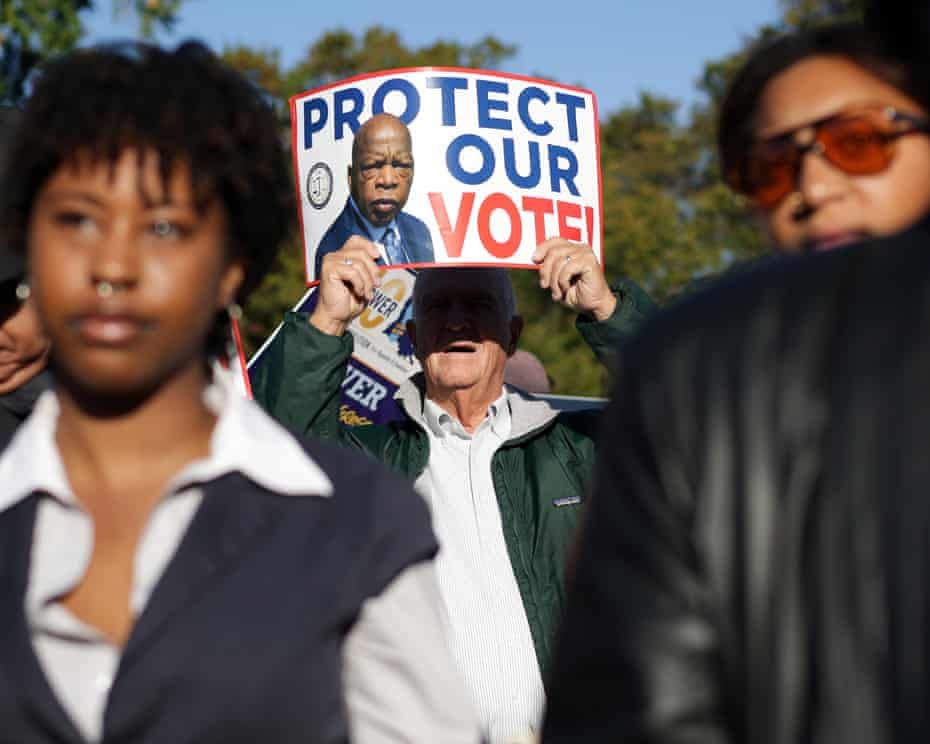
A landmark ruling that reshapes civil rights law
“Allowing race to play any part in government decision-making represents a departure from the constitutional rule,” wrote Samuel Alito, delivering the majority opinion.
He added that “compliance with section 2 thus could not justify the state’s use of race-based redistricting,” concluding that Louisiana’s actions amounted to “an unconstitutional racial gerrymander.”
The decision marks a significant shift in how courts interpret protections designed to prevent discrimination in voting systems.
For decades, section 2 has been used to ensure minority voters are fairly represented, particularly in redistricting cases across the United States.
Dissent warns of “demolition” of protections
In a sharply worded dissent, Elena Kagan said the court had carried out a “demolition of the Voting Rights Act.”
“Under the court’s new view of section 2, a state can, without legal consequence, systematically dilute minority citizens’ voting power,” she wrote.
She rejected the majority’s claim of modest reform, arguing that the so-called “‘updates’ eviscerate the law.”
“Today’s decision renders section 2 all but a dead letter,” Kagan added, warning of long-term consequences for minority political representation.
She emphasized that districts giving minority communities a “meaningful political voice” may now exist only temporarily, and “probably not for long.”
Louisiana case at the center of the ruling
The dispute stems from a case involving Louisiana’s congressional map following the 2020 census.
Black voters challenged the original map, arguing it diluted their influence by limiting majority-Black districts despite representing a significant share of the population.
A federal court initially agreed, ordering the creation of a second majority-Black district to ensure fair representation.
Lawmakers complied, but the revised map was later challenged by other voters who argued it relied too heavily on race.
New legal test raises burden for discrimination claims
“In short, section 2 imposes liability only when the evidence supports a strong inference that the state intentionally drew its districts” to disadvantage minority voters, Alito wrote.
The court introduced new requirements that make it significantly harder for plaintiffs to succeed in discrimination claims.
Under the revised framework, challengers must prove intentional racial discrimination, a standard that is notoriously difficult to meet.
They must also demonstrate that alternative district maps meet political and traditional criteria without relying on race.
Critics say ruling ignores historical realities
Legal experts argue the decision departs from decades of precedent and undermines the original purpose of the Voting Rights Act.
The law was amended in 1982 specifically to ensure that plaintiffs did not need to prove intentional discrimination, recognizing the complexity of systemic bias.
Kagan highlighted the challenge in separating race from political behavior, noting how closely the two are intertwined in voting patterns.
“So in offering evidence of polarized voting preferences, a plaintiff must remove from the equation … polarized voting preferences,” she wrote, underscoring the contradiction.
Broader implications for elections and representation
The ruling is expected to have immediate and far-reaching consequences for electoral politics, particularly in southern states.
Lawmakers may now redraw districts in ways that reduce the influence of minority voters without violating the new legal standard.
Kagan warned that states could justify such actions with alternative explanations, making it nearly impossible to challenge discriminatory outcomes.
“The possibilities are endless,” she wrote, pointing to scenarios where political goals could override fair representation.
A continuation of legal rollbacks
The decision builds on earlier rulings that have gradually weakened the Voting Rights Act, including the landmark Shelby County v Holder case in 2013.
That case removed federal oversight requirements for jurisdictions with histories of discrimination, significantly reducing protections.
Read also:Golders Green stabbing attack on Jewish Londoners leaves two injured as Starmer says “utterly appalling”
The latest ruling continues this trajectory, further limiting the ability of courts to intervene in voting rights disputes.
Political and social consequences
The ruling has intensified debate over the future of civil rights protections in the United States.
Advocates warn it could lead to a rollback of gains made over decades, particularly for Black voters and other minority groups.
Supporters of the decision argue it restores constitutional principles and limits the role of race in government decisions.
The divide reflects broader tensions in American politics over equality, representation, and constitutional interpretation.
A defining moment for voting rights
The US Supreme Court Voting Rights Act ruling represents a defining moment in the evolution of American civil rights law.
With one side declaring race-based redistricting unconstitutional and the other warning the law is “all but a dead letter,” the implications are profound and far-reaching.
As states respond and legal challenges emerge, the full impact of this decision will unfold in upcoming elections and court battles.
Do you think this ruling strengthens constitutional fairness or weakens protections for minority voters? Drop your thoughts in the comment box below.
About The Author
