

The US Australia rare earth deal was signed by President Trump and Prime Minister Albanese, aiming to reduce dependency on China rare earth supply, crucial for defense and industrial technology.
Both nations committed $1 billion each to joint projects, strengthening processing facilities while ensuring US strategic minerals and Australian mineral reserves remain under allied control rather than China’s monopolistic grip.
Trump emphasized that the rare earth deal is essential for military technology supply, including advanced submarines, aircraft engines, radars, and electric vehicles, protecting Western nations’ strategic advantage.
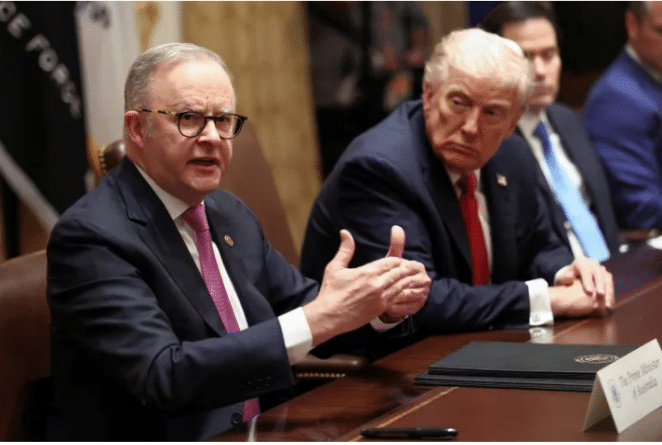
Albanese described the agreement as an $8.5 billion pipeline, highlighting AUKUS partnership cooperation and reinforcing defense and trade cooperation while mitigating global supply chain risk from China rare earth export controls.
China’s rare earth export restrictions have disrupted global markets, making the deal a decisive countermeasure against Beijing’s dominance in the production and processing of strategic minerals.
Officials confirmed the agreement covers extraction, processing, and long-term strategic reserves, with Australia providing preferential access to allies while ensuring the US can stabilize critical minerals and defend technological sovereignty.
Trump and Albanese indicated that the US Australia rare earth deal complements previous agreements on nuclear-powered submarines, integrating defense cooperation with economic security and industrial resilience in a volatile Indo-Pacific environment.
Analysts warn that China may retaliate against the Australia rare earth deal through trade barriers or additional restrictions, testing allied nations’ ability to secure military technology supply outside Beijing’s control.
Australia’s willingness to sell shares in its strategic reserves signals the Australia rare earth deal is not purely commercial, but a geopolitical maneuver enhancing regional security and deterring reliance on hostile actors.
The rare earth deal represents a coordinated industrial and technological strategy, combining financial resources, processing expertise, and strategic planning to prevent critical minerals supply disruptions caused by China.
Experts note that rare earths are essential for modern defense readiness, powering electric vehicles, wind turbines, fighter jets, and missile systems, making the US Australia rare earth deal a national security imperative.
Trump stressed that the US Australia rare earth deal demonstrates decisive action, ensuring allied military technology supply chains remain intact while reducing exposure to China rare earth supply manipulation.
Albanese reaffirmed Australia’s commitment to the US Australia rare earth deal, noting that trilateral AUKUS partnership contributions reinforce naval readiness and integrate critical minerals projects into broader regional defense priorities.
The US Australia rare earth deal illustrates the growing nexus between trade and national security, showing how rare earth export controls motivate Western powers to diversify supply chains and safeguard industries.
China’s aggressive expansion of export controls makes the US Australia rare earth deal urgent, as both nations seek to secure alternative sources of critical minerals essential for military technology supply.
US and Australian officials emphasized the deal includes advanced processing capabilities, aiming to refine rare earth metals into components vital for defense, energy, and high-tech industries outside Chinese control.
The US Australia rare earth deal strengthens strategic collaboration by aligning economic, industrial, and military objectives, ensuring that supply chain disruptions do not weaken the Western technological edge or defense readiness.
Albanese highlighted that Australia has been preparing to maintain US Virginia-class submarines in the Indian Ocean, demonstrating how the US Australia rare earth deal complements long-term defense and regional security objectives.
Trump insisted the US Australia rare earth deal would proceed “full steam ahead,” dismissing prior ambiguities and signaling Washington’s determination to accelerate mineral production and secure critical industrial infrastructure.
Analysts argue that rare earths and critical minerals are central to emerging technologies, giving the US Australia rare earth deal extraordinary significance in the global competition for technological and military supremacy.
Australia’s role in the US Australia rare earth deal underscores its strategic importance, providing Western nations with access to reserves that reduce reliance on China and mitigate global supply chain risk.
US defense officials noted that the US Australia rare earth deal complements ongoing AUKUS projects, including nuclear-powered submarines and trilateral training exercises, reinforcing the partnership while protecting strategic minerals.
China’s position as the world’s largest rare earth producer makes the US Australia rare earth deal a bold confrontation, signaling that Western powers will act decisively to counter monopolistic supply control.
Both leaders confirmed that the US Australia rare earth deal is designed to last decades, establishing processing infrastructure, strategic reserves, and cooperative frameworks that ensure resilience against future geopolitical shocks.
Trump emphasized that the US Australia rare earth deal secures critical minerals and military technology supply chains, reducing vulnerability to Beijing’s manipulative export policies and ensuring strategic independence.
Albanese added that Australia’s contributions to the US Australia rare earth deal, including preferential access and financial investment, demonstrate Canberra’s commitment to allied defense priorities and industrial collaboration.
Experts suggest that the US Australia rare earth deal may prompt other allies to seek similar arrangements, potentially reshaping global trade dynamics and fortifying Western resilience against Chinese supply chain domination.
The US Australia rare earth deal represents a strategic pivot toward resource security, industrial strength, and allied coordination, highlighting how defense, technology, and trade intersect in global geopolitics.
Officials stressed that the US Australia rare earth deal is designed to withstand pressure from hostile actors, combining processing, reserves, and cooperative oversight to secure military technology supply and national security.
Trump concluded the White House meeting by declaring that the US Australia rare earth deal signals a hardline approach to China, with both nations ready to assert control over strategic minerals.
The US Australia rare earth deal exemplifies a coordinated strategy for technological and industrial dominance, protecting critical infrastructure and ensuring allied nations maintain operational and economic independence.
By reducing reliance on China, the US Australia rare earth deal positions both nations to safeguard military technology supply chains, stabilize global markets, and secure regional security in the Indo-Pacific.
Analysts warn that the US Australia rare earth deal could provoke retaliation, but the long-term benefits of diversified supply chains, AUKUS partnership integration, and strategic reserves outweigh potential Chinese countermeasures.
The agreement also demonstrates the fusion of trade policy and national defense, highlighting how access to strategic minerals has become a decisive factor in Western power projection.
By committing significant financial and technical resources, the deal establishes a resilient, long-term framework for extracting, processing, and securing critical minerals for military, energy, and industrial applications.
Trump’s administration framed the US Australia rare earth deal as a message to allies and rivals: Western powers will act decisively to protect access to resources critical for defense and technological supremacy.
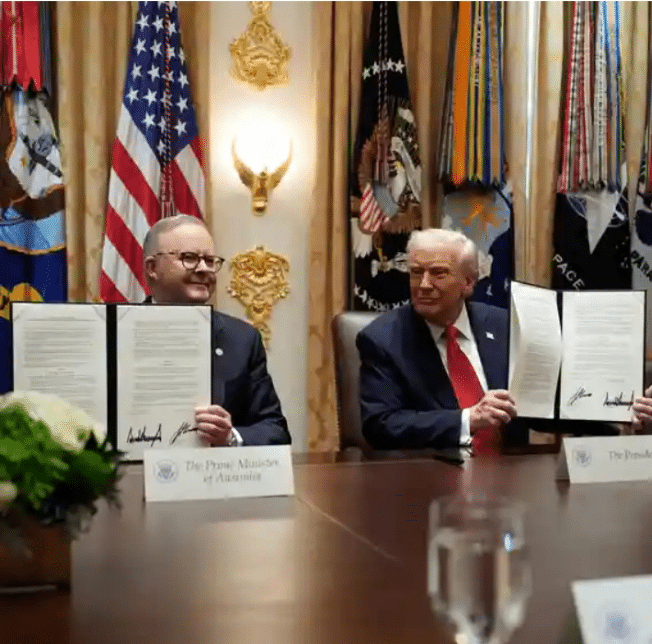
Albanese concluded that the deal reinforces allied coordination, ensures long-term security of critical minerals, and creates a blueprint for future collaboration in defense, trade, and industrial innovation.
The rare earth deal exemplifies a bold strategy in the face of Chinese monopolization, securing military technology supply, critical minerals, and global supply chain stability for the next decade and beyond.
About The Author


