

China’s latest decision to tighten export controls on rare earth metals signals the revival of an economic confrontation with Washington that could reshape global industrial strategy.
Beijing’s move targets the United States where it hurts most — in the core of its military and technological production lines — exposing the vulnerability of American dependence.
The announcement, issued by the Chinese Ministry of Commerce, expands restrictions to twelve of the seventeen rare earth elements critical to modern defense and high-tech industries.
These materials — essential for advanced weapon systems, fighter jets, semiconductors, and electric vehicles — have now become the sharpest geopolitical tool in Beijing’s strategic arsenal.
“Rare earth elements are dual-use resources with military and civilian applications. Export controls are an international practice to protect national security,” a ministry spokesperson declared in Beijing.
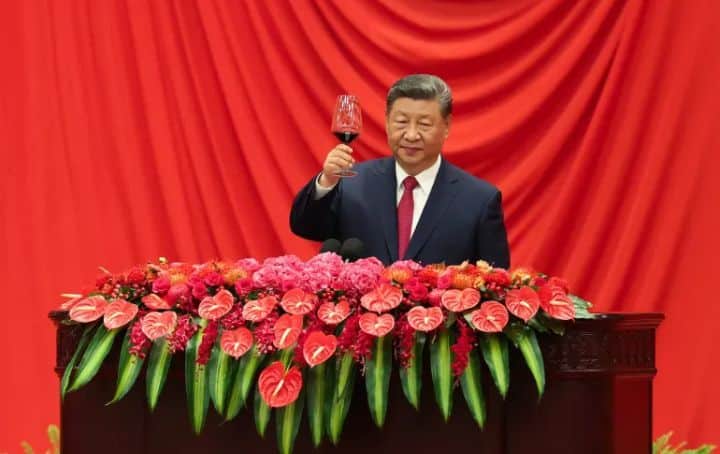
The statement framed the tightening as a lawful defense of national interests, but analysts read it as a clear message to Washington ahead of another tense round of trade talks.
For years, rare earths have given China quiet leverage in its competition with the United States. Now, that leverage is being converted into an explicit geopolitical weapon.
China currently mines around sixty percent and refines nearly ninety percent of the world’s rare earth supply, granting it unparalleled dominance over this vital industrial chain.
The United States, despite vast technological capacity, has failed to rebuild its own refining infrastructure, depending heavily on imports to sustain its defense manufacturing base.
From F-35 fighter jets and Tomahawk missiles to radar arrays and guided munitions, the Pentagon’s advanced weapons rely on materials that Beijing can now throttle at will.
According to the Center for Strategic and International Studies, “Washington faces critical shortfalls in domestic mineral processing capability, leaving defense programs exposed to foreign supply disruptions.”
That vulnerability is now being tested. Beijing’s export curbs are set to take effect on December 1, allowing a narrow window for diplomatic maneuvering before the restrictions bite.
By then, US President Donald Trump and Chinese President Xi Jinping are expected to meet during the Asia-Pacific Economic Cooperation summit in South Korea.
The timing is deliberate. Beijing’s restrictions arrive as the White House pursues aggressive tariffs on Chinese goods and seeks to force new terms in bilateral trade.
Trump’s administration has already imposed levies as high as 145 percent on imports, with China retaliating at 125 percent before both sides agreed to a temporary truce.
That truce, repeatedly extended but never resolved, now appears fragile as China asserts its industrial dominance in response to what it views as American economic coercion.
“China understands that rare earths are its pressure point,” said Gracelin Baskaran, director of the CSIS Critical Minerals Security Program. “Washington has very limited options here.”
Baskaran warned that “restricting supply will deepen vulnerabilities across the US defense ecosystem, widening the capability gap at a critical time of Indo-Pacific tension.”
The decision underscores a deeper contest between two superpowers locked in a struggle not only for markets but for control of the technologies that define modern warfare.
For Beijing, the restrictions serve multiple objectives: securing its supply chain, deterring containment policies, and signaling that resource control is now an extension of national defense.
For Washington, they expose the cost of decades of offshoring and the strategic blind spot that allowed China to dominate the mineral ecosystem.
The Pentagon has long warned that America’s dependency on Chinese rare earths poses a national security risk, yet domestic extraction and processing remain commercially limited.
Efforts to rebuild have been slow. Projects in California and Texas have struggled against environmental challenges, high costs, and the sheer scale of China’s processing efficiency.
“The West underestimated the industrial groundwork China laid decades ago,” said an analyst at the London-based consultancy CRU Group. “Now that investment is paying off geopolitically.”
This new round of restrictions covers holmium, erbium, thulium, europium, and ytterbium — five metals added to the seven already restricted earlier this year.
Together, they power the magnets, guidance systems, and optical instruments essential to both civilian electronics and precision weaponry.

Foreign companies will now be required to obtain Beijing’s special export licenses, explaining the precise end-use of any product containing more than 0.1 percent heavy rare earths.
Failure to comply could trigger penalties or denial of supply — a bureaucratic weapon that allows China to track, limit, and potentially block Western industrial usage.
“This is not an embargo, it’s a filtration mechanism,” said a Beijing-based trade researcher. “It lets China see exactly where its materials go and why.”
Such control transforms resource policy into intelligence gathering, offering Beijing new insight into the defense-industrial activities of rival economies.
Washington, meanwhile, finds itself caught between its need for these materials and its own restrictions on exporting semiconductors to China — a technological stalemate with strategic overtones.
By framing the issue under “national security,” Beijing echoes US justifications for earlier sanctions, turning Washington’s legal language back against it in the trade arena.
“China is matching the US method for method,” observed a Singapore-based analyst. “This is not retaliation, it’s recalibration of power symmetry.”
The rare earth squeeze also complements Beijing’s longer ambition to move up the value chain — from raw material supplier to dominant manufacturer of advanced technologies.
As supply tightens, global manufacturers will face rising costs and potential delays, driving new investment in alternative sources across Africa, Australia, and Latin America.
Yet such diversification takes years. For now, China’s position remains unassailable, cementing its role as the primary gatekeeper of materials critical to the world’s digital and military future.
US officials have avoided direct confrontation over the announcement, but privately, defense planners warn that shortages could disrupt munitions production and delay key modernization programs.
An unnamed Pentagon official admitted that “every missile, every radar array, every stealth jet depends on these materials. Losing access even temporarily creates ripple effects.”
That anxiety explains the urgency of Trump’s planned meeting with Xi. Washington hopes to avoid escalation before the December enforcement deadline draws the next battle line.
China, however, appears in no rush. Its officials insist the new measures are lawful and transparent, yet the timing and scope reveal a clear strategic intention.
“The United States has enjoyed unrestrained access to Chinese materials for decades,” said a Chinese scholar at Tsinghua University. “That era of free access is ending.”
The scholar added, “If the US wants to weaponize trade, China can weaponize resources. Balance must be restored.”
Analysts describe this as the beginning of a resource-driven cold war — one defined less by ideology than by the struggle to secure industrial self-reliance.
Beyond Washington and Beijing, the impact will ripple through Japan, Europe, and Russia, whose industries also depend on Chinese-processed rare earths for critical technologies.
Markets have already reacted. Global prices of key elements such as dysprosium and terbium spiked within hours of the announcement, signaling investor anxiety over future availability.
The rare earth dispute illustrates how global power now rests not only on military capability but on the minerals that sustain it — an invisible backbone of modern strength.
For China, it is a chance to remind the world that control of resources equals control of influence. For the United States, it is a wake-up call decades overdue.
Unless Washington rapidly builds its own processing infrastructure, analysts warn that Beijing’s grip will tighten further, reshaping the balance of economic and military power.
“Supply chains are the new front lines,” Baskaran concluded. “Whoever controls them controls the next century.”
About The Author


