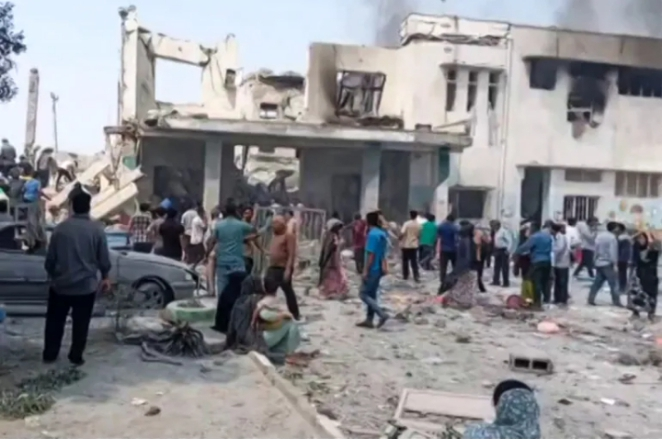
Mapping US and Israeli attacks on Iran and Tehran’s retaliatory strikes has become essential as the Middle East faces its most dangerous military escalation in decades.
The coordinated operation launched by the United States and Israel against Iran triggered immediate retaliation, spreading conflict across borders and drawing in multiple regional actors.
Early on Saturday, explosions were reported across Tehran and several Iranian cities. Iranian state and semi-official media confirmed strikes on sensitive military and government-linked locations.
Videos shared online showed smoke rising from residential and administrative districts, underscoring the scale of the assault.
According to Iranian officials, the attacks targeted infrastructure linked to national defence and intelligence. The Ministry of Defence, the Atomic Energy Organization of Iran, and military compounds were reportedly struck.
An Iranian security official said the strikes were “a direct act of aggression designed to cripple Iran’s defensive capabilities”.
Iran’s Islamic Revolutionary Guard Corps (IRGC) responded within hours. In a statement carried by state media, the IRGC said, “This operation will continue relentlessly until the enemy is decisively defeated.” The statement added that “all US assets in the region are legitimate targets”, marking a clear escalation.
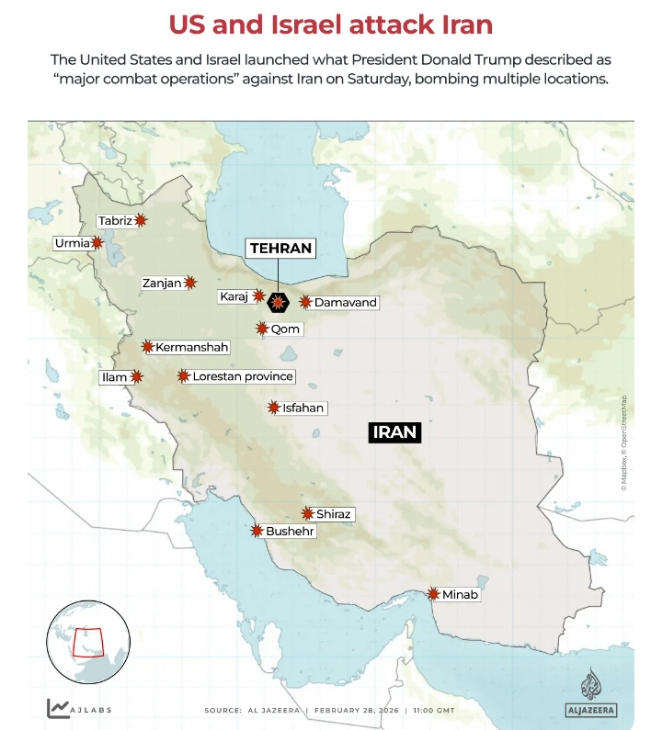
Mapping US and Israeli attacks on Iran and Tehran’s retaliatory strikes also highlights the geographic breadth of the confrontation. Missiles reportedly struck locations in Tehran’s University Street area and the Jomhouri district.
In eastern Tehran, Mehr News Agency reported that “at least two students were killed” after a school was hit, though casualty figures remain under verification.
Outside the capital, the southern city of Minab experienced one of the deadliest incidents. Iranian media said an Israeli strike hit a girls’ elementary school, killing more than 50 people. A provincial official described the incident as “a massacre that violates all international norms”, intensifying public anger.
In central Iran, Isfahan once again emerged as a focal point. The city, considered vital to Iran’s missile and defence industries, has been targeted repeatedly in previous confrontations.
Military analysts say strikes there aim to disrupt production and research tied to Iran’s ballistic missile programme.
Additional strikes were reported in Kermanshah, Qom, Tabriz, Ilam, Karaj, Zanjan, Urmia, Bushehr, Damavand, Shiraz and parts of Lorestan province. Iranian authorities urged residents in several areas to remain indoors amid fears of further attacks.
As Iranian air defences engaged incoming missiles, the government’s National Security Council advised civilians to temporarily leave parts of Tehran. The advisory warned of “continued hostile action against strategic locations”, signalling expectations of prolonged confrontation.
Iran’s retaliation quickly extended beyond its borders. Missiles and drones were launched toward Israel and towards US military installations across the Middle East. Many were intercepted, but debris caused damage and casualties in multiple countries.
In Israel, authorities declared a “special state of emergency”. Explosions were heard over Tel Aviv and Haifa as air defence systems intercepted incoming missiles. The Israeli military said it was responding to “multiple waves of Iranian projectiles”.
A nine-storey building in northern Israel was damaged after interceptor debris struck the structure. Israel’s Channel 12 reported one civilian suffered minor injuries. An Israeli official said, “Our defence systems are functioning, but the threat is ongoing.”
Mapping US and Israeli attacks on Iran and Tehran’s retaliatory strikes also reveals the vulnerability of US assets in the Gulf. In Qatar, debris from intercepted missiles fell near residential areas outside Doha. The Ministry of Defence said several attacks were “thwarted”.
In the United Arab Emirates, a Pakistani national was killed after falling debris struck a residential zone. Emirati authorities confirmed multiple interceptions and urged calm as investigations continued.
Bahrain said Iranian missiles targeted the headquarters of the US Navy’s Fifth Fleet. While no major damage was reported, the incident marked a direct challenge to US naval presence in the Gulf.
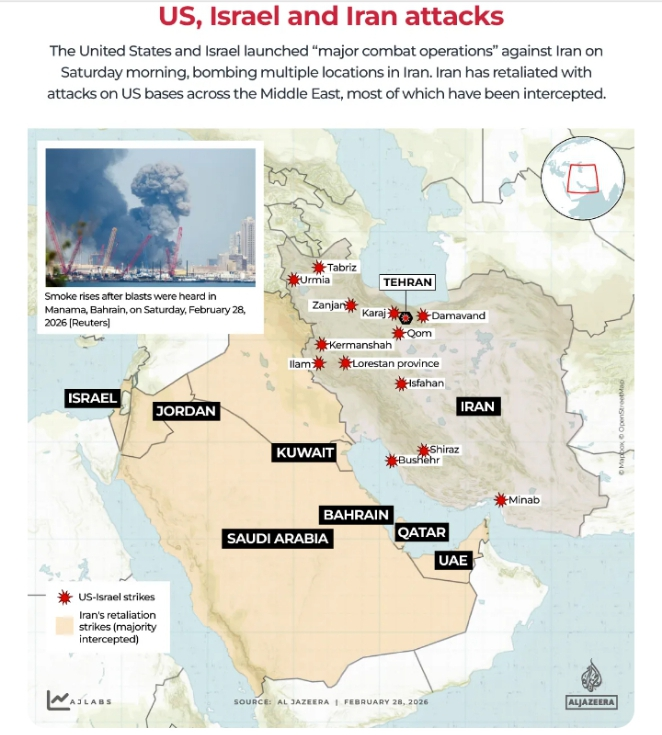
In Kuwait, the Ministry of Defence confirmed that Ali al-Salem Air Base was targeted by ballistic missiles, all of which were intercepted. Officials described the response as “successful and proportionate.”
Loud explosions were heard in Riyadh, according to AFP. Saudi Arabia’s Foreign Ministry issued a statement expressing solidarity with Gulf states affected by the Iranian retaliation.
In Iraq, air defences intercepted a drone near Erbil International Airport. Authorities said no casualties were reported, but security levels were raised nationwide.
Missiles were also intercepted over Amman, where flaming debris fell near a residential building. Jordanian officials said there were no injuries but condemned the escalation.
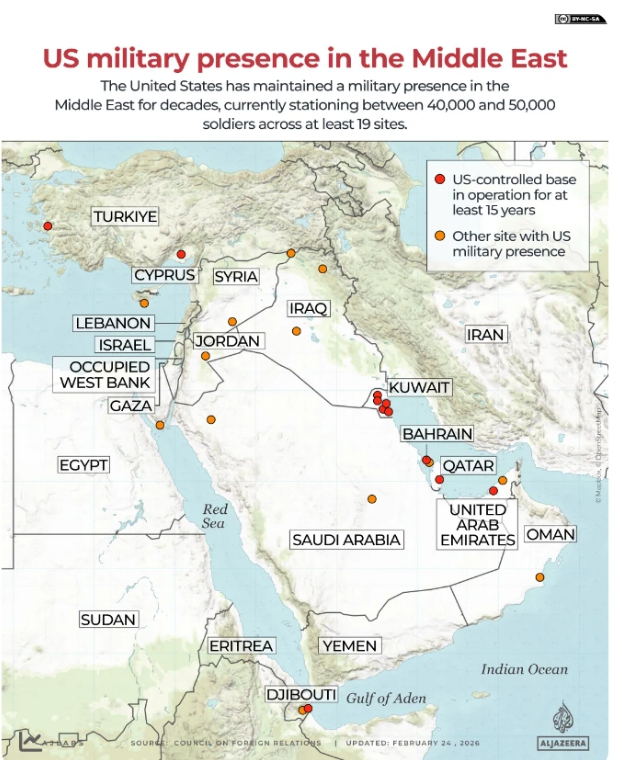
The conflict has brought renewed attention to the scale of US military presence in the Middle East. According to the Council on Foreign Relations, the US operates permanent bases in at least eight countries, with tens of thousands of troops stationed across the region.
Analysts say Iran’s strategy aims to stretch US and allied air defences across multiple theatres. A regional security expert said, “Iran is signalling that any attack on its territory will be met with regional consequences.”
The US has reinforced its posture with two carrier strike groups in nearby waters. The USS Abraham Lincoln and the USS Gerald R Ford are supported by dozens of warships and more than 150 aircraft, representing the largest US naval deployment in the region in decades.
Iran’s missile arsenal, one of the most extensive in the Middle East, plays a central role in its deterrence strategy. Ballistic missiles, capable of travelling at hypersonic speeds, reduce reaction time for air defence systems and complicate interception efforts.
Israel, meanwhile, relies on a layered air defence network including Iron Dome, David’s Sling, Arrow systems and US-supplied THAAD batteries. Military officials say the systems are effective but not impenetrable during sustained barrages.
Mapping US and Israeli attacks on Iran and Tehran’s retaliatory strikes ultimately shows a conflict that is no longer confined to bilateral hostilities. Civilian casualties, damaged infrastructure and the involvement of multiple countries raise fears of a broader regional war.
Diplomatic efforts remain limited. The United Nations Security Council has yet to agree on a unified response, while calls for restraint compete with warnings of further retaliation.
As the situation evolves, observers warn that miscalculation could trigger an uncontrollable spiral. A former diplomat said, “Once missiles are flying across half the Middle East, the margin for error disappears.”
For now, the region remains on edge, with air defences active, civilians seeking shelter, and governments bracing for what may come next.
About The Author