

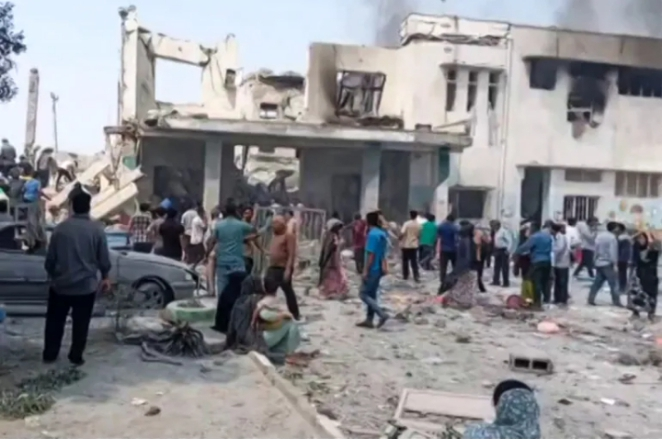
Israel strikes two schools in Iran, according to Iranian state media and officials, as deadly air attacks hit educational facilities in the southern province of Hormozgan and near the capital Tehran, killing dozens of civilians and injuring many more.
Iranian authorities said one of the deadliest strikes targeted a girls’ elementary school in the city of Minab, where rescue workers continued clearing rubble more than a day after the attack.
Officials described scenes of widespread destruction, collapsed classrooms, and surrounding homes damaged by the blast.
The strikes came amid a wave of joint US-Israeli military operations across Iran, marking one of the most intense escalations between the longtime adversaries in years.
Tehran says the attacks are part of a broader campaign that has increasingly affected civilian areas rather than exclusively military targets.
Iran’s semiofficial Tasnim News Agency quoted judicial officials in Minab as saying the death toll from the school strike had risen to 85, with at least 63 others wounded. Many of the injured were reported to be children and teachers who were inside the building at the time of the attack.
State broadcaster IRIB aired footage showing shattered walls, destroyed desks, and personal belongings scattered across the school grounds. Emergency responders were seen searching through debris as grieving families gathered near the site.
Iran’s Foreign Minister Abbas Araghchi condemned the attack, sharing images of the destroyed school on social media and calling the victims “innocent children.”
“These crimes against the Iranian people will not go unanswered,” Araghchi wrote, adding that Iran considers the strike a clear violation of international law.
Iran’s Foreign Ministry spokesperson Esmaeil Baghaei also denounced what he described as a “blatant crime,” urging the United Nations Security Council to take immediate action.
“These attacks on civilian infrastructure, particularly schools, are unacceptable under any circumstances,” Baghaei said, accusing Israel of deliberately targeting non-military sites.
Separately, Iran’s Mehr News Agency reported that another Israeli strike hit a school east of Tehran, killing at least two students. Local officials said the building sustained significant damage, and nearby residential areas were also affected.
There was no immediate response from Israel regarding the claims that schools were hit. Israeli officials have repeatedly stated that their military operations are aimed at Iranian military capabilities and infrastructure linked to armed groups hostile to Israel.
The United States, which Iran says is jointly responsible for the wider bombardment campaign, also did not immediately comment on the reports. Washington has maintained that its involvement is focused on preventing further regional destabilisation.
Newsmen reporting from Tehran said the strikes raise serious questions about US and Israeli claims that they are avoiding civilian targets.
“They say they are targeting military sites and trying to pressure the leadership, not the people,” Vall said. “But when schools are hit and children are killed, that narrative becomes very difficult to sustain.”
Vall added that Iranian officials are likely to emphasise the civilian toll in international forums, framing the attacks as evidence of aggression against the population rather than the government.
The strikes come against the backdrop of heightened regional violence, with Iran launching retaliatory attacks on Israeli and US-linked targets across the Middle East.
Several Gulf states have reported drone and missile incidents in recent days, prompting airspace closures and heightened security alerts.
The current escalation follows a brief but devastating conflict in June 2025, when Israel and the US carried out strikes on Iranian territory during what became known as the 12-day war.
Iranian officials say thousands of civilians were killed or injured during that confrontation, with hospitals, roads, and public utilities severely damaged.
Iran’s Ministry of Health and Medical Education said the cumulative civilian impact of repeated attacks has placed enormous strain on the country’s healthcare system, particularly in remote provinces such as Hormozgan.
Human rights organisations have also expressed alarm at reports of schools being struck, noting that educational facilities are protected under international humanitarian law unless they are being used for military purposes.
“There is a legal obligation on all parties to a conflict to distinguish between military targets and civilian objects,” said one regional analyst. “Strikes on schools, if confirmed, could constitute war crimes.”
The situation has also drawn renewed attention to statements made by US President Donald Trump, who has previously said that the Iranian people should not be punished for the actions of their leaders. Iranian officials now argue that the reality on the ground contradicts those assurances.
Residents of Minab described a night of terror as explosions shook the city and emergency sirens wailed. One local resident told state media that families were still searching for missing relatives hours after the strike.
“We never imagined a school would be hit,” the resident said. “This was a place where our children learned and felt safe.”
As debris continues to be cleared and casualty figures rise, Iran has called for an emergency international investigation into the attacks. Diplomats in Tehran say the issue will be raised at the United Nations and other multilateral forums in the coming days.
Read also: Iranian missile strike sparks fire at Dubai’s Fairmont Palm Jumeirah luxury hotel
Despite growing global concern, there are no signs that the violence is easing. Military activity remains high across the region, and analysts warn that further escalation could draw in additional countries.
For many Iranians, however, the focus remains on mourning the dead and caring for the wounded. Funerals have begun in Minab, with large crowds attending ceremonies for children killed in the strike.
As tensions deepen, Israel strikes two schools in Iran has become a stark symbol of the human cost of the conflict, underscoring fears that civilians are increasingly bearing the brunt of a widening war.
About The Author
