The UK heatwave is set to intensify on Friday as forecasters warn temperatures could soar to 40°C, potentially breaking the record for the hottest June day ever recorded.
While southeastern England braces for dangerous heat, thunderstorms, heavy rain and lightning have swept across other parts of Britain, prompting multiple weather warnings and placing hospitals, transport networks and emergency services under growing pressure.
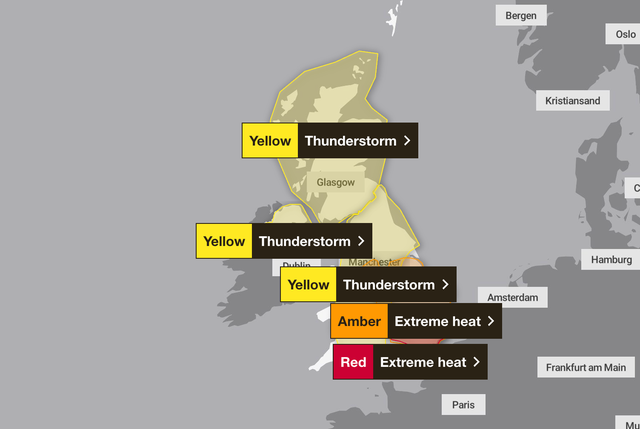
The Met Office has maintained its rare red warning for extreme heat across London, the South East and the East of England, warning that exceptionally high temperatures combined with intense humidity could have significant impacts on health, transport and public services.
Hospitals have declared critical incidents, rail operators are urging people to avoid unnecessary journeys, and scientists say the unprecedented heat would have been virtually impossible without the influence of climate change.
Britain Faces Another Day of Record-Breaking Heat
Friday could become another historic day for Britain’s weather records as temperatures are forecast to reach 40°C in parts of Norfolk.

If the forecast is realised, it will surpass Thursday’s record-breaking 36.7C recorded at Merryfield in Somerset, making it the hottest June day ever measured in the United Kingdom.
The Met Office said the country remains under an “exceptional spell of hot and humid weather” that will continue throughout Friday before cooler conditions begin arriving during the weekend.
Forecasters warned that the combination of extreme temperatures and unusually high humidity would increase discomfort while significantly raising the risk of heat-related illnesses.
A rare red warning remains in effect until 9 p.m. across London, South East England and the East of England, while an amber warning covers a much wider area extending from the south coast through the Midlands and into northern England.
Thunderstorms Sweep Across Britain
Despite the exceptional heat, several parts of the UK have also experienced severe thunderstorms.
Heavy rain, lightning and gusty winds moved across Scotland overnight, while Northern Ireland, Wales and parts of northern and eastern England also came under yellow thunderstorm warnings.
The Met Office expects further heavy showers, some accompanied by thunder, to move into southeastern England overnight before cooler conditions gradually spread across the country during the weekend.
Saturday is expected to remain warm, particularly across southeastern England, before temperatures ease closer to seasonal averages from Sunday onwards.
Hospitals Declare Critical Incidents Amid Extreme Heat
The prolonged heatwave is placing growing pressure on Britain’s National Health Service.
Several hospitals have declared critical incidents after soaring temperatures disrupted medical services and affected vital equipment.
Queen Alexandra Hospital in Portsmouth, Norfolk and Norwich University Hospitals NHS Foundation Trust and University Hospital Southampton all reported major operational challenges as temperatures continued climbing.
Medical equipment, including MRI scanners, reportedly stopped working because of the intense heat, while some scheduled operations had to be postponed.
Health authorities continue urging elderly people, children and those with underlying medical conditions to remain hydrated, stay indoors during the hottest parts of the day and avoid prolonged exposure to direct sunlight.
Rail Operators Warn Against Unnecessary Travel
Britain’s transport network is also struggling under the intense weather conditions.
Network Rail has urged passengers to avoid non-essential travel across much of England, warning that extreme temperatures could cause delays and disruptions.
Rail services within both the red and amber weather warning areas have been reduced, with operators expecting trains that do run to be considerably busier than usual.
South Western Railway also appealed to members of the public to avoid travelling unnecessarily to popular coastal destinations.
Stuart Meek, Chief Operating Officer for South Western Railway and Network Rail Wessex, said: “While it might be tempting to head down to the beach to enjoy the sunshine, we strongly urge customers to heed our advice to avoid getting stranded.”
Rail operators say prolonged extreme heat can cause tracks to expand, requiring speed restrictions to maintain passenger safety.
Scientists Say Climate Change Is Driving the Extreme Heat
Climate researchers believe this week’s extraordinary temperatures are closely linked to global warming.
Scientists from the World Weather Attribution group concluded that weather conditions like those currently affecting Britain would have been virtually impossible under the climate experienced five decades ago.
According to their analysis, a similar June heatwave occurring in 1976 would have been approximately 3.5C cooler.
The researchers also found that today’s unusually warm overnight temperatures are now around 100 times more likely than during the deadly European heatwave of 2003, while record-breaking daytime temperatures have become roughly 10 times more likely because of climate change.
Experts further warned that increasing humidity is creating dangerous levels of heat stress across Europe, with numerous cities recording unprecedented “wet bulb globe temperatures,” a measure of how effectively the human body can cool itself through sweating.
Health Experts Warn Millions Face Increased Risks
Health organisations continue warning that the extreme weather poses serious risks to millions of vulnerable people.
Andrew McCracken, Director of External Affairs at Asthma + Lung UK, said: “The health impacts of climate change are impossible to ignore.”
He added: “Heatwaves are a real threat to the 12 million people living with lung conditions in the UK.”
McCracken warned that extreme heat creates multiple dangers for people suffering from respiratory illnesses.
“The soaring temperatures pose a double danger—not only does the heat make it harder to breathe, but it worsens air quality by increasing the amount of ozone and particulate pollution in the atmosphere,” he said.
Calling for stronger environmental protections, he added: “The government can do something to change this, by delivering on its promise of a new Clean Air Act—protecting people from dangerous heatwave pollution and cutting the emissions that make these extreme events more frequent.”
Schools Stay Open Despite Soaring Temperatures
Despite the unprecedented conditions, schools across England are expected to remain open.
The Department for Education says there is currently no legal upper temperature limit requiring schools to close during periods of extreme heat.
Instead, schools are being encouraged to implement practical measures that reduce risks to pupils while maintaining lessons where possible.
Officials continue advising parents to send children to school unless severe weather directly affects their ability to travel safely.
Read also: Venezuela earthquake death toll rises as hundreds remain trapped, 46,000 reported missing
Hosepipe Ban Introduced as Water Demand Surges
The prolonged heat has also placed enormous pressure on water supplies across southeastern England.
South East Water has introduced an official hosepipe ban across much of Kent, while customers in Surrey, Hampshire, Berkshire and Sussex have also been urged to significantly reduce water consumption.
Authorities warned that anyone found breaching an official hosepipe ban could face fines of up to £1,000 as exceptionally high demand continues placing strain on reservoirs and water networks.
Cooler Weather Expected After Friday
Although Friday is forecast to be the hottest day of the heatwave, forecasters say relief is finally approaching.
Heavy showers and rain are expected to spread eastward during Sunday, introducing cooler and fresher air across much of the United Kingdom.
By Monday, temperatures are forecast to return much closer to seasonal averages, although occasional rain and showers may continue across northwestern regions.
Until then, authorities continue urging people to remain hydrated, avoid unnecessary travel during peak afternoon temperatures, check on vulnerable relatives and neighbours, and closely monitor official weather updates as Britain experiences one of the most intense June heatwaves ever recorded.